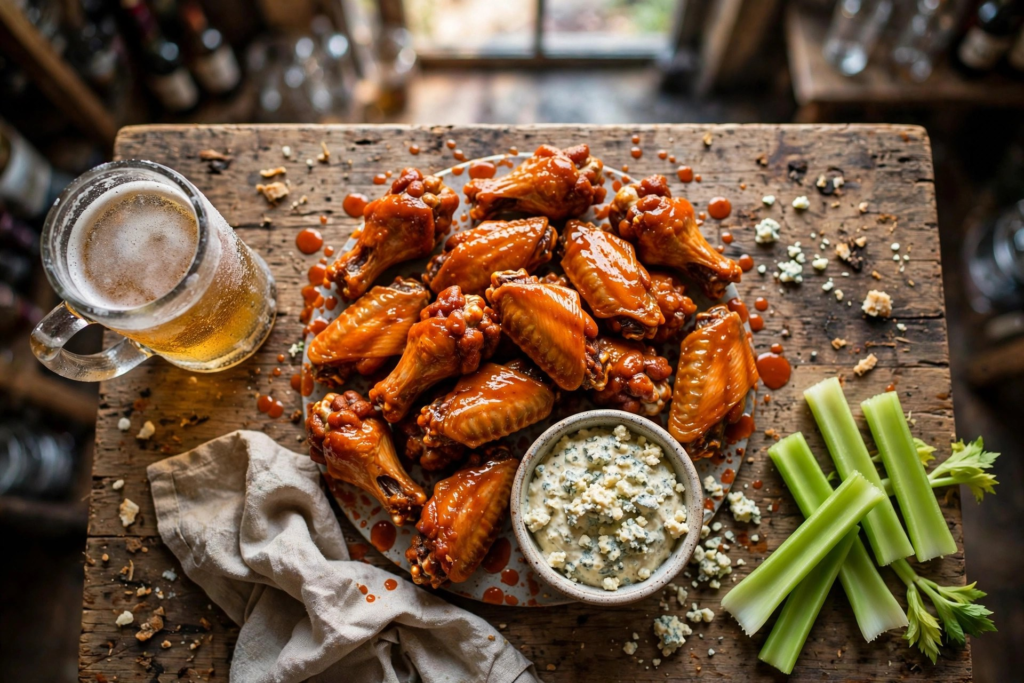
There is a particular kind of September afternoon in Buffalo that tells you everything you need to know. The air turns crisp, the sky does something dramatic over Lake Erie, and somewhere in the city a fryer basket hits hot oil for the first time that day. Fall doesn’t start with a calendar date here. It starts when the first platter of wings lands on a table while a game is on.
Every town has its autumn rituals. Ours just happens to be the one the rest of the country copied.
How wings became the official food of football
It’s easy to forget that the buffalo wing is younger than most people’s grandmothers. The origin story most Buffalonians will give you starts in 1964, when Teressa Bellissimo at the Anchor Bar reportedly took a batch of chicken wings that had been destined for the stock pot, fried them instead, and tossed them in a simple cayenne-and-butter sauce for a late-night crowd. Celery and blue cheese came with it. A city tradition was born at a bar counter.
There’s some honest debate about the details — a few historians point to earlier wing-slinging in the city, including an uncut-wing spot on the East Side in the 1960s — but the Anchor Bar account is the one the city has rallied behind for sixty years, and nobody in Buffalo is letting it go. What matters for our purposes is what happened next: the wing found football. By the time the first Super Bowl was played in 1967, Buffalo sports fans had already figured out that cheap, hand-held, sauce-drenched chicken was the perfect companion to three hours of watching a game, and the combination never looked back.
Buffalo Wild Wings took the concept national from Columbus, Ohio in 1982, and by now wings are as embedded in American football culture as the coin toss. The National Chicken Council’s 2026 report estimated Americans would eat about 1.48 billion chicken wings during Super Bowl LX — a number so large the Council noted it would take a convoy of roughly 3,400 eighteen-wheelers to haul them all. That’s not a snack statistic. That’s a national ritual with a supply chain.
What makes wing season different from just… fall
Wing season is not a date range. It’s a posture. It’s the difference between eating wings because you were hungry and eating wings because it was Sunday and the game was on and your friends were coming over and someone had to do something about it.
At its best, wing season has a cadence to it. Early weeks are exploratory — you’re trying the new sauce that showed up on the menu, arguing about flats versus drums, ordering one platter too many because the game went to overtime. Mid-season is when the regulars emerge: the same corner of the bar, the same order, the server who starts your beer when you walk in. By late season, when the stakes of the actual games get higher, the wings start carrying emotional weight. A bad call by a referee and a plate of hot wings arrive at the same time, and suddenly the sauce tastes spicier than it did in September. It didn’t. You were just angrier.
This is the part that restaurant chains can’t quite replicate and sports bars in other cities only imitate. In Buffalo, wing season runs on familiarity — the place where the fryer is dialed in, the bartender who knows your heat tolerance, the table where you’ve celebrated and mourned in equal measure.
The rules of the season (unwritten, but real)
If you’re going to do wing season properly, a few things are worth observing. None of these are written down anywhere. All of them are enforced by peer pressure.
Order enough. Wings vanish faster than anyone predicts, every single time. If the game matters, round up by half of what you think you need. Cold wings are a tragedy that reheating cannot fix.
Pace yourself on heat. The rookie move is ordering the hottest sauce on the menu during the first commercial break and then spending the second half of the game with a ruined palate and a sweaty forehead. Start medium, finish hot. The nuclear stuff is for the final quarter, when your judgment is gone anyway.
Respect the blue cheese. In Buffalo this is not a debate. Celery sticks exist to cool the burn and to give your hand something to do between wings. Ranch people are tolerated. Ranch people know they’re tolerated.
Beer is load-bearing. A crisp lager or a clean pilsner will do more for a plate of buffalo wings than any fancy pairing advice. The carbonation cuts the fat, the cold tames the cayenne, and the whole thing works the way it has worked for sixty years. There’s a reason the wing-and-beer order is the oldest pairing on the menu.
Get to the game early. Not the game — the bar. The good tables go first, the kitchen gets slammed at kickoff, and the person who ordered at 12:58 is eating at halftime. This is logistical advice dressed up as tradition, but it matters.
How we keep score around here
We’ve been running our own little wing-off diary this season — a running taste test of what’s landing on the table and what we’d order again. The early installments are worth catching up on: our week one wing-off and week two wing-off set the baseline, and the season’s young enough that there’s plenty of platter left to judge.
That’s really what wing season is: an excuse to pay attention to something delicious at regular intervals, in good company, for months on end. The football gives it a schedule. The wings give it a point. The beer gives it a rhythm.
Declaring it open
So consider this the official kickoff. The fryer is hot. The sauce is mixed. The blue cheese is crumbled, the celery is cut, and the first cold one is already sweating on the bar.
Wing season is open. Act accordingly.