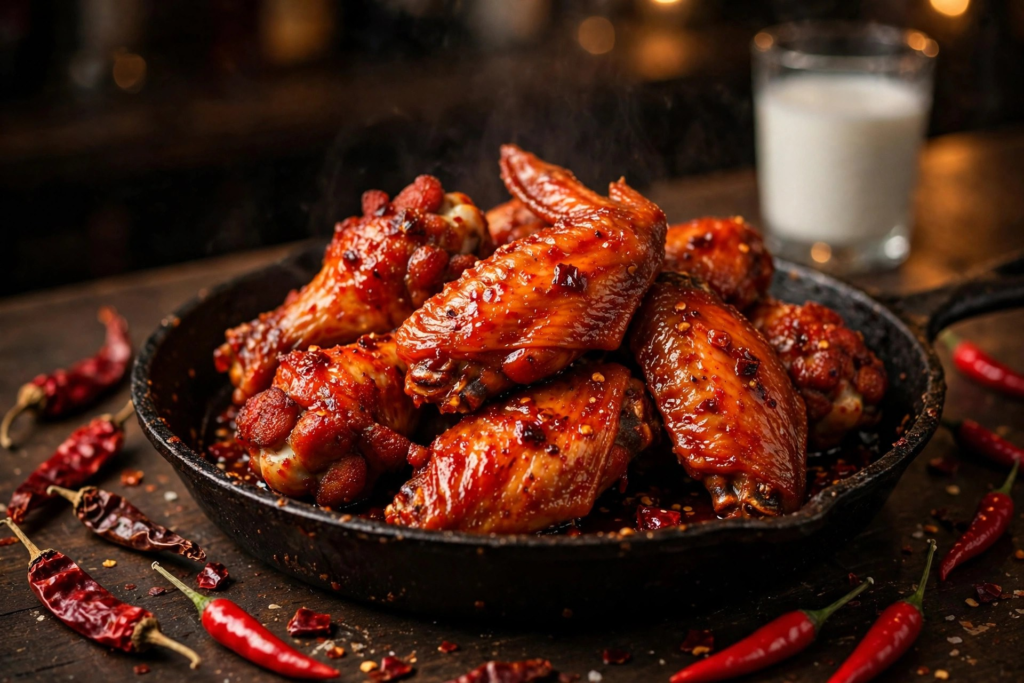
There comes a point in every wing lover’s life when “hot” stops being hot. You order the top of the menu, the one with the little flame icons, and it lands with a shrug. Pleasant warmth. Nice flavor. No fear. That’s when the phrase “wings of death” starts floating around the table — half dare, half curiosity — and somebody brings up the challenge.
Almost every wing town has one now: a gauntlet of wings engineered not for enjoyment but for survival. A plate arrives glossed with a sauce the color of a traffic cone, the table goes quiet, and somebody starts a timer. What follows is part eating contest, part ritual humiliation, and — if we’re being honest — some of the best bar theater in America.
What a real wing challenge looks like
The anatomy of a serious spicy wing challenge is remarkably consistent across the country, which tells you everything about how the format evolved. There’s almost always a time limit — five to ten minutes is standard — and a wing count that sounds modest until the sauce hits your tongue. Buffalo Wild Wings’ Blazin’ Challenge, for example, asks for ten of its Blazin’ Knockout wings in five minutes, no drinks allowed. Sounds doable. It is not.
The no-drinks rule is the beating heart of every legitimate challenge. Water wouldn’t help you anyway — more on that in a minute — but the prohibition is what separates a challenge from a meal. In Washington state, the Wing Dome’s infamous 7-Alarm Challenge adds two more cruelties: no napkins, and after seven wings in seven minutes, you have to lick your plate and fingers completely clean or you’re disqualified. Finishers earn a spot on the restaurant’s Wall of Flame and the kind of sweat-soaked photo that becomes a profile picture for years. The whole thing costs the price of the wings unless you win, and losers get the traditional consolation prize: paying for the experience of public suffering.
Then there’s the waiting period. Most challenges enforce an “afterburn” — anywhere from two to ten minutes where you can’t touch a drink after the last wing is gone. This is where challenges are actually won or lost, because capsaicin is a slow-building weapon. The first bite is always manageable. The damage accrues. By minute six your face is doing things your face has never done.
A quick tour of the heat ladder
To understand what you’re up against, it helps to know how heat is measured. The Scoville scale — developed by pharmacist Wilbur Scoville back in 1912 and now measured in labs with precise chromatography — rates peppers by capsaicin concentration. A jalapeño, the friendly gatekeeper of spice, sits somewhere around 2,500 to 8,000 Scoville heat units. Respectable. A habanero jumps to somewhere between 100,000 and 350,000. That’s the pepper that lives in most genuinely hot wing sauces, and it’s already more than forty times a jalapeño.
Then the ladder gets cruel. The ghost pepper, or bhut jolokia, crosses the million-Scoville line. The Carolina Reaper — the Guinness-certified world’s hottest pepper from 2013 until 2023 — averages around 1.6 million. And in 2023, Guinness crowned its successor: Pepper X, bred by the same man who created the Reaper, clocking in at a verified 2.69 million Scoville units. That’s roughly a thousand times a jalapeño, concentrated into a sauce you are about to put on chicken and eat on a timer.
Most “wings of death” style sauces live in the habanero-to-ghost-pepper band, often boosted with pepper extracts that take the number even higher. The flavor at that level is almost beside the point — there’s heat, and then there’s the thin, bright fruitiness you notice for about three seconds before your nervous system files a complaint.
Why water makes it worse and milk saves you
Here’s the science that matters when you’re mid-challenge and desperate. Capsaicin, the compound responsible for the burn, is oil-soluble, not water-soluble. Drinking water during a wing challenge is like throwing gasoline on a grease fire — it spreads the capsaicin around your mouth to fresh territory. This is why the no-drinks rule is so devastating: your instincts are actively working against you.
What actually helps is fat and protein. Milk — whole milk, ideally, or better yet ice cream — contains a protein called casein that binds to capsaicin and strips it off your pain receptors. It’s genuinely the best emergency tool you can have waiting at the finish line, which is why serious challengers have a glass of milk staged like a pit crew. Starchy foods like bread and rice help too, absorbing some of the oil, and a spoonful of sugar can dull the burn by overwhelming the palate with a competing sensation.
That burning sensation itself isn’t heat at all, by the way. Capsaicin binds to TRPV1 receptors — the nerve endings that normally report actual heat — and tricks your brain into thinking your mouth is on fire. The body responds accordingly: sweating, tearing up, the runny nose, the hiccups that show up in about half of all challenge attempts. It’s a false alarm your entire nervous system takes seriously. Many challengers describe a weird euphoria afterward, and that’s real too — the pain triggers an endorphin release, the body’s own consolation prize.
Training for the gauntlet
If you’re planning to take on a spicy wing challenge rather than just surviving one your friends signed you up for, there’s a way to prepare that doesn’t involve bravado. Work up the heat ladder over a couple of weeks: start with your usual hot, graduate to the habanero-based sauces, then try something with ghost pepper in it. You’re not building calluses — you’re teaching your brain that the alarm isn’t an emergency.
Eat something beforehand, but nothing heavy. An empty stomach and a gallon of capsaicin are a combination you’ll regret the next morning — and yes, the heat makes a second appearance on its way out, a detail every challenge veteran learns exactly once. Line your stomach with something starchy and fatty a couple of hours before, and keep the real meal for after.
During the challenge, the veterans all say the same thing: don’t stop moving. The instinct is to pause between wings and feel sorry for yourself, but momentum is everything. Small bites, steady pace, no dramatic pauses. And never — never — touch your face. Sauce-covered fingers near the eyes is the mistake that ends more challenges than the heat itself. The waivers exist for a reason: you’ll sign one acknowledging the risks, including the ones nobody wants to describe, and you’ll laugh while you sign it, and then you’ll understand.
Worth it? Honestly, yes
Here’s the thing nobody admits about wings of death: the wings themselves are usually terrible. Nobody is eating a reaper-extract sauce for the flavor profile. The challenge is the point — the timer, the crowd, the photo on the wall, the story you’ll tell for years about the night you finished wing number six with two minutes to spare and couldn’t feel your lips.
And when it’s over, when the afterburn fades and someone slides a basket of normal, delicious, properly sauced wings across the table, they will taste like the best food you’ve ever eaten. That’s the real prize. Not the t-shirt, not the wall of fame — the sudden, overwhelming appreciation for a regular buffalo wing, made the way it was meant to be made.
Just give it a day before you do it again.