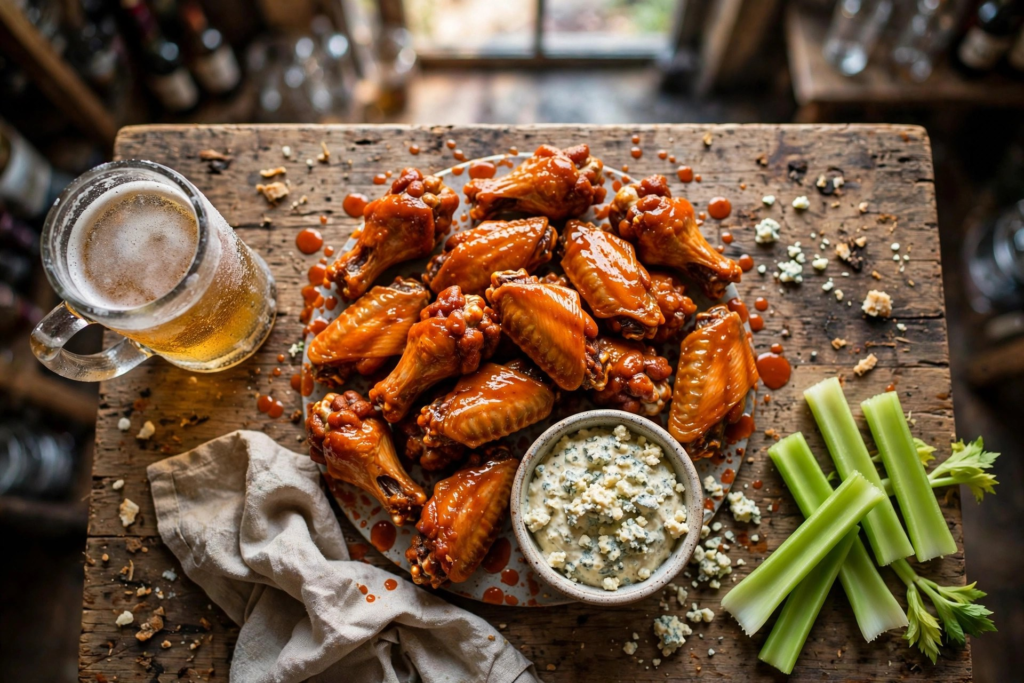
There are two foods that define a proper football Sunday, and nobody has ever needed to argue about what they are. Pizza and wings. They show up at every party, they disappear at every party, and every so often some genius in a kitchen looks at both boxes, looks at both trays, and asks the dangerous question: why are these two separate things?
We are a Buffalo bar. We do not have a choice here. If we ever served a bad buffalo wing pizza, the city would revoke something — our liquor license, our birth certificates, we’re not sure which. So we have opinions about this. Strong ones. The good news is that building a great one at home is mostly about avoiding about five mistakes that most recipes walk straight into.
First: this is not Italian pizza, and tomato sauce has no business here
The single most important decision happens before a single topping is placed. On a buffalo wing pizza, the base layer is not marinara. It is buffalo sauce — the cayenne-and-butter stuff that has been coating wings in this town since Teressa Bellissimo grabbed a batch of wings at the Anchor Bar back in 1964 and changed eating forever.
Some builders like a thin swipe of blue cheese dressing under everything instead, and there is a champion-level pedigree to that move — a six-time world champion pizza chef once built his Super Bowl version exactly that way, blue cheese dressing as the foundation, scallions on top. It works. But our house preference is a thin layer of straight buffalo sauce on the dough. Here’s why: blue cheese dressing under hot cheese can go greasy and mute, while buffalo sauce baked into the crust sets into something almost like a barbecue layer — sticky, sharp, and loud in the best way. The blue cheese gets its moment later. It always does.
One firm rule either way: keep the sauce layer thin. Pizza built under wet sauce does not get crispy. It steams. And a steamed pizza is a casserole wearing a costume.
Sauce the chicken before it touches the cheese
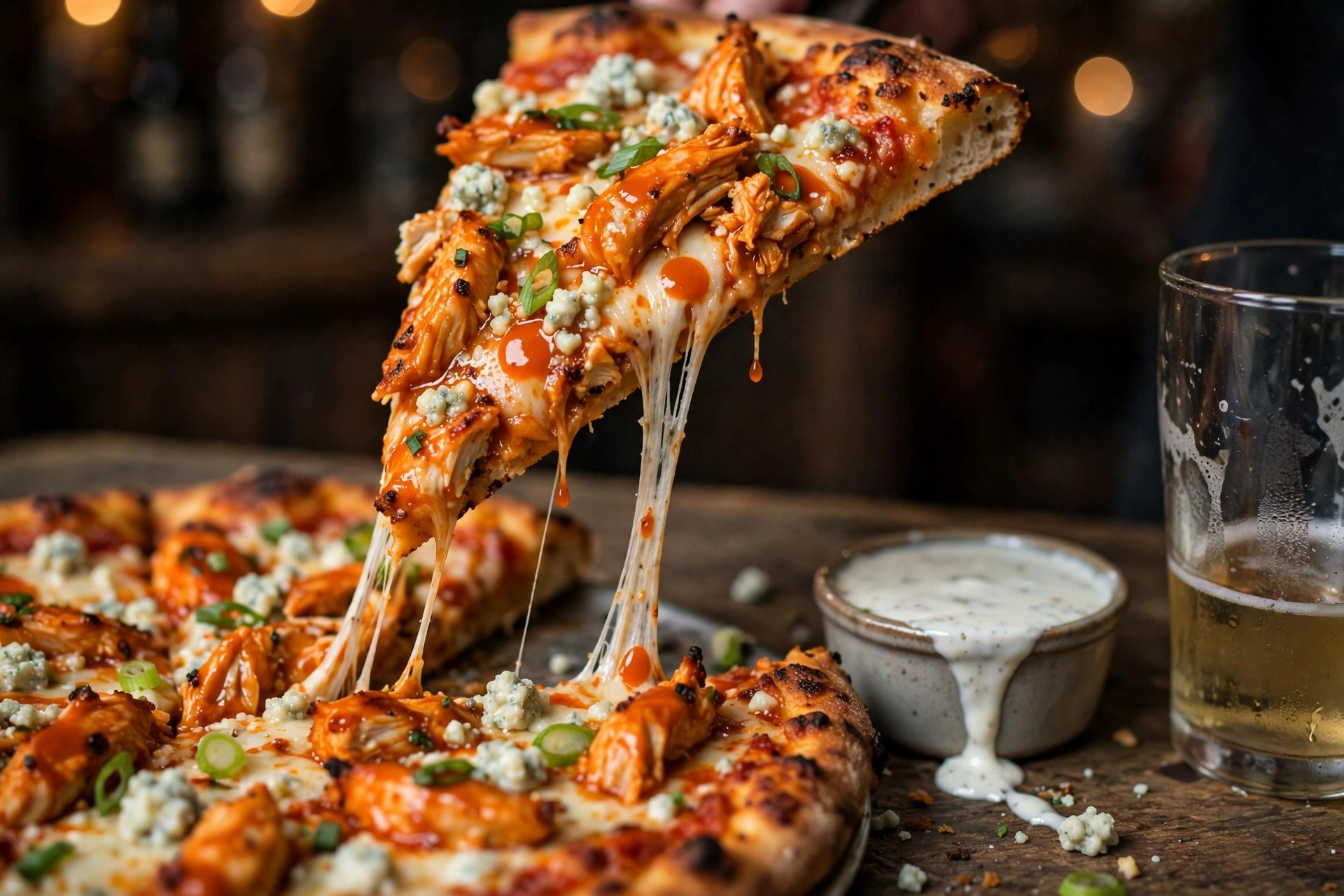
This is where most homemade versions die. Dry, unsauced chicken goes on the pizza, and then it bakes under a blanket of cheese and turns into something with the texture of a packing peanut. The fix is simple: cook the chicken first — roast it, poach it, or grab a rotisserie bird and skip the hard part — chop it into bite-size pieces, and toss it in buffalo sauce while it’s still warm. Warm chicken drinks up sauce the way a sponge drinks up a spill.
Want to get fancy? Bread the chicken first — flour, egg, seasoned breadcrumbs, a quick shallow fry — and then toss the crispy pieces in sauce. That’s the move the pizza champions use, and there’s a reason: the breading gives the sauce something to cling to, so every bite is saucy instead of half the sauce sliding to the crust. It is an extra twenty minutes. On game day, twenty minutes is two commercial breaks. You have the time.
The cheese has two jobs, so use two cheeses
Mozzarella is there for the stretch and the coverage. Use low-moisture, shredded mozzarella — the stuff in the bag is fine, and honestly better than fresh here, because fresh mozzarella weeps water and water is the enemy of everything we’ve built so far. Lay down a layer over the sauce, add your sauced chicken, then another light layer of mozzarella to pin the chicken down.
And the blue cheese? That goes on after the bake. Crumbled blue cheese can survive an oven, technically, but it melts into anonymous funk and you lose the punch — those little cool, salty explosions against the heat. Scatter it over the finished pie along with a handful of chopped scallions, and it hits your palate the way a ramekin of dressing does with a basket of wings.
Blue cheese vs. ranch: the bar settles this one
We have written about this before, but since it comes up every single time: in Buffalo, blue cheese is the law and ranch people are tolerated. Order accordingly. For the pizza, the ruling is the same — a zigzag of blue cheese dressing over the finished pie, served with celery sticks on the side, exactly the way a basket of wings shows up.
That said, a ramekin of ranch on the side for the dissenters is not a surrender. It is hospitality. Just don’t put the drizzle on before the bake — dressing under a 450-degree oven breaks and separates into an oily mess. Post-bake only. The drizzle is a finishing move, not a topping.
Bake it hot, and par-bake the crust first
The oven should be at 450°F, fully preheated, no apologies. A hot oven does two things: it leopards the crust the way a good pizza crust should look, and it sets the sauce instead of letting it pool. If you have a pizza stone or steel, heat it in the oven for a full half hour. If you don’t, flip a heavy sheet pan upside down and heat that — same idea, works fine.
Here is the part people skip: par-bake the naked dough for five to seven minutes before you build on it. This is the difference between a crust that stands up to sauced chicken and a crust that goes soggy in the middle and folds like a sad envelope. Stretch your dough, give it its head start, then sauce, cheese, chicken, cheese, and back in for ten to twelve more minutes until the edges are golden and the cheese is bubbling with browned spots.
The game-day build, start to finish
So here is the whole play, one pizza, feeds about four people who will fight over the last slice:
Stretch a pound of pizza dough over a floured surface and slide it onto your hot stone or pan. Par-bake five to seven minutes. Pull it out and spread a thin layer of buffalo sauce edge to edge, leaving a half-inch border for the crust. Lay down half your shredded mozzarella, scatter the sauced chicken evenly — about two cups, chopped bite-size and tossed in a half-cup of buffalo sauce with a tablespoon of melted butter whisked in — then the rest of the mozzarella. Bake ten to twelve minutes at 450°F until golden and bubbling. Out of the oven: crumbled blue cheese, chopped scallions, a zigzag of blue cheese dressing, and celery sticks alongside. Slice it and do not wait.
Serve it with a cold lager, because the same pairing logic that governs our hottest wings governs this pie: carbonation scrubs the fat, cold tames the cayenne, and the whole thing has been working for sixty years. Some combinations don’t need improving. They just need combining.