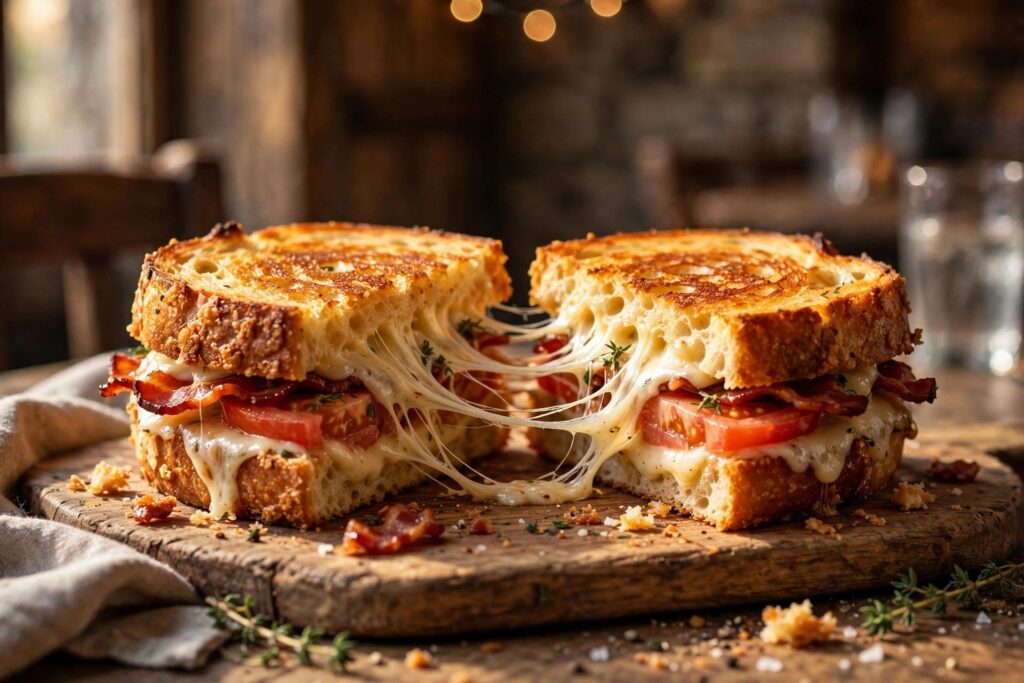
There is a particular kind of silence that falls over a table when a proper grilled cheese arrives. It is not polite silence. It is the sound of everyone leaning in, watching cheese stretch from bread to plate, and quietly deciding whether to eat it with their hands or go straight in with a knife and fork and lose all dignity. A plain grilled cheese earns that moment. A wild one earns a story you tell later.
That is the difference between a sandwich and bar food. Bar food is not supposed to be tidy. It is supposed to be a little excessive, a little indulgent, and best eaten with other people around, preferably while a game is on and nobody is in a hurry to leave. Grilled cheese fits that job better than almost anything else on a tavern menu, because it starts from something everybody already loves and then gives a kitchen room to play.
The trick is knowing where to stop. A great over-the-top grilled cheese is not a dare. It is a balance act: crisp bread, cheese that actually melts instead of turning rubbery, one bold flavour doing the talking, and one or two supporting flavours keeping it interesting. Pick a direction and commit to it, and you get something worth ordering again.
Why Grilled Cheese Belongs on a Bar Menu
Think about what a good bar snack has to do. It has to arrive fast enough that nobody loses interest, it has to hold up to a drink, and it has to be shareable without a formal cutting ceremony. Grilled cheese checks all three, and it does something else that matters just as much: it makes people nostalgic. Almost everyone has a version of this sandwich in their past, whether it was made on a stovetop after school or ordered late at night when nothing else sounded right.
A tavern version can honour that memory without simply repeating it. Swap plain white bread for sourdough with a real crust, or thick-cut Texas toast that can stand up to a heavier filling. Use a cheese blend instead of a single slice, so you get both flavour and pull. Then add the twist. That is where a kitchen earns its reputation.
It also pairs beautifully with the rest of a bar table. A rich, cheesy sandwich next to something sharp and salty, like jalapeno poppers, gives the whole spread a rhythm: heat, then comfort, then heat again. Nobody wants a table full of only heavy food, and nobody wants a table full of only spicy food either. Grilled cheese is the anchor that lets the louder dishes shine.
The Rules Before the Wild Part
Before any of the fun variations, the basics have to be right, and they are less forgiving than people think. Low heat is your friend. A screaming-hot pan browns the bread before the cheese has a chance to melt, leaving you with a beautiful exterior and a cold, unmelted middle. Medium-low heat, a little patience, and a lid for the last minute will get you further than any fancy ingredient.
Butter matters too, and not just for flavour. Softened butter spread edge to edge gives an even, golden crust, while a dry corner stays pale and sad. Some cooks swear by a thin layer of mayonnaise on the outside instead, which browns beautifully and adds a faint tang. Either way works, as long as the whole surface is covered. A half-buttered sandwich is a half-finished job.
Cheese choice is where most wild grilled cheeses succeed or fail. Young, high-moisture cheeses melt into that long, photogenic pull: mozzarella, fontina, Monterey Jack, and young Gouda are all reliable. Aged cheeses bring flavour but melt less willingly, so they work best blended with a good melter. Sharp cheddar on its own can turn grainy if it gets too hot; cheddar mixed with Jack or Gruyere gives you sharpness and smoothness in the same bite. Shredded cheese melts faster and more evenly than thick slices, which is worth remembering when you are loading a sandwich up.
Bread choice follows the same logic. Thin sandwich bread disappears under a heavy filling. Sourdough, brioche, and thick country bread hold their shape, and their crusts add crunch that contrasts with the soft middle. If the bread cannot survive the filling, the sandwich cannot either.
Five Variations That Actually Work
Start with the buffalo chicken grilled cheese, because it is the most natural crossover for a wings-loving crowd. Shredded chicken tossed in a moderate buffalo-style sauce, layered with Monterey Jack and a smear of blue cheese dressing or crumbled blue cheese, on sourdough. The heat is there, but the cheese and bread soften it, and the whole thing eats like a wing night in sandwich form. Keep the sauce restrained; a swimming sandwich is nobody’s friend.
Then there is the pizza grilled cheese, which sounds like a novelty and eats like a genuinely good idea. Mozzarella and a little provolone, a spoonful of tomato sauce kept away from the bread’s edges, pepperoni, and a pinch of oregano, all pressed until the cheese bubbles at the sides. It is the sandwich equivalent of folding a pizza slice in half and deciding not to apologise for it.
For something sweeter and saltier, try bacon, apple, and cheddar. Crisp bacon, thin slices of a firm apple, and sharp cheddar on sourdough, with a whisper of whole-grain mustard on the inside. The apple stays crunchy, the bacon stays salty, and the cheddar ties them together. It is autumn in a sandwich, and it works far better than it has any right to.
The mushroom and Swiss version is the quiet overachiever of the group. Mushrooms cooked down until they are deeply browned and almost meaty, with Swiss or Gruyere and a few leaves of thyme, make a sandwich that tastes far more grown-up than the effort involved. A splash of something savoury in the pan while the mushrooms cook, like Worcestershire sauce, deepens the flavour without making the sandwich taste like a steakhouse.
Finally, the caprese grilled cheese is the one to make when the weather turns warm or when the table needs something brighter. Fresh mozzarella, sliced tomato that has been salted and drained for a few minutes so it does not sog the bread, basil, and a drizzle of balsamic reduction after grilling, never before. The balsamic goes on at the end, or it makes the bread wet and the whole sandwich falls apart in your hands.
How to Build One Without a Soggy Middle
Order matters as much as ingredients. Cheese should touch both slices of bread, acting as a kind of edible glue and a moisture barrier. Wet ingredients, like tomato or sauce, belong in the middle, surrounded by cheese, not pressed directly against the bread. If you are using something juicy, drain it first. A tomato slice blotted dry is a different ingredient from one straight off the board.
Thickness matters too. A sandwich that is too tall will not cook through, and pressing it flat with a spatula squeezes out the cheese you worked so hard to melt. Build it generously but sensibly, grill it gently, and let it rest for a minute before cutting. That rest lets the cheese settle instead of running straight onto the board, and it keeps the first bite from scalding anyone.
Cutting on the diagonal exposes more melted cheese and gives two easy-to-hold halves. Serve it with something to cut the richness: a small cup of tomato soup for dipping, a handful of pickles, or a simple salad with a sharp dressing. The contrast is what lets you finish the sandwich instead of stalling halfway through.
Making It a Game-Day Spread
Grilled cheese also scales up beautifully for a crowd, which is why it deserves a place next to the usual game-day lineup. Set up a station with two or three breads, a few cheeses, and the fillings for two variations, and let people build their own while one person works the griddle. It turns cooking into part of the gathering.
If you are planning a spread, think about balance across the whole table. A rich grilled cheese station sits well beside a bowl of something bright and scoopable, and our game-day dips roundup is a good place to start when you are deciding what else to put out. The point is not to outdo every other dish. It is to give people a reason to linger, to try one more combination, and to argue, fondly, about which variation was best.
That argument is the real payoff. A plain grilled cheese is comfort; a wild one, done well, is a conversation. Just bring napkins.