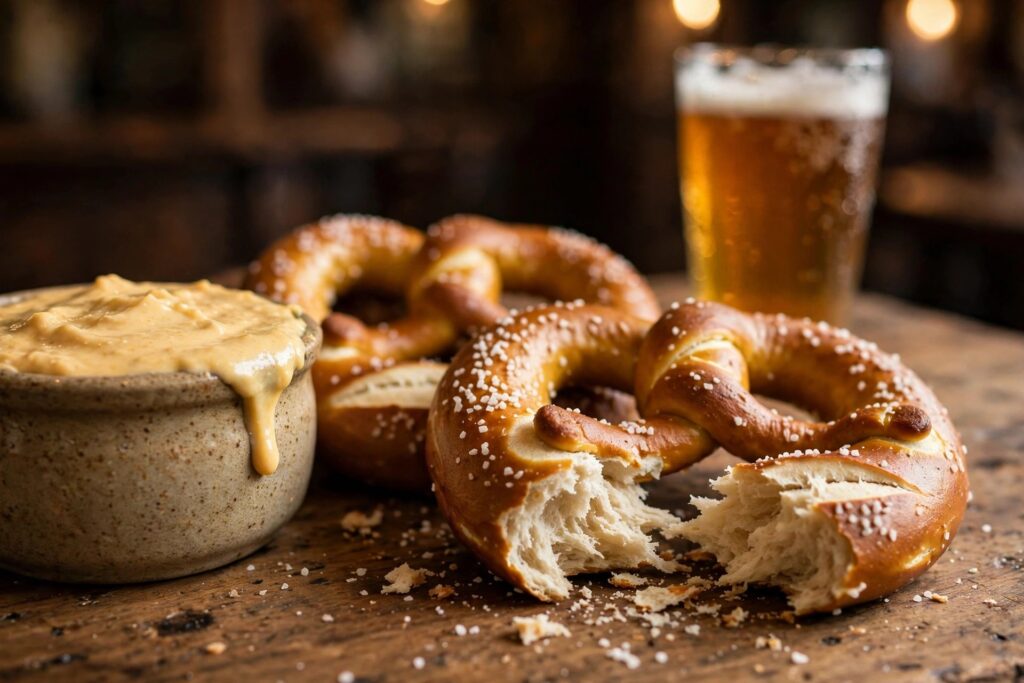
There are bar snacks, and then there is the moment a basket of warm soft pretzels lands on the table next to a cold pint and the whole table goes quiet for a second. Everybody reaches at once. Somebody tears one open, steam curls up, salt crunches, and the beer-cheese dip disappears faster than anyone wants to admit. It is one of the oldest partnerships in tavern food, and it works for a reason that goes deeper than habit: the beer is not just sitting next to the pretzel. It is baked into it, melted into the dip, and poured alongside it, three versions of the same flavour talking to each other.
This is a from-scratch guide to doing it properly at home: beer in the dough, a dip that stays smooth instead of turning grainy, and the right pint to serve with both. No special equipment beyond a pot, a baking sheet, and a little patience while the dough rises.
Why beer belongs in the dough
A soft pretzel is, at heart, a simple bread: flour, water, yeast, salt, a little sugar and butter. Swapping some or all of the water for beer changes the loaf in ways you can taste. The malt in the beer brings a toasty, faintly sweet depth that plain water never will, and the beer’s gentle acidity gives the yeast a little extra encouragement. The result is a pretzel with a more interesting crumb — still soft and chewy inside, but with a rounder, breadier flavour underneath the salt.
Which beer you pour in matters more than most recipes let on. A malty lager, an amber ale, or an Oktoberfest-style beer is the safest bet, because malt is what you are after here. A wheat beer works nicely too, lending a soft, bready note. What you want to avoid is anything aggressively bitter: a big double IPA’s hop bitterness concentrates as the dough bakes and can leave a harsh edge, especially in the dip. For the dough, think malt first, hops second.
One practical detail: warm the beer gently to around 105–110°F before it meets the yeast, the same range you would use for warm water. Hotter than that and you risk killing the yeast; cooler and the rise drags. Flat beer is fine — the carbonation does not survive kneading and baking.
The bath that makes a pretzel a pretzel
The thing that separates a pretzel from a breadstick twisted into a knot is the bath it takes before baking. Shaped pretzels are dunked briefly in an alkaline solution, and that alkaline surface is what drives the deep mahogany colour and the distinctive tangy, chewy crust when it hits the oven heat. Traditional Bavarian bakeries use food-grade lye, a sodium hydroxide solution, for this step. It produces the darkest, glossiest crust, but raw lye is caustic stuff that demands gloves and eye protection, and it has no place in a casual home kitchen unless you know exactly what you are doing.
The home-baker alternative is a baking soda bath: a pot of boiling water with baking soda stirred in, with each pretzel lowered in for about 20–30 seconds per side. It is far safer and still gives you a properly browned, chewy pretzel. The colour will be a shade lighter and the tang a touch milder than a lye-dipped pretzel, and that is a perfectly good trade for a weeknight project. Whatever you do, do not skip the bath and try to fake it with an egg wash. You will get a nice roll, but it will not taste like a pretzel.
As for the shape itself, pretzels are one of Europe’s oldest surviving baked shapes, with roots commonly traced to medieval monasteries, where the crossed-arms knot is said to have echoed a prayer pose — though historians still debate the details. What is not in doubt is how the shape eats: the fat belly stays soft while the thin twisted arms bake up chewier and darker, so a single pretzel gives you two textures. When you roll your ropes, aim for a thick middle and tapered ends, about 20 inches long, then loop and twist. Your first one will look lopsided. Your third will look like it came from a bakery. Nobody at the table will care about the first one once it is warm and salted.
The dough, step by step
For eight pretzels, you need 1¼ cups beer warmed to 105–110°F, 1 tablespoon brown sugar, 2¼ teaspoons (one packet) yeast, 1 tablespoon melted butter, 3½ cups bread or all-purpose flour, and 1½ teaspoons kosher salt. Bloom the yeast in the warm beer with the sugar for about five minutes, until it foams. Stir in the butter and salt, add the flour, and knead — by hand or with a dough hook — for six to eight minutes, until the dough is smooth and slightly tacky but not sticky. Cover it and let it rise in a warm spot for about an hour, until doubled.
Turn the dough out, divide it into eight pieces, and roll each into a rope with a fat middle and thin ends. Shape the classic knot: form a U, cross the ends twice, and press them onto the belly of the U. Meanwhile, bring a wide pot of water to a boil and add the baking soda slowly — it will foam up, so give it room. Boil the pretzels two at a time, 20–30 seconds per side, lift them out with a slotted spatula, and set them on parchment-lined sheets. Brush with beaten egg, shower with coarse pretzel salt, and bake at 425°F for 12–14 minutes, until deeply golden. They are best within the hour, torn open while the inside is still steaming.
A beer-cheese dip that stays smooth
Most beer-cheese dips fail the same way: the cheese goes in too fast, over too much heat, and the sauce splits into a grainy, oily mess. The fix is patience and low heat. Start with a roux — two tablespoons of butter melted, two tablespoons of flour whisked in and cooked for a minute or two until it smells faintly nutty. Whisk in ¾ cup beer and ¾ cup whole milk slowly, and simmer gently for two or three minutes until it thickens slightly. Never let it boil hard; boiling is what breaks milk-based sauces.
Season first, then cheese. A teaspoon of Dijon mustard, a half-teaspoon of Worcestershire sauce, a pinch of garlic powder and smoked paprika, salt, and a little cayenne if you want heat. Then take the pan off the high heat, turn it low, and add two cups of freshly grated sharp cheddar a handful at a time, whisking until each handful melts before the next goes in. Freshly grated matters — pre-shredded cheese is coated in anti-caking starch that fights a smooth melt. If the dip gets too thick, loosen it with a splash more beer or milk. Keep it warm, not bubbling, and it will stay silky for the whole basket.
Want to riff on it? Swap half the cheddar for smoked Gouda or Gruyère for a nuttier, more Oktoberfest-leaning dip, or stir in a spoonful of whole-grain mustard for texture.
Variations worth trying
Once the base recipe is in your hands, it bends easily. Cut the ropes into one-inch pieces before the bath and you have pretzel bites, the version that disappears fastest at a party because nobody has to commit to a whole pretzel. Brush baked pretzels with butter and roll them in cinnamon sugar instead of salt for a sweet-salty dessert version that pairs beautifully with a dark lager. Or skip the knot altogether and bake the dough as sticks for dunking straight into the dip.
For a Bavarian-leaning spread, serve the pretzels with obatzda, the Bavarian beer-cheese spread made from ripe Camembert, cream cheese, onion, and paprika, alongside the warm dip. Beer-festival veterans even wear pretzel necklaces — small pretzels strung together so there is always something salty between tastings. It looks ridiculous, and it is genuinely smart.
What to drink with them
The obvious answer is the same beer you cooked with, and it is a good one — the dip and the dough echo the pint in your glass, and the whole thing feels intentional. But you can also play contrast. A crisp lager cuts through the richness of the cheese dip and resets your palate between bites, while a malty Märzen or amber ale leans into the pretzel’s toastiness and makes the whole plate taste warmer and rounder. A wheat beer splits the difference, light enough to refresh, bready enough to belong. If you want more ideas for cooking with the pint rather than just drinking it, our guide to dishes that cook with beer is a natural next stop, and the Oktoberfest angle gets the full treatment in our Oktoberfest survival guide.
The real secret is that every part of the plate respects the others: malt in the dough, malt in the dip, malt in the glass, salt over everything, served warm instead of cold from a bag. Make a double batch. You will need it.