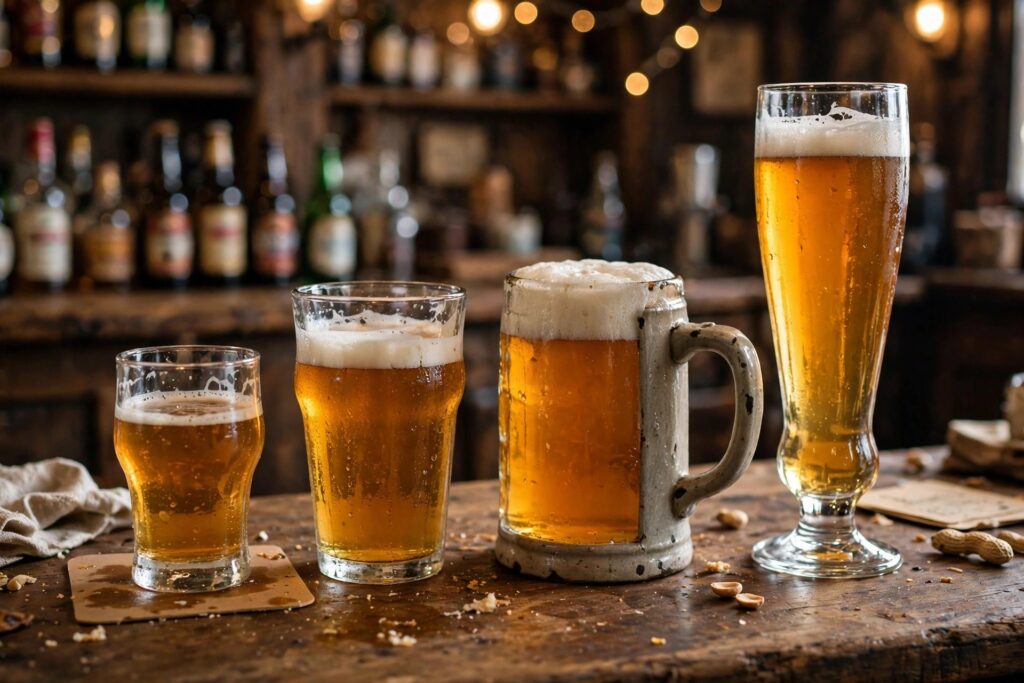
Everybody remembers the fast-food documentary that asked what happens when you supersize everything. Beer has been asking the same question for a lot longer. Walk into any tavern and the vessels read like a dare: a thimble-sized taster, a pint, a stein the size of a flowerpot, a pitcher built for a table, and somewhere in the glassware cabinet, a yard of ale that looks less like a drinking glass and more like a piece of plumbing.
Beer has always come in sizes that tell a story about the room you’re in and how the evening is going to go. The fun part is knowing what each size actually holds, because the glass in front of you keeps the truth quiet until the tab arrives.
The Standard Drink: The Only Size That Counts on Paper
Before the parade of glassware starts, it helps to know the one measurement that actually matters. In the United States, the National Institute on Alcohol Abuse and Alcoholism defines one standard drink as any beverage containing about 0.6 fluid ounces of pure alcohol. For beer, that works out to a 12-ounce can or bottle of regular beer at about 5% alcohol by volume. A 12-ounce beer at 10% ABV counts as two standard drinks, not one.
That definition is the Rosetta Stone for the whole supersizing question. Every glass on the bar is just some multiple of it. A pint of 5% lager is about one and a third standard drinks; a liter stein is nearly three. The glass never tells you the math — you have to do it yourself, and most people at a bar are not doing math.
The Taster and the Flight: Small on Purpose
Start at the bottom of the size chart, where beer is at its most civilized. A taster pour runs about three to five ounces, and a flight is usually four or five of them on a little wooden paddle. The whole point is sampling without commitment — the only format here designed to slow you down rather than speed you up.
Flights exist because the beer world got complicated. When a bar has a dozen taps and you can’t decide between a hazy IPA and a smoked porter, ordering four tiny glasses is the honest answer. A three-ounce pour of a 10% imperial stout gives you the whole flavor arc — the roast, the sweetness, the warmth — in exactly the amount your palate can handle before it goes numb.
The Pint: Two Countries, Two Pints, One Argument
The pint is the default setting of the beer world, and it is also a quiet international misunderstanding. An American pint holds 16 fluid ounces. A British imperial pint holds 20. Order a pint in Buffalo and a pint in London and you are not drinking the same amount of beer — and regulars in both cities will defend their version like it was handed down on stone tablets.
The American pint glass comes in two main shapes: the straight-sided shaker pint that every bar in America seems to own by the hundred, and the slightly tapered nonic pint, the one with the bulge near the top, which is easier to stack and harder to chip. The pint’s genius is that it is big enough to feel substantial and small enough to finish while it’s still cold.
The Stein and the Maß: When a Liter Is the Unit
Cross the Atlantic and the math changes. In a Munich beer hall, the standard serving is the Maß, a full liter of beer — about 34 ounces — served in a heavy glass or stoneware stein. It is not a novelty or a challenge. It is simply how beer is ordered, the way a pint is in an American bar. A liter of 5% lager is close to three standard drinks — and it arrives looking like a piece of furniture.
The Maß has its own etiquette, too. Carrying a half dozen of them at once is a genuine athletic skill, and Oktoberfest servers do it every day without spilling a drop. Our Oktoberfest survival guide covers the tents, the pace, and the food that goes with it. The short version: a Maß is a marathon format, not a sprint. People who treat it like a pint usually regret it by the second one.
The Pitcher: Beer as a Group Project
The pitcher is where beer stops being a personal drink and becomes a social contract. The standard sizes in American bars are 32, 48, and 60 ounces, with the 60-ounce pitcher being the most common. That big one holds about five 12-ounce servings, or just under four pints — enough for a small table to share without flagging down a server every ten minutes.
Pitchers solve a real problem: the round. One pitcher instead of four separate pints means less waiting and a tab that is easier to split. They also quietly change the pace of the evening. The glass in front of you keeps getting refilled from the jug in the middle of the table, and it is remarkably easy to lose track of how many pours that adds up to. A 60-ounce pitcher of 5% beer is five standard drinks sitting on the table in a single vessel. Split four ways, that’s a reasonable evening; finished mostly by one person, a very different story.
The Yard of Ale: Three Feet of History
And then there is the yard. A yard of ale is a glass about a yard long — roughly three feet — with a bulb at the bottom and a long, flared shaft. The classic version holds around two and a half imperial pints, about 1.4 liters, though modern novelty versions vary. It is the most theatrical vessel in beer: the glass most likely originated in 17th-century England, where it was known as a “long glass” or a “Cambridge yard,” and the diarist John Evelyn recorded one being used to toast King James II at Bromley in 1685.
Legend ties the yard to stagecoach drivers: an innkeeper could hand the long glass up to a driver who didn’t have time to climb down from his coach. Historians say the story is probably more legend than fact, but it survives because it feels true — the yard looks exactly like a glass designed for someone in a hurry. What is documented is that it was mainly used for drinking feats and ceremonial toasts, and it still is. The fastest recorded drinking of a yard of ale in the Guinness Book of Records is five seconds. The bulb at the bottom means the last gulp arrives all at once, like a wave breaking at the end of the glass.
The Boot, the Tower, and the Keg: Going Bigger Still
Once you’ve met the yard, the rest of the oversized family feels almost restrained. The das Boot, the boot-shaped glass borrowed from German drinking tradition, usually holds around two liters and comes with its own technique: drink it wrong and the toe of the boot dumps beer on your shirt. The beer tower, a tall clear tube with a tap at the bottom, typically holds two to three liters and sits mid-table, dispensing beer by gravity while everyone watches the level drop.
At the far end of the scale sits the keg. A standard half-barrel keg holds 15.5 gallons — roughly 165 twelve-ounce servings, or about 124 pints. Nobody orders a keg for one person. A keg is a party in a steel cylinder — the same math as everything else here, multiplied until the numbers stop sounding like a drink and start sounding like inventory.
Why Bigger Isn’t Better — and How to Enjoy the Parade Anyway
Here is the honest part. Every step up this size chart multiplies the alcohol, not just the volume. A liter stein isn’t “one beer.” It’s nearly three standard drinks. A yard of ale at 5% is close to four. A 60-ounce pitcher is five. The glass makes it feel like one serving because it arrives as one object, and our brains count objects far better than ounces.
None of that means the big glasses are off limits. Beer culture is full of them for a reason: they’re fun, they’re social, they’re historic, and a Maß in a Munich beer hall is one of the great simple pleasures in the world. Know what you’re holding. Eat something — wings, pretzels, anything with substance. Drink water between rounds. Share the pitcher, split the tower, and treat the yard of ale as what it has always been: a toast, a stunt, a story for later, not a personal hydration plan.
Beer has been supersized for four hundred years, and the joke has always been the same: the glass gets bigger, the beer stays the same, and the person holding it has to do the math. Do the math, enjoy the parade, and let the yard stay a legend instead of a regret.