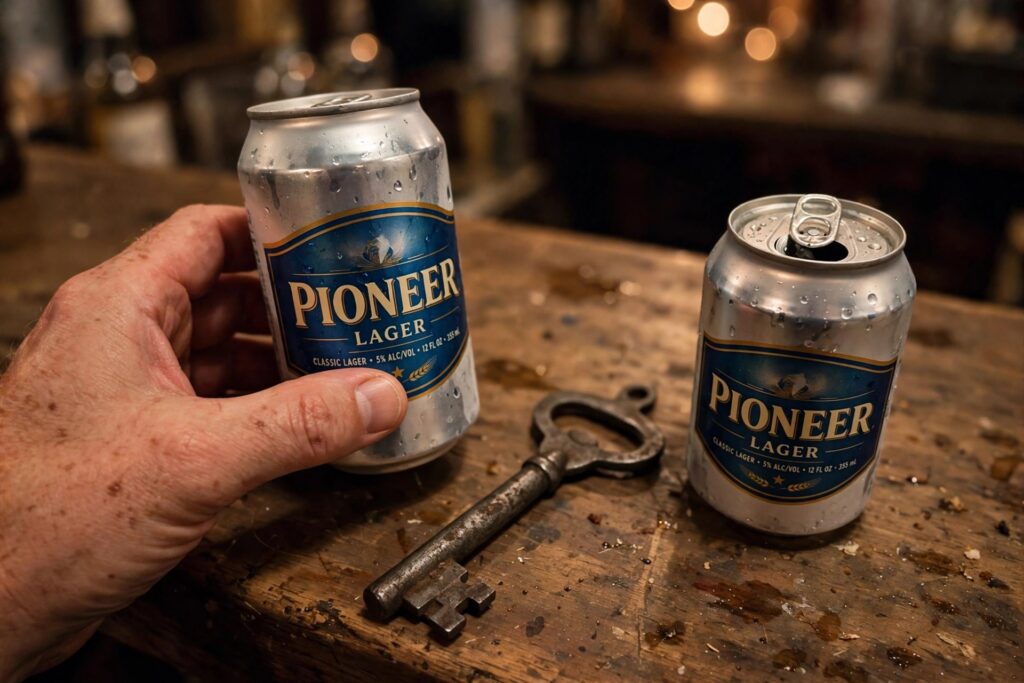
Every beer can asks the same question before it gives up its contents: how are you getting in? For most of us the answer is automatic — flip the tab, take a sip, don’t think about it. But the can has been opened a dozen different ways over the past ninety years, and two of the strangest methods are still with us: the punch top, a civilized little vent hole, and the shotgun, the rowdy college ritual that turns a can into a fire hose. Same aluminum cylinder, same beer inside, two completely different relationships with it.
The rivalry between them is older than it looks. It starts with a problem that had nothing to do with parties: for the first few decades of its life, the beer can was essentially a sealed box with no way in.
The Flat Top and the Church Key: Beer Needed a Tool
The first beer cans hit the market in 1935, when the Gottfried Krueger Brewing Company in Newark, New Jersey, started selling beer in flat-top steel cans made by the American Can Company. The cans were a genuine breakthrough — lighter than bottles, unbreakable, stackable — but they had one obvious flaw. The top was a solid sheet of metal, and you needed a pointed metal opener called a church key to get in, a name nobody has ever satisfactorily explained.
Opening a flat-top can was a two-hole job. You punched a triangular hole on one side to drink from and a smaller hole on the opposite side to let air in, so the beer could flow smoothly instead of glugging and sputtering. That second hole was the whole secret, and it is the ancestor of everything in this story: beer pours better when air has somewhere to go. A can with only one hole fights you. A can with a vent behaves.
Flat-top cans stuck around for decades, finally fading out by the late 1960s, but the church key never really went away. Bartenders still keep one behind the bar for cans of juice and the occasional throwback brew. Punching two holes in a can top is the oldest beer-opening ceremony in America, invented out of pure necessity.
The Pull Tab: A Picnic, a Car Bumper, and a Revolution
The punch top’s long reign ended because of a forgotten church key at a picnic. The story, told many times and never really disputed, is that in 1959 an engineer from Dayton, Ohio, named Ermal Fraze was at a family picnic when he realized nobody had brought an opener. He tried to open a beer can on his car bumper and got a messy geyser of beer for his trouble. Being an engineer, he went home and designed a can that didn’t need a tool at all: a scored tear strip in the aluminum top with a small riveted tab to pull it open.
Fraze’s pull tab was test-marketed by the Pittsburgh Brewing Company on Iron City Beer in 1962, and he patented the design in 1963. Within a few years the pull tab was everywhere. The detachable tab had one flaw — people tossed the little metal strips on the ground, and beaches and parks started glittering with them — which is why the stay-on tab, the one still on your can today, replaced it in the 1970s and 80s.
The Punch Top Comes Back — This Time on Purpose
Just when the pull tab seemed to have settled the question forever, the punch top came back, this time as a feature instead of a workaround. Coors led the way in the 1970s with a push-button can that had two stamped circles in the top you pressed in with a finger — a bigger hole for drinking, a smaller one for venting, the same two-hole logic as the old church key, built right into the can. It was an interesting idea that never quite caught on, partly because the buttons were fiddly and partly because the rest of the industry had already moved on.
The punch top’s real comeback arrived in April 2012, when Miller Lite launched its Punch Top Can: a second scored opening on the top of the can, next to the regular tab. Punch it open — with a key, a pen, the edge of a lighter, anything handy — and the can suddenly has the vent hole the old church-key drinkers always knew it needed. Air flows in through the second hole while beer flows out of the first, and the pour comes out smoother and faster, closer to drinking from a glass than from a can.
MillerCoors was upfront about what it was selling: not just a hole, but a ritual — a small ceremony before the first sip, a deliberate throwback to the era when opening a beer took a moment of attention instead of a flick of a thumb.
The Shotgun: Same Physics, Opposite Manners
While the punch top was being refined in boardrooms, the shotgun was being perfected in dorm rooms and backyards. The move is simple, passed down by demonstration for as long as there have been beer cans: poke a hole in the side of the can near the bottom, put your mouth over the hole, tilt the can upright, pop the tab, and let gravity and air pressure do the rest. Air rushes in at the top while the beer rushes out at the bottom, and a 12-ounce can empties itself in a few seconds. Folklore archives at the University of Southern California have documented the ritual, noting it shows up wherever college kids and canned beer meet, functioning as much as a bonding rite as a way to drink.
Here’s the part people miss: the shotgun and the punch top are the same trick. Both are just the old church-key insight — beer flows better when air has a way in — applied with very different intentions. The punch top vents the can at the top so the beer pours smoothly into your mouth or your glass. The shotgun vents the can at the top so the beer pours violently out of a hole in the side. Same physics, opposite manners. One is a pour, the other is a flood.
Two Ways to Open a Can, Two Kinds of Evening
That shared physics is what makes the comparison fun, because the two methods lead to two completely different evenings. The punch top is a slow-down ritual. It adds a step before the first sip, it makes the beer taste a little better by letting it breathe, and it turns opening a can into something you do with a little care. The shotgun is a speed-up ritual. It removes every obstacle between you and an empty can, and it turns drinking into a race against gravity.
There is also a practical difference worth saying plainly. A punch top is a small, clean hole made in a sturdy part of the can. A shotgun hole is punched or cut into the thin side wall, often with keys or a knife, and the ragged edge of torn aluminum sits right against your mouth. People cut their lips on them more often than anyone admits, and a punctured can sprays if it has been shaken or warmed up. The punch top was engineered by a brewery. The shotgun was engineered by enthusiasm.
None of this is a lecture. Beer culture has always had room for both the ceremony and the chaos. The point is just to know which one you’re choosing. A punch top makes the beer better. A shotgun makes the beer disappear. There is a time and a place for disappearing beer, but it is not every beer, and it is not a contest worth winning more than once in an evening. Pace yourself, keep water in the rotation, eat something, and let the can-opening ritual be the fun part — not the reason the night ends early.
The Can Keeps Evolving
The beer can’s story didn’t stop with the punch top. Breweries are still experimenting with can ends — wider openings that turn the whole top into a drinking surface, resealable lids, textured grips — because the can is still the cheapest, lightest, most portable way to get beer from a brewery to a bar stool. Every one of those experiments is wrestling with the same problem the flat top had in 1935: how do you get beer out of a sealed metal box in a way that feels good?
The punch top answered that question with a vent and a ritual. The shotgun answered it with a hole and a dare. Both answers are still in circulation, and both tell you something about the people who use them. So the next time you’re holding a can, take a second before you open it. There’s ninety years of history in your hand, and how you choose to get in says a lot about the evening you’re planning.