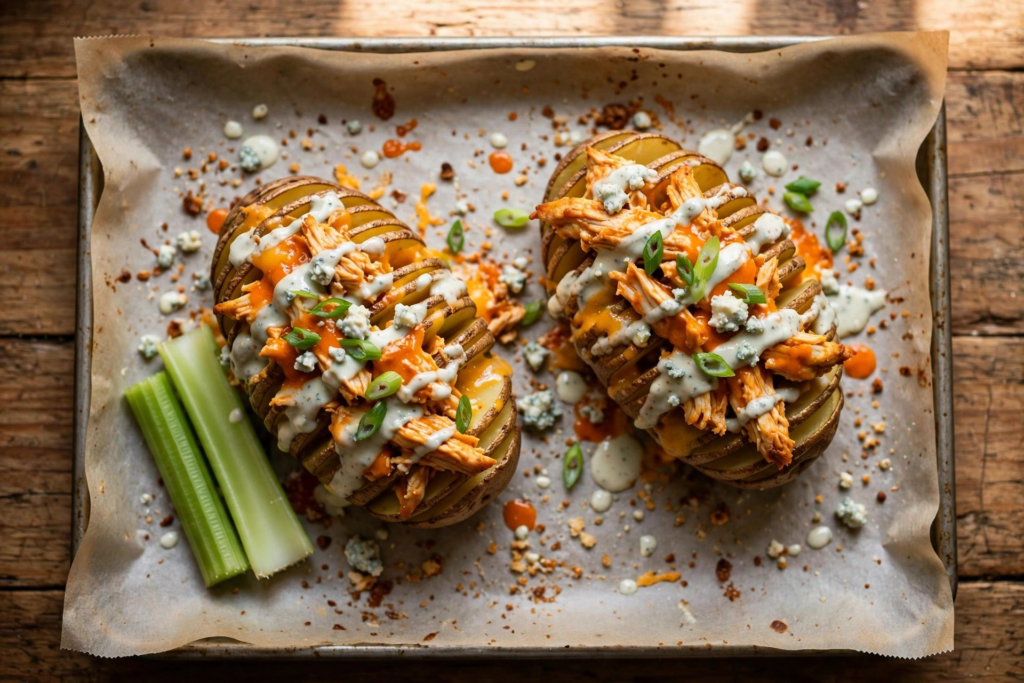
Buffalo flavor is a format, not a food. Once you accept that — that the cayenne-vinegar-butter combination is a delivery system that works on anything with a surface — the whole menu opens up. We’ve put it on pizza. We’ve put it on cauliflower. Today we’re putting it on the most structurally ambitious potato in the game: the hasselback, that fanned Swedish showpiece that looks like you went to culinary school and eats like the best loaded baked potato of your life.
And yes, the title says “hasselback-ish,” and that’s deliberate. A true hasselback — thin, perfectly even slices fanned like an accordion, born at Stockholm’s Hasselbacken restaurant in the 1950s — is a knife-skills flex. We’re not doing a flex. We’re stuffing sauced chicken and melted cheese into the crevices of a roasted potato on a football Sunday. The slices can be a little uneven. The fan can be a little lopsided. Once it’s loaded, nobody is grading your knife work. They’re too busy eating.
Why the hasselback is built for stuffing
A plain baked potato is a closed system: you split it, fluff it, and pile things on top, and half the toppings slide off onto the plate. The hasselback is an open system. All those thin slices create dozens of little pockets and dramatically more surface area, which means two things a loader cares about: more crispy, browned edges (the best part of any roasted potato, multiplied), and actual crevices for the good stuff to lodge in. Sauced chicken tucked between slices stays put. Melted cheese drapes down into the cuts instead of sliding off.
There’s a secondary benefit nobody talks about: the fan structure lets heat and steam escape as it roasts, so the interior goes fluffy instead of gummy. A hasselback eats lighter than a twice-baked potato of the same size, which matters when it’s sitting on a game-day spread next to wings and dip and you’re hoping people make it to the fourth quarter.
Pick the right potato
Russets. This is not close. Russets are high-starch and low-moisture, which means they roast up with crisp, separate slices that fan open dramatically, and the interior goes properly fluffy. Yukon Golds will work in a pinch — they’re waxier, so the slices hold together more tightly and don’t fan as wide — but they fight the whole concept. You want the potato that opens up and invites the filling in.
Size matters too: medium russets, roughly 8 to 10 ounces each, about the size of your fist. Enormous baking potatoes take forever and the centers never quite catch up to the edges. Small ones don’t have enough slice-depth to hold a meaningful amount of chicken. Four medium potatoes feed four people as a hearty appetizer, or two very committed people as dinner. Scale linearly; the method doesn’t change.
The slicing, minus the anxiety
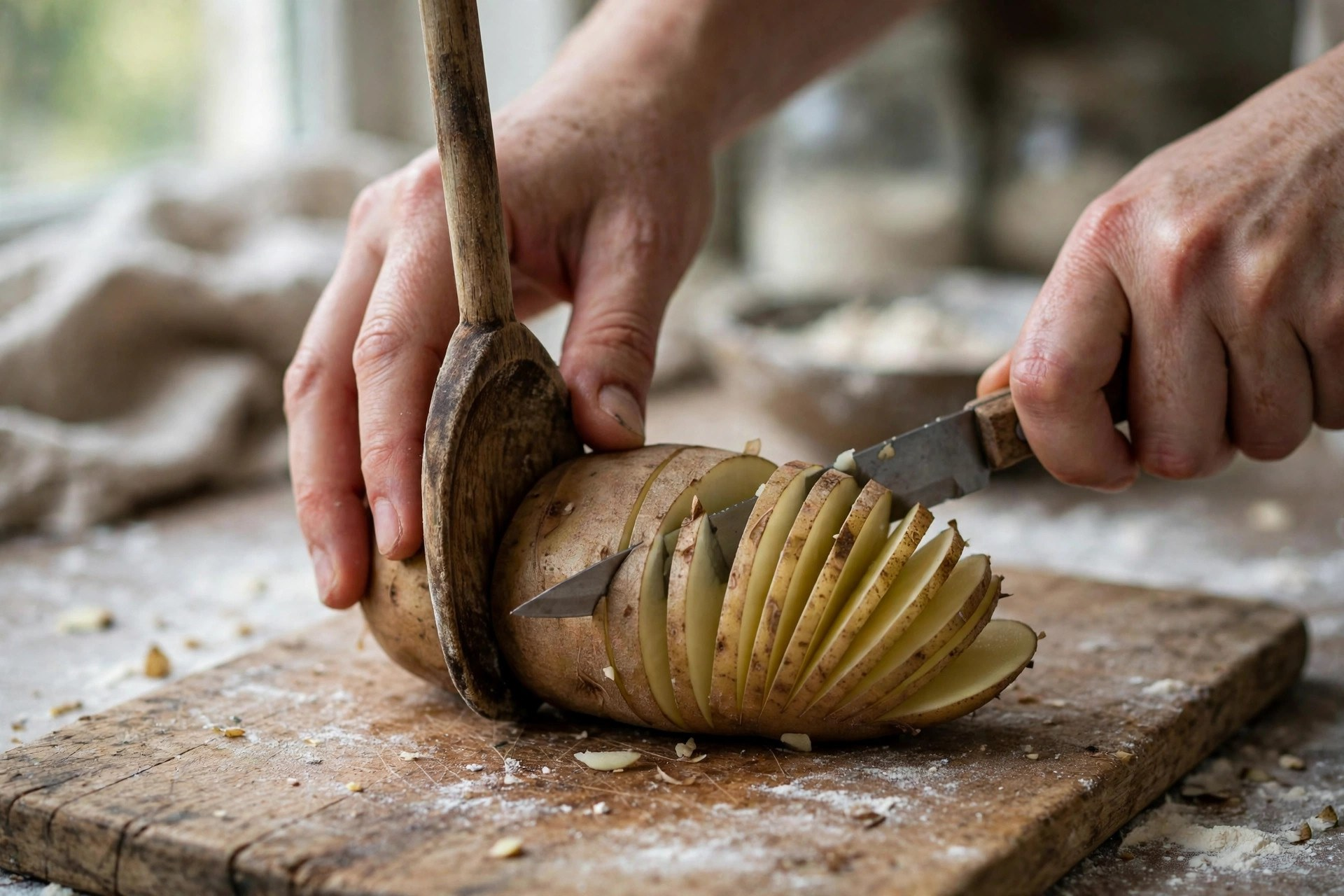
Here’s the technique, and it’s the only fiddly part: set the potato between the handles of two wooden spoons and slice down in quarter-inch intervals. The spoon handles stop the knife before it goes all the way through, leaving the bottom intact so the potato holds together. That’s the entire trick. Your slices won’t be perfectly even. Some will be a little thick, some a little thin. The potato does not care, and once it’s roasted and stuffed, neither will anyone else.
Two practical notes that most recipes skip. First, the slices can be cut hours ahead: drop the sliced potatoes into a bowl of cold water and refrigerate up to 24 hours. The water keeps them from browning, and you just pat them thoroughly dry before oiling. Game-day prep, handled during pregame. Second, the oil has to get between the slices, not just on top. Brush generously with olive oil or melted butter and work it into the cuts with the brush or your fingers, then season salt, pepper, and garlic powder the same way — into the crevices, not just the surface. Dry interior slices are the one real failure mode here, and oil is the fix.
The recipe
Serves 4 as a hearty appetizer. About 15 minutes of active work; the oven does the rest.
You’ll need:
- 4 medium russet potatoes (8–10 oz each), scrubbed
- 3 tbsp olive oil or melted butter
- 1 tsp kosher salt, 1/2 tsp black pepper, 1 tsp garlic powder
- 2 cups cooked shredded chicken (rotisserie is perfect here)
- 1/2 cup hot sauce whisked with 2 tbsp melted butter
- 1 1/2 cups shredded cheddar, or a cheddar-mozzarella blend
- Blue cheese dressing, for drizzling
- 2–3 scallions, sliced, and celery sticks for serving
How to make it:
- Heat the oven to 425°F and line a sheet pan with foil. Slice each potato hasselback-style — quarter-inch cuts, wooden spoon handles as your guard, stopping before the bottom.
- Brush oil generously into every cut, then season salt, pepper, and garlic powder the same way, working it between the slices. Set the potatoes cut-side up on the pan.
- Bake 60–70 minutes, until the bottom third is fork-tender and the slices have fanned open with crisp, browned edges. At the 35-minute mark, brush a little more oil over the tops to keep them from drying out.
- While the potatoes bake, toss the shredded chicken with the hot sauce and melted butter. Warm chicken drinks up sauce; cold chicken just wears it.
- Pull the potatoes and tuck the sauced chicken down between the slices and in a heap on top. Shower with the shredded cheese, getting it into the cuts.
- Back into the oven for 8–10 minutes, until the cheese is melted and browning in spots. Drizzle with blue cheese dressing, scatter the scallions, and serve hot with celery sticks alongside.
The shortcut nobody should be embarrassed about: a full-size russet needs that whole hour in the oven, which is a long time on a game-day schedule. Scrub the potatoes, prick them a few times with a fork, and microwave 6–8 minutes until they just start to give when squeezed. Let them cool enough to handle, then slice and bake — they’ll finish in 30–35 minutes instead of 60–70. The texture is marginally less crisp than the full oven roast. Nobody at a football party will know, and you’ll have your oven free for the dip.
Timing it for game day
Here’s the play: slice the potatoes in the morning and hold them in cold water in the fridge. An hour before people eat, pat them dry, oil, season, and get them in the oven — the microwave shortcut puts this at halftime if you’re running behind. Shred the chicken and mix the sauce during the first half. Stuff and cheese during the second-half kickoff, and they come out hot right when the game gets tense, which is exactly when a table needs something to do with its hands.
They hold about 20 minutes under loose foil, but this is a serve-it-hot dish — the cheese sets and the edges soften as they sit, and while still perfectly good, it’s not the same as the fresh-from-the-oven version with the cheese still bubbling. Time it like you’d time wings: pull them when people are ready, not when the guests arrive.
The buffalo format keeps traveling
What this dish really proves is the thesis: buffalo isn’t a wing flavor, it’s a food group. The same cayenne-butter-vinegar logic that built the wing works on pizza, on cauliflower, in a lightened-up dip, and now fanned into a potato. The throughline is always the same — heat, acid, fat, something crispy underneath — and the vehicle just changes.
As for the eternal garnish question: blue cheese dressing drizzle is the house ruling, scallions for color, celery sticks on the side because the ritual is half the flavor. Ranch people, you know the policy — a ramekin on the side, tolerated, never drizzled. And if anyone at your table asks why the potatoes are called hasselback-ish instead of hasselback, tell them the “-ish” is doing the same job it does everywhere else in cooking: it’s the difference between a technique and a good time.