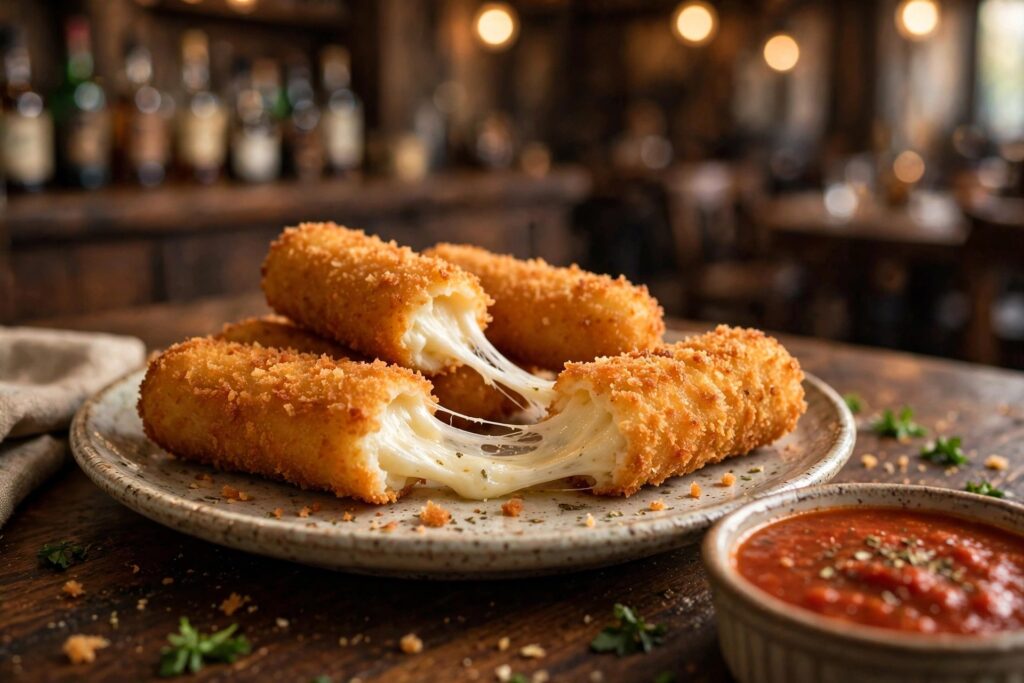
Every bar menu in America has them. Every appetizer sampler includes them, usually sitting next to the wings like a quiet cousin who never causes trouble. And yet, for a food this universal, mozzarella sticks inspire an odd amount of strong feeling. People defend their favorite version. People mock the frozen ones. People film the cheese pull like it is a magic trick. So what is the deal with mozzarella sticks, really? Why does a stick of fried cheese command this much loyalty?
The short answer is that mozzarella sticks are the rare bar food that is almost impossible to get completely wrong and surprisingly hard to get completely right. The difference between a forgettable stick and a great one comes down to a handful of decisions, and most of them happen before the cheese ever touches the oil.
A Longer History Than You Would Guess
Fried cheese is older than the sports bar. A recipe for cheese sticks battered in egg yolks, flour, salt, and wine, then fried, appears in Le Ménagier de Paris, a French household guide from 1393, under the name pipefarce. Food historians are quick to note that medieval fried cheese and the modern mozzarella stick are distant relatives at best, but the instinct is the same: take cheese, give it a crunchy jacket, and fry it until it gives in.
The modern version is American, and it most likely emerged in the 1970s. Two things came together at once: mass-produced mozzarella became widely available starting in the 1960s, and efficient commercial frying equipment spread through bowling alleys and sports bars. Some enterprising cook put the two together, and the result spread fast. By the 1980s, mozzarella sticks were a staple at national casual dining chains, and the frozen-food aisle carried them into home freezers everywhere. There is no single confirmed inventor, which feels right for a food this democratic. Nobody owns the mozzarella stick. Everybody just agrees it belongs on the menu.
There is also an Italian ancestor worth knowing about. Mozzarella in carrozza, literally mozzarella in a carriage, is a traditional dish of fresh mozzarella sandwiched between bread slices, battered, and fried. Food writer Arthur Schwartz has called it the prototype of the American mozzarella stick. The American version just stripped it down to its essentials: cheese, coating, heat, dip.
The Cheese Is the Whole Argument
Here is the rule that decides everything else: use low-moisture mozzarella. Fresh mozzarella, the soft kind packed in water, has too much moisture. It turns watery in the fryer, steams the breading soft from inside, and leaks through the coating like it is trying to escape. Low-moisture mozzarella, the firm kind sold as string cheese or in blocks, melts slowly and evenly into that famous stretch instead of a puddle.
String cheese is the easiest shortcut and there is no shame in it. It is already stick-shaped, already low-moisture, and already portioned. Cut a block of low-moisture whole-milk mozzarella into sticks about four inches long and half an inch thick if you prefer, but keep the size uniform. Uneven sticks cook unevenly, and the thin ones will blow out while the thick ones are still cold in the middle. Whole-milk mozzarella melts a little more richly than part-skim, while part-skim holds its shape slightly better. Either works. What does not work is pre-shredded mozzarella, whose anti-caking agents interfere with the melt, or fresh mozzarella, which was never built for this job.
Why the Cheese Pull Actually Matters
It is easy to dismiss the cheese pull as a social media gimmick, something that went viral in the mid-2010s and never left. But the pull is not just theater. A long, stretchy pull tells you something real about what is inside the stick: the cheese is hot all the way through, it melted evenly, and it has the right moisture level to stretch instead of break or run. A stick with no pull is either undercooked, made from the wrong cheese, or already ten minutes cold.
That is also why mozzarella sticks have a short window of perfection. They are at their best within minutes of leaving the fryer, when the cheese is molten and the coating is still crisp. Order them, eat them hot, and do not let them sit while you finish a conversation. A mozzarella stick that has gone cold is a different food, and not a better one.
The Breading: Double Coat, Freeze Solid
If the cheese is the argument, the breading is the evidence. The standard three-step setup still rules: flour first, to absorb surface moisture and give the egg something to grip; beaten egg with a splash of milk second, as the glue; seasoned breadcrumbs third, for the crunch. Garlic powder, dried oregano, a little basil, salt, and pepper in the crumbs make the difference between a coating that tastes like something and one that tastes like fried cardboard.
Then do it twice. Flour, egg, crumbs, then egg and crumbs again. The double coat builds a shell thick enough to seal the cheese completely, and a sealed stick is a stick that does not leak. A mix of fine Italian-style breadcrumbs and panko gives you both flavor and crunch: the fine crumbs fill the gaps, the panko flakes crisp into a craggy golden surface.
And then, the step people skip and regret: freeze the breaded sticks solid. At least two hours, overnight if you can. Frozen cheese gives the coating time to turn golden before the cheese can melt and burst through. Fry a room-temperature stick and the cheese wins the race every time, blowing out through the weakest point in the breading and leaving you with an empty shell and a mess in the oil. Freeze them, and the crust wins instead.
When it is time to cook, heat the oil to 350 degrees and fry small batches for two to three minutes, until deep golden. Too hot and the coating burns before the cheese melts. Too cool and the sticks drink oil and go greasy. Drain on paper towels, serve immediately, and watch how fast they disappear.
The Dip Question
Marinara is the classic for a reason. The acidity of tomato cuts through the richness of fried cheese, and the Italian seasoning in both the breading and the sauce ties the whole thing together. A warm, decent-quality marinara is all you need, and it is what most restaurants serve.
But the stick is a blank canvas, and the dip is where a kitchen gets to show personality. Ranch is the crowd favorite in much of the country. Honey mustard adds sweetness that plays nicely against salty breading. Spicy marinara, with red pepper flakes stirred in, keeps the classic shape while adding a kick. Barbecue sauce, jalapeño jelly, and even plum sauce all have their defenders. On a game-day table, a tray of mozzarella sticks with two or three dips turns a simple appetizer into a small event, and it pairs naturally with the rest of the spread. Our pub food triple play is built on exactly that logic: give people more than one thing to reach for, and let the table do the talking.
So What Is the Deal?
The deal is that mozzarella sticks are simple in a way that leaves nowhere to hide. There are only four ingredients that matter, cheese, breading, oil, and heat, and every shortcut shows. Frozen sticks from a bag can be fine, even good, but they are a photocopy of the real thing. A fresh stick, made from low-moisture mozzarella, double-coated, frozen solid, and fried to order, is something else: crisp outside, molten inside, gone in four bites.
That is why they never leave the menu. Trends come and go, but a food that is cheap, fast, shareable, and satisfying in exactly the way fried cheese is satisfying does not need reinventing. It just needs to be done right. The cheese pull is not the point. It is the proof.