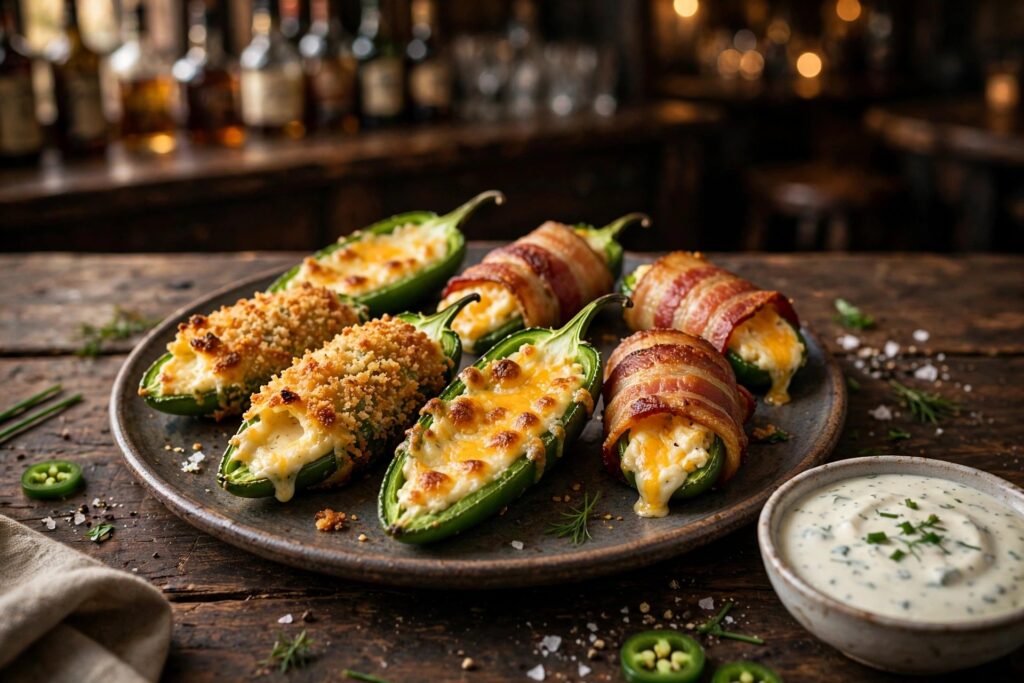
Some bar snacks come and go. One season the whole town is obsessed with loaded fries, the next it’s all about some dip that disappears by spring. Jalapeño poppers never left. They were on the menu when you were sneaking into bars with a fake ID’s older brother, and they’ll be on the menu when your kids are old enough to order for themselves. There is a reason for that staying power, and it has almost nothing to do with novelty. A popper gets four things right at once: heat, cream, salt, and crunch. Take one away and the whole thing falls apart.
Walk into any tavern in America on a Friday night and you will find some version of them: breaded and fried until they shatter, wrapped in bacon and kissed with smoke, or just halved, stuffed, and baked until the cheese bubbles over the edges. All three are legitimate, and all three will disappear from the plate before the second round arrives. That is the popper’s real trick. It is not a dish you admire. It is a dish you reach for, again and again, while arguing about the game on the television above the bar.
Where Poppers Actually Came From
The popper did not spring fully formed from a corporate test kitchen, even though it sometimes feels that way. Its roots run back to Mexico, to chiles rellenos, the stuffed peppers that have been filled with cheese and meat and fried for well over a century. When that tradition crossed into Texas and the American Southwest, it shrank. Cooks started working with jalapeños instead of poblanos, and the stuffed pepper became a finger food instead of a knife-and-fork dinner.
By the 1950s, snack-sized stuffed chiles were already showing up in the United States. Import shops in Texas advertised canned jalapeños stuffed with cheese and seafood, and by 1960 newspapers were printing recipes for stuffed jalapeños filled with everything from ground beef to grated cheese. Through the 1970s and 1980s, the dish kept turning up in more newspaper recipes, restaurant ads, and party menus, sometimes under the name “armadillo eggs” when the bacon-wrapped version was involved. The fillings were all over the place at first, but gradually the experimentation settled into a more consistent recipe.
By 1989, a syndicated food columnist was already calling stuffed jalapeños “standard fare.” Then the 1990s happened. A Wisconsin food company filed a trademark for the term “jalapeño poppers” in 1992, though the name was already circulating on bar menus across Middle America. National chains caught on fast: by early 1995, both Applebee’s and TGI Friday’s had poppers on their menus, and TGI Friday’s eventually sold a frozen version in grocery stores. From there, the popper stopped being a regional curiosity and became part of the national bar-food canon, right alongside wings and nachos.
What Makes a Popper Work
A great popper is a balancing act, and the balance starts with the pepper itself. Jalapeños are not all equally hot, and that is part of the fun and part of the risk. A smooth, glossy, firm pepper tends to be milder. One with pale stretch marks running down its skin, the little white lines growers call corking, tends to run hotter. Neither is better. The trick is knowing what you are working with before you serve a whole tray to people who did not sign up for a dare.
Most of a jalapeño’s heat lives in the white ribs inside, not in the seeds themselves, though the seeds catch plenty of it by proximity. Scrape out the ribs and seeds thoroughly and you get a warm, friendly popper that most people can eat without breaking a sweat. Leave some rib in and you get a slow burn that builds with each bite. Good kitchens decide which version they are making before they start stuffing, because a tray that mixes the two is how friendships get tested.
Then there is the filling, and here the classic formula has survived because it is hard to beat. Cream cheese gives body and tang. A sharper cheese, usually cheddar or pepper jack, gives it flavor that actually stands up to the pepper instead of disappearing into it. Garlic, a pinch of salt, and maybe some onion powder round it out. That is really all you need.
Fried, Baked, or Wrapped in Bacon
The breaded, deep-fried popper is the original bar version for a lot of people. The coating goes golden and crisp, the cheese inside turns into a river, and the whole thing eats like a dare you are happy to take. It is also the most work, and the easiest to ruin: too cool an oil temperature and the breading soaks up grease; too hot and the outside burns before the cheese melts.
The baked popper is the weeknight answer and, in a lot of kitchens, the better one. Halve the peppers, fill them, top with a little extra cheese or panko, and roast at around 400 degrees until the tops brown and bubble. You lose some of the deep-fried crunch, but you gain a pepper that actually still tastes like a pepper, with a little char at the edges.
Then there is the bacon wrap, the version that turns a snack into an event. A strip of bacon around each stuffed half adds salt and smoke and holds the whole thing together while it cooks. The bacon needs time to crisp, so use thin-sliced bacon rather than thick-cut, which can stay flabby while the pepper overcooks. Done right, the bacon goes crackly at the edges and the cheese peeks out between the folds. It is the version that disappears first at every cookout, every time.
How to Make Them at Home Without Regret
Start with a dozen medium jalapeños, firm and roughly the same size so they cook evenly. Cut them in half lengthwise and scrape out the seeds and ribs with a small spoon. Wear gloves for this part. It sounds fussy until the first time you rub your eye twenty minutes later and understand, in a very personal way, why everyone tells you to wear gloves.
For the filling, beat together eight ounces of softened cream cheese, a cup of shredded sharp cheddar, a clove of minced garlic, and a good pinch each of salt and black pepper. Some people add a spoonful of chopped green onion or a dash of smoked paprika. Both are good ideas. Spoon the filling generously into each pepper half, mounding it slightly, because it settles as it bakes.
If you are going the baked route, set the filled halves on a lined baking sheet, dust the tops with panko or extra cheddar, and bake at 400 degrees for about 20 to 25 minutes, until the cheese is bubbling and spotted with brown. If you are wrapping in bacon, wrap each half with a half-slice of thin bacon, secure it with a toothpick if it will not stay put, and give them 25 to 35 minutes, until the bacon is crisp. Either way, let them sit for five minutes before serving. Molten cheese straight from the oven is a burn waiting to happen, and the filling actually tastes better once it has settled for a moment.
Serve them with something cool. Ranch is the classic for a reason: its buttermilk tang cuts through the richness and gives your mouth a break between peppers. Sour cream with lime zest works too, and a smoky chipotle mayo is the move if you want to lean into the heat instead of taming it.
Why They Belong on Every Bar Menu
Here is the thing about poppers that menu planners figured out decades ago: they are the rare appetizer that works for the whole table. The spice lover gets the heat. The cautious eater gets the cheese. The person who claims they are not hungry eats four of them while insisting they are just tasting. They pair with beer the way wings do, they hold up on a shared plate without going soggy in five minutes, and they give a kitchen a way to use a cheap, sturdy ingredient and turn it into something people actually talk about on the way home.
If you are building a game-day spread at home, poppers are the anchor. Start there, add a dip or two from our game-day dips roundup, and let the rest of the table fill itself in. And if you are still deciding what to order first at the bar, well, you already know the answer. You knew it before you started reading.