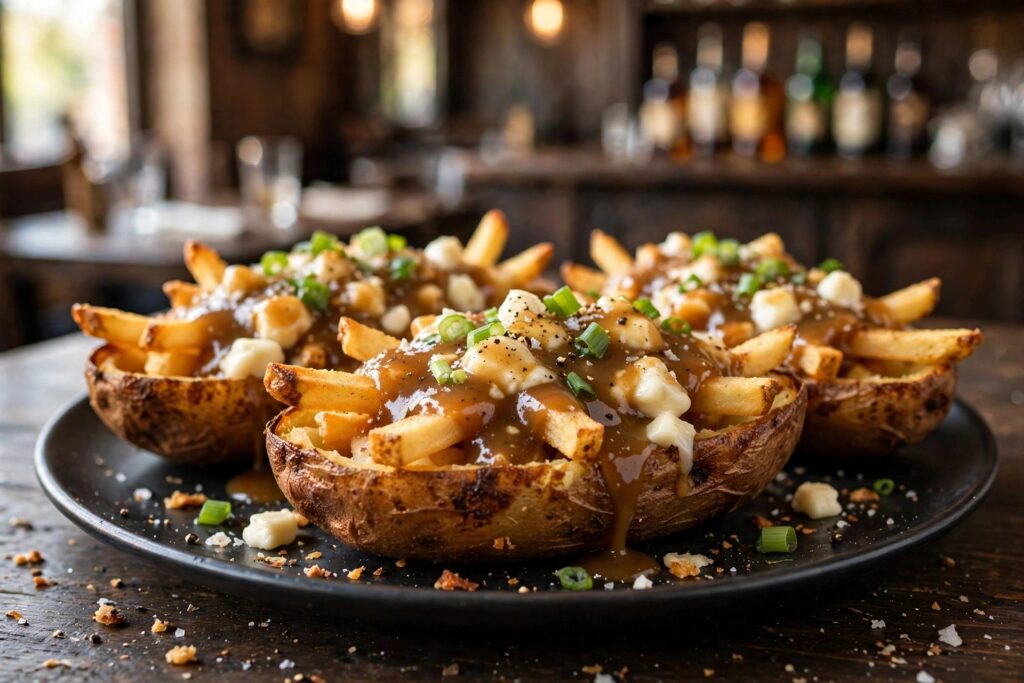
Some mashups feel forced, like two foods shoved together because somebody ran out of ideas. Poutine potato skins are not one of those. This one makes sense the moment you hear it, because both halves of the combination are already doing the same job: turning a humble potato into something you cannot stop eating. Poutine brings the gravy and the cheese curds. Potato skins bring the crispy boat and the excuse to eat the whole thing with your hands. Put them together and you get a bar snack that solves poutine’s one real problem, which is that a plate of fries and gravy is a glorious mess that does not travel well, and a loaded potato skin is a glorious mess with handles.
The idea is simple enough that you wonder why it took so long to become a thing. Bake potatoes until the skins crisp. Scoop them out, crisp them again, and then load them with everything that makes poutine what it is: hot brown gravy, fresh cheese curds that go half-melty and squeaky, and a handful of crispy fries tucked inside for good measure.
First, a Quick Word About Real Poutine
Poutine was born in rural Quebec in the late 1950s, and like most beloved dishes, several towns claim to have invented it. The most told version credits Fernand Lachance of Le Lutin qui rit in Warwick, Quebec, who in 1957 tossed cheese curds into a bag of fries at a customer’s request and supposedly declared it would make a damn mess. The word poutine itself comes from Quebec slang for a mess, which tells you the dish never pretended to be elegant. Gravy joined the party a few years later: Jean-Paul Roy of Le Roy Jucep in Drummondville began serving the full three-part combination in 1964, fries plus curds plus gravy, and the dish as we know it was set.
From there it spread across Quebec in the 1970s and 1980s, rode into the rest of Canada on diner and fast-food menus, and eventually crossed borders the way all great comfort food does. Along the way it picked up endless variations, but the purists have always held one line: real poutine needs real cheese curds.
Why the Skin Makes It Better
Traditional poutine has a structural weakness, and anyone who has ordered it to go knows exactly what it is. Fries go soft under gravy. That is part of the charm when you are eating it fresh with a fork, racing the clock before the whole plate turns to mush. But give it ten minutes in a takeout box and the bottom layer is gone, a sad, soggy layer nobody fights over.
A potato skin fixes that by giving the poutine a foundation that can take the gravy and keep standing. A well-crisped skin stays sturdy under a ladle of hot gravy in a way a fry never could. It also gives you something to hold. Poutine is a fork food; potato skins are finger food. That single change moves the dish from the dinner table to the bar table, from a plate you guard to a platter you share. And sharing is the whole point of bar food. Nobody orders a plate of skins for one person, at least not honestly.
There is also the potato-on-potato question, which deserves an honest answer. Yes, putting fries inside a potato skin is doubling down on the same ingredient. It works because the textures are different: the skin is crisp and sturdy, the fries are golden and light, the curds are soft and squeaky, and the gravy ties it all together.
Building Them at Home
Start with four large russet potatoes. Russets are the right call here because their skins crisp up well and their flesh scoops out cleanly, leaving a sturdy shell. Scrub them, prick them a few times with a fork, rub them with a little oil and salt, and bake at 400 degrees for about an hour, until the skins are crisp and the insides give easily when squeezed. Let them cool for at least fifteen minutes. Trying to scoop a just-baked potato is how you end up with a torn skin and a burned hand, and patience here pays off in a shell that actually holds together.
Cut each potato in half lengthwise and scoop out most of the flesh with a spoon, leaving about a quarter inch attached to the skin. Do not scoop too aggressively. A skin with nothing behind it collapses under the broiler and will not hold a filling. Brush the shells inside and out with melted butter, season with salt and pepper, and slide them under a hot broiler for a few minutes until the insides start to crisp and color. Watch them closely. The line between crisp and burnt under a broiler is about ninety seconds.
While the skins crisp, make the gravy. A simple brown gravy does the job: melt butter, whisk in flour to make a roux, cook it for a minute or two until it smells nutty, then whisk in beef stock, a splash of Worcestershire sauce, and plenty of black pepper. Let it simmer until it coats the back of a spoon but still pours easily. It should be thinner than a Thanksgiving gravy. Thick, pasty gravy sits on top of the curds instead of seeping around them, and the whole point is that hot, thin gravy doing the work of softening the curds without drowning the skin.
Now assemble, and do it right before serving, not twenty minutes ahead. Tuck a small handful of crispy fries into each skin first. You can use leftover fries, frozen fries crisped in the oven, or a quick batch from your air fryer. Scatter a generous handful of fresh white cheese curds over the fries, then ladle the hot gravy over the top, just enough to start melting the curds at the edges. Finish with sliced scallions or chives. That green on top is not decoration for its own sake: the fresh, sharp bite cuts through all that richness and keeps the third skin from tasting like the first two.
Variations Worth Trying
The classic version is hard to beat, but the format invites tinkering, and some of the riffs are genuinely good. Crispy bacon crumbled over the top adds smoke and salt and makes the whole thing taste even more like bar food, which is never a bad direction. A spoonful of caramelized onions tucked under the curds adds sweetness that plays nicely against the salty gravy. And if you want heat, a drizzle of hot sauce or a few pickled jalapeño slices on top wakes the whole plate up without fighting the gravy.
One version worth knowing about swaps in a spicier, more loaded filling, with seasoned ground meat and an Asian-inspired sauce alongside the curds, for people who want their poutine skins to lean fusion rather than traditional. It is not classic poutine, and nobody should pretend it is. But it shows how sturdy the format is: once you have a crisp skin and a hot sauce, the filling can wander pretty far and the snack still works.
The one variation to skip, at least if you care about the name, is swapping the curds for shredded cheese. It melts flat, it loses the squeak, and it turns the dish into something you already know. If you cannot find fresh curds near you, diced low-moisture mozzarella is the closest stand-in, and it is a fair compromise.
Why This Mashup Earns Its Place
Bar food works when it understands the room it is served in. People are standing, or perched on stools, holding drinks, talking over each other, and reaching for a shared plate without looking down. Poutine potato skins understand that room. They are sturdy enough to pick up, saucy enough to feel indulgent, and structured enough that the last one on the plate is almost as good as the first. They also give a kitchen a way to serve a Canadian classic to a crowd that might never order a full plate of poutine on its own, which is how regional dishes travel: not as museum pieces, but as snacks that meet people where they already are.
They sit naturally in a spread built for a crowd, too. Pair them with the fried pickles and mozzarella sticks from our fried pickles and mozzarella sticks guides, or set them out alongside the trio in our pub food triple play, and you have a table that covers crispy, cheesy, and saucy without repeating itself. That is the test of a good mashup: it does not just combine two dishes, it earns a spot the originals did not already fill. Poutine potato skins pass that test. Make a batch, keep the gravy hot, and watch how fast the platter empties.