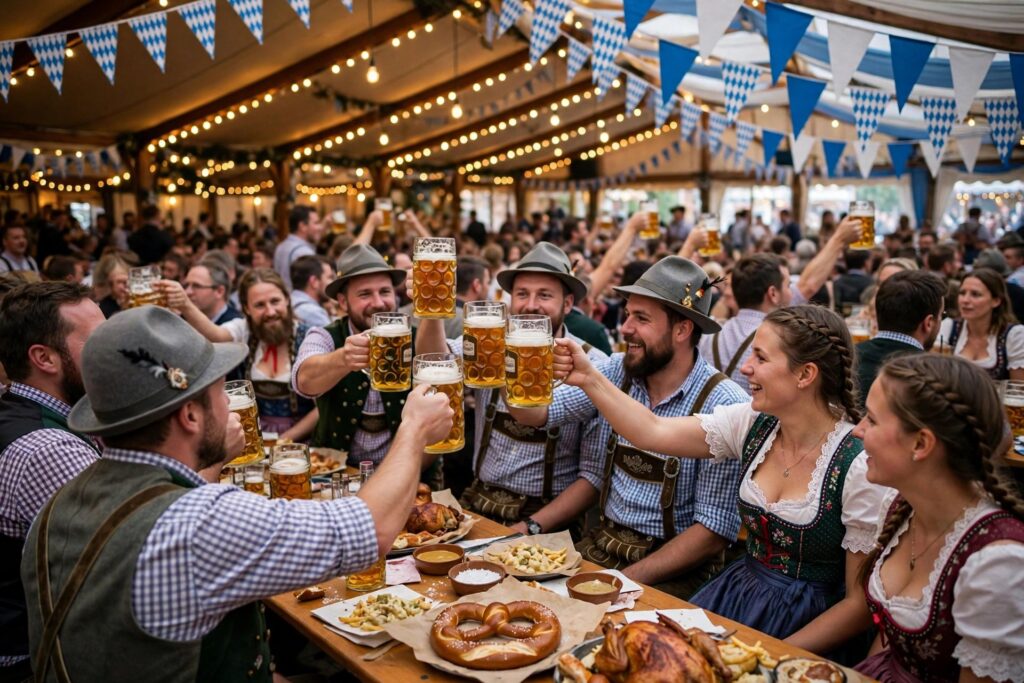
There are beer festivals, and then there is Oktoberfest. Six million people, sixteen days, a fairground in the middle of Munich, and beer served by the litre in tents the size of airplane hangars. It is the largest folk festival on earth, it has been running since 1810, and it is the kind of trip people plan for years and then still manage to get wrong on day one.
Most first-timers get it wrong in the same ways: they arrive at noon on a Saturday, they try to order beer without a seat, they drink a litre on an empty stomach, and they spend the rest of the day wondering why the ground is tilting. All of it is avoidable. Here is the guide we wish someone had handed us before our first Wiesn.
When to go, and how to get in
Oktoberfest runs for sixteen days, opening on the third Saturday in September and closing on the first Sunday in October — which means most of it actually happens in September, despite the name. The 2026 edition ran from Saturday, September 19 to Sunday, October 4, on the Theresienwiese, the big meadow Munich locals call the Wiesn. Dates shift slightly each year, so check the current year’s calendar before booking anything.
Entry to the grounds and the tents is free. You pay only for what you eat and drink. That sounds generous until you discover the catch: on busy evenings and weekends, tents close their doors once they are full, and a full tent stays full. The single best move a first-timer can make is to arrive early — weekday mornings are the sweet spot — and to treat weekends as a different, louder, much more crowded animal. The opening weekend and the first Sunday, when the traditional costume and riflemen’s parade winds through the city, are the busiest days of the whole festival.
Getting there is easy, and driving is not worth it. From Munich Central Station it is one stop on the U4 or U5 underground lines to Theresienwiese station, or about a fifteen-minute walk. There are no visitor car parks at the grounds and many surrounding streets close during the festival, so leave the car at a park-and-ride on the edge of the city. If the trains are packed, walking is often quicker anyway.
Pick your tent before you go
There are fourteen large tents and twenty-one smaller ones, plus three more over on the Oide Wiesn, the traditional, quieter part of the fair. Each has its own character, and picking one in advance saves you from wandering the grounds overwhelmed while everyone else is already seated with a litre in hand.
For a relaxed daytime start, the Augustiner-Festhalle is the classic recommendation — rustic, traditional, and pouring beer from Augustiner, Munich’s oldest brewery. The Marstall is a good bet for families. If you want the full-throttle party, the Hofbräu-Festzelt draws the biggest international crowd and stays loud late. The Schottenhamel is where Munich’s mayor taps the first keg to open the festival at noon on the first Saturday, which makes it a popular stop for tradition-minded visitors.
You do not need a reservation to get in, but a guaranteed table on a busy evening is a different story. Reservations are usually free but come with prepaid food and drink vouchers, and for a larger group they are worth arranging directly with the tent well in advance.
What a day actually costs
Beer at Oktoberfest comes by the Maß, a full litre, poured from one of Munich’s six traditional breweries: Augustiner, Hacker-Pschorr, Löwenbräu, Paulaner, Spaten, and Hofbräu. In 2025 a Maß cost between €14.50 and €15.80, and prices creep up most years, so budget a little above whatever last year’s figure was. A roast half-chicken, the Hendl, costs roughly the same as a beer. Add a giant soft pretzel, maybe a pork knuckle to share, and a ride or two on the fairground, and a full day comfortably reaches €60 to €80 per person before accommodation.
Carry cash. Card acceptance has improved, but many food stalls and smaller tents still prefer cash, and nothing ruins a moment like standing three metres from a pretzel with an empty wallet. Rounding up for your server is the local way of tipping — they carry an astonishing number of litres at once and they remember who treats them well.
Dress the part (but dress for walking)
Traditional Bavarian dress is welcomed, not required. Plenty of visitors come in jeans and have a wonderful time. But a dirndl or lederhosen genuinely adds to the day, and both are easy to buy or rent in Munich. If you go for it, one detail is worth knowing: on a dirndl, the apron bow sends a signal. Tied on the left it traditionally means single, on the right it means taken — a bit of folklore that still gets talked about in the tents.
Whatever you wear, wear comfortable, closed shoes. The grounds are gravel, you will stand for hours, and the tents get crowded enough that open-toed shoes are a regret waiting to happen. Layers matter too: late September in Munich is usually mild by day, but evenings in a tent doorway turn chilly, and rain is always possible. A light waterproof jacket earns its keep.
Tent manners that keep you welcome
The unwritten rules are simple and they matter. You order beer only once you have a seat — servers do not serve wanderers. Wait for the first toast, a hearty “Prost!”, before you drink, and clink glasses at the base of the Maß rather than the rim, so nothing shatters. Dancing on the benches is welcome; standing on the tables is not. Every fifteen minutes or so the band strikes up “Ein Prosit,” the whole tent stands, sings, and drinks together — join in, even if you fake the words. Enthusiasm counts for more than pronunciation.
Two practical habits save more trips than any other advice. First, agree on a meeting point with your group before you split up, because a dead phone in a crowd of thousands is a certainty, not a risk. Second, keep your belongings close — crowds this size attract pickpockets, and a small crossbody bag beats a backpack, which in any case faces bag checks and size limits at the entrances.
Pace yourself like a local
This is the one that gets people. A Maß is a full litre of beer at around six percent alcohol — roughly three regular beers in a single mug. The classic rookie mistake is treating it like one drink. Veterans stick to about one stein per hour at most, and they treat the radler — beer mixed with lemon soda — as a secret weapon: it keeps you in the tent, glass in hand, at half the strength.
Eat before you drink, and keep eating. A Maß on an empty stomach after a morning of sightseeing is how afternoons end early. The food is half the festival anyway: roast chicken, pork knuckle, grilled fish on a stick, and the giant pretzels that have been beer’s best friend since monks were baking them centuries ago. Alternate beer with water, and plan your way home before the evening really gets going — never drive, and sort out the train or the walk while you can still think clearly.
Beyond the beer
It is easy to forget that Oktoberfest is a fairground as much as a beer festival. The rides are serious — the Olympia Looping, a five-loop roller coaster, is billed as the world’s largest traveling coaster — and the food stalls, the roasted almonds, the carnival games, and the Oide Wiesn’s old-fashioned rides and brass bands are worth an afternoon of their own. Tuesdays are family days, with reduced ride prices until early evening, and they are also one of the calmer times to bring kids.
And if Munich is not on this year’s calendar, the Wiesn spirit travels well. A home Oktoberfest night — a few good lagers, a roast chicken, a pile of pretzels, and a spread of dips worth your chips for the table — captures more of the real thing than you might expect. The tents are enormous, but the idea at the heart of them is small: long tables, shared food, and strangers who feel like old friends by the end of the night. Get the basics right — arrive early, eat first, pace yourself, know the toasts — and the festival takes care of the rest. Prost.