Most people think of beer as the drink that goes with dinner. Fewer think of it as an ingredient in dinner, which is a shame, because beer might be the hardest-working bottle in the kitchen. It brings malt sweetness, a little bitterness, yeast character, and carbonation that can lighten a batter in a way water never will. Wine gets all the cooking glory. Beer quietly does at least as much, and in some dishes it does more.
The trick is knowing which beer belongs in which pot. The rule of thumb is the same one that applies to wine: cook with a beer you’d happily drink. If it tastes thin, stale, or harsh from the glass, it won’t improve in the pan. Beyond that, match the beer to the job. Light lagers and wheat beers are your all-purpose players. Malty ambers and browns bring depth to braises and sauces. Big, bitter IPAs are the ones to be careful with — hop bitterness concentrates as liquid reduces, so a beer that tastes pleasantly bitter in the glass can turn aggressively bitter in a sauce that’s been simmering for an hour.
Dish One: Beer Cheese Soup
Beer cheese soup is the dish that converts skeptics. It’s a tavern classic for a reason: sharp cheddar, a little mustard, onions and garlic softened in butter, and a malty beer tying the whole pot together. A brown ale or a malty amber is the right call here — it adds a toasty, caramel depth that a light lager can’t, without the hop bite that would fight the cheese.
The technique matters more than the recipe. Keep the heat gentle once the cheese goes in, because high heat makes cheese seize and turn grainy. Add the cheese a handful at a time, stirring until each addition melts before the next goes in. And here’s a detail that saves many a pot: stir the beer in and let it simmer a few minutes before the cheese arrives, so the raw, yeasty edge cooks off and the malt flavor settles in. Serve it with crusty bread or soft pretzels, and if you’re feeling indulgent, a bowl of it next to a properly over-the-top grilled cheese is one of the great cold-weather lunches.
Dish Two: Beer Batter for Fish and Onion Rings
This is beer’s most famous kitchen job, and it’s famous because the science is on its side. A batter made with beer fries up lighter and crisper than one made with water or milk, for two reasons. First, the carbonation creates tiny bubbles that expand in the hot oil, giving the crust a delicate, lacy texture. Second, beer’s alcohol evaporates faster than water, so the crust dries out and sets more quickly instead of steaming itself soggy.
A light lager or pilsner is the classic choice, and it stays classic because it works — clean flavor, plenty of fizz, nothing to get in the way of the fish. Keep the batter cold and don’t overmix it; a few lumps are fine, and overworking the flour develops gluten that makes the coating tough instead of crisp. Dip, fry at around 350 to 375 degrees, and don’t crowd the pot, which drops the oil temperature and turns crisp into greasy. The same batter does beautiful work on onion rings, and a pile of them next to a cold pint is hard to argue with.
Dish Three: Carbonnade Flamande, the Flemish Beef and Beer Stew
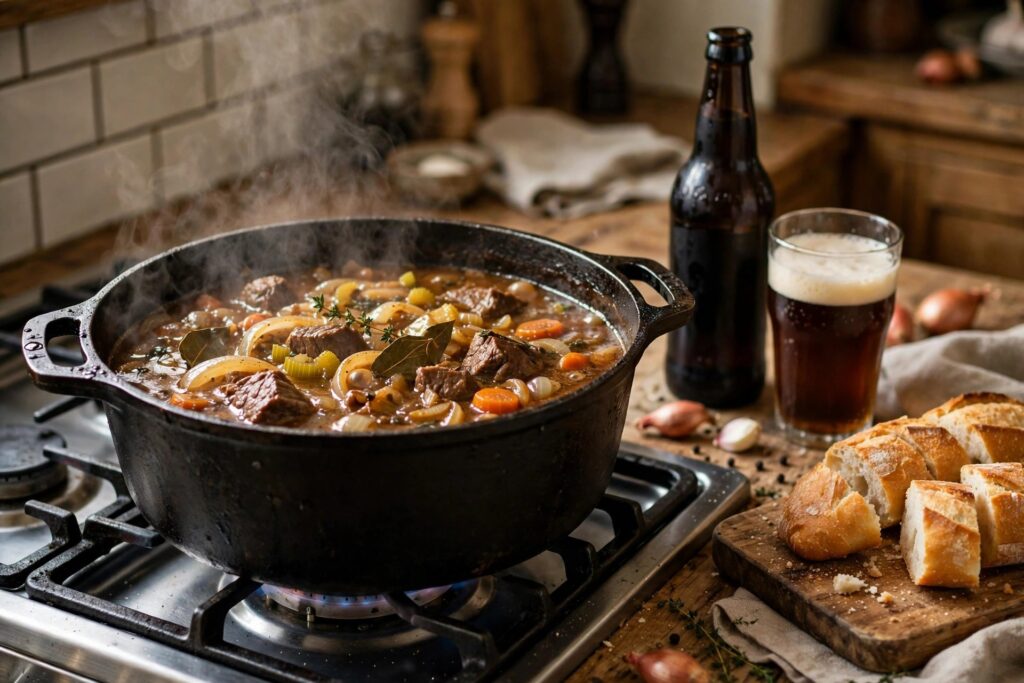
If beer cheese soup is the quick convert and beer batter is the party trick, carbonnade flamande is the main event. This is the Flemish beef stew — beef and onions braised low and slow in dark Belgian ale — that has been feeding people in Belgium and northern France for generations. It’s the dish that proves beer isn’t just an ingredient; it’s the backbone of an entire cuisine.
The method is simple and forgiving. Brown chunks of beef chuck well, because that browning is where most of the flavor comes from. Cook sliced onions down until they’re soft, sweet, and deeply caramelized — this takes longer than you think, often half an hour, and it’s worth every minute. Then pour in a dark Belgian-style ale, add stock, a spoonful of mustard, a pinch of brown sugar, thyme and bay, and let the pot go low and slow for about two hours until the beef surrenders. Traditionally it’s served with fries or mashed potatoes, and with a glass of the same ale you cooked with.
Choose the beer carefully here. A Belgian dubbel or a dark, malty ale is the traditional pick, and the reason is that its malt sweetness balances the onions and the slight tang of the mustard and vinegar. A very hoppy beer will turn bitter over a two-hour simmer, and a light lager will disappear into the pot and contribute almost nothing. This is the dish where spending a little more on the beer pays you back directly.
The Question Everyone Asks: Does the Alcohol Cook Out?
Short answer: not completely. This is one of cooking’s most persistent myths, and the numbers behind it are worth knowing. Research funded by the U.S. Department of Agriculture found that how much alcohol remains depends on time and method. A dish baked or simmered for 15 minutes retains roughly 40 percent of its original alcohol; after an hour, about 25 percent; and even after two and a half hours of simmering, around 5 percent is still there. A sauce that’s just brought to a boil and pulled off the heat can keep as much as 85 percent, and flambéed dishes keep roughly 75 percent despite the dramatic flames.
In practice, that doesn’t make a beer-braised stew a problem for most adults — the absolute amount of alcohol in a serving is small, since a whole pot might contain a single bottle spread across six servings. But it does matter for people who avoid alcohol entirely, whether for health, pregnancy, or personal reasons, and it’s worth being honest about rather than waving it away with “it all cooks off.” It doesn’t. Say so, and let people decide for themselves.
Putting It on the Table
The beauty of cooking with beer is that dinner and drinks stop being two separate shopping lists. Buy an extra bottle of whatever you’re cooking with, and the pairing takes care of itself — the beer in the pot and the beer in the glass were made for each other, literally. A brown ale in the cheese soup and a brown ale beside it. A dubbel in the carbonnade and a dubbel with it. A cold lager for the batter and a cold lager for the cook, which, tradition holds, is the most important pairing of all.
Start with one of these three dishes. Beer cheese soup if you want something fast and forgiving, beer batter if you’ve got a fryer and a Friday night, carbonnade if you’ve got an afternoon and a Dutch oven. Each one teaches you something different about what beer can do in a kitchen, and by the third, you’ll be the person at the table who reaches for the beer aisle before the wine rack — and you’ll have the dinner to prove it was the right call.