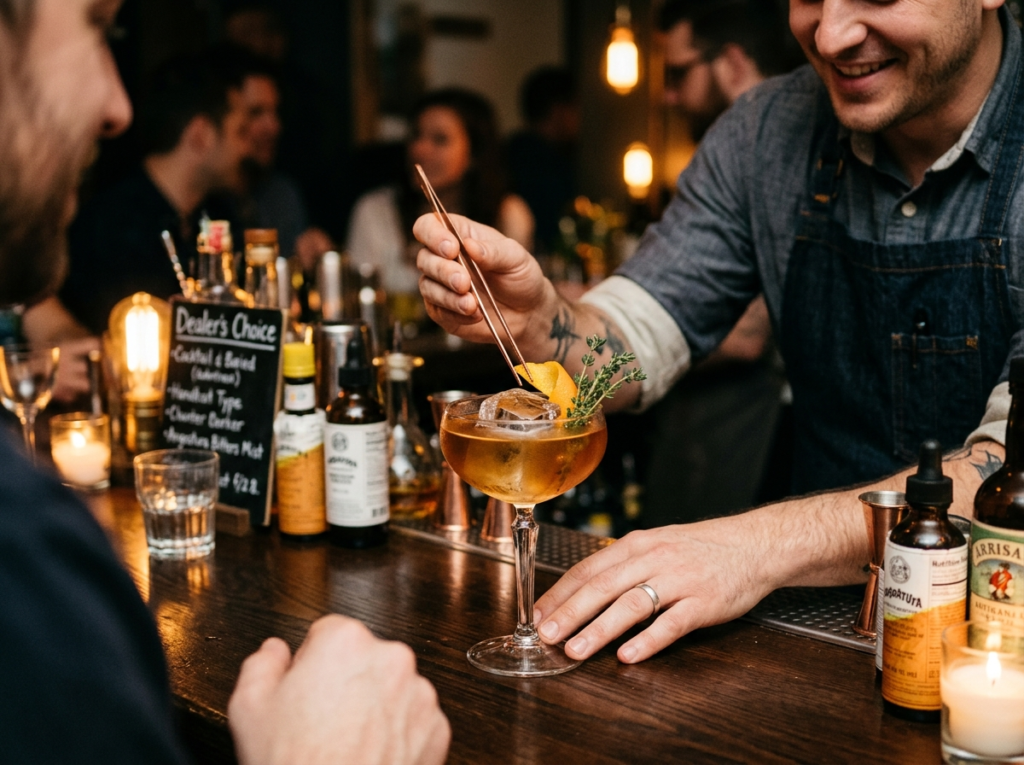
You sit down at a bar. The bartender walks over. And instead of handing you a menu, they ask you one simple question: “What are you feeling tonight?”
You say something like, “I don’t know — something spirit-forward, maybe a little bitter.” And then they disappear for two minutes, shake or stir something, and slide a glass in front of you that you’ve never had before but somehow tastes exactly right.
That’s a dealer’s choice cocktail. And if you’ve never experienced one, you’re missing out on one of the most genuinely fun things a bar can offer.
What “Dealer’s Choice” Actually Means
The phrase comes from poker. In a dealer’s choice poker game, the dealer gets to pick which variant of the game is played for that hand. It’s their call. Their creative moment.
Bars borrowed the concept — and it fits perfectly. A dealer’s choice cocktail means you hand the reins over to the bartender. You give them a few cues about what you’re in the mood for, and they build something original for you. No recipe card. No menu item. Just craft, instinct, and experience.
It’s the opposite of walking in and ordering a gin and tonic off the top of your head. It’s also the opposite of spending 20 minutes staring at a menu, paralyzed by options.
The best bartenders genuinely love this format. It gives them creative freedom in a job that, on busy Saturday nights, can feel very repetitive. Dealer’s choice is their chance to actually cook, so to speak.
The Conversation Is Half the Experience
Here’s what most people get wrong about dealer’s choice: they think it means saying “surprise me” and then going quiet. That’s not really how it works — at least not at bars where the bartenders take this seriously.
The best dealer’s choice interactions feel like a short conversation. The bartender is essentially interviewing your palate. They might ask:
- Do you want something boozy or lighter?
- Citrusy and bright, or dark and warming?
- Any spirits you love or absolutely hate?
- Bitter, sweet, sour — what direction sounds good tonight?
You don’t need to answer these like a cocktail expert. “I usually drink bourbon, but I’m open to something new” is a perfectly good starting point. “I had an Aperol Spritz last time and I loved it but I want something different” tells a bartender a lot.
Think of it like telling a chef at an omakase counter that you don’t eat shellfish but you’re open to everything else. You’re giving creative constraints, not writing the menu yourself.
Pro tip: Don’t be afraid to say “I trust you.” At bars that genuinely offer dealer’s choice, those words are a green light for the bartender to do something they’re actually proud of.
Where Dealer’s Choice Thrives (and Where It Falls Flat)
Not every bar is the right place for this. Let’s be real about that.
At a sports bar or a packed weekend spot where the bartender is making 12 drinks at once, asking for a dealer’s choice cocktail is going to go poorly — for both of you. That’s not a knock on those bars. It’s just a different environment.
Dealer’s choice works best at craft cocktail bars, places where the bartender has a deep spirits inventory to pull from, understands flavor profiles, and actually has time to think. These tend to be smaller, quieter spots — the kind of place where the bar program is built around creativity, not volume.
Speakeasies and tasting menus bars are another natural home for this. Some of them don’t even offer a traditional menu — dealer’s choice is just how they operate. You come in, sit down, have a chat, and the whole experience is curated around what you’re feeling that night.
If you’re into food experiences that feel personal and tailored — the kind where someone is genuinely trying to match something to your taste — dealer’s choice cocktails scratch that same itch. It’s the same reason people love a good omakase or a meal at a place where the chef is sending things out based on instinct rather than a fixed menu.
The Skills Behind the Glass
When a bartender does this well, there’s a lot happening that you don’t see. It’s not random. They’re pulling from a pretty deep mental library of technique, flavor theory, and knowledge of what’s in stock behind the bar.
Flavor Mapping
Good bartenders think in flavor families. Citrus-forward, herbal, funky, smoky, bitter, warming — these are the broad categories, and most classic cocktails live clearly in one or two of them. When you say “something refreshing,” they’re already triangulating toward a certain spirit, a certain sweetener, and a certain acid source.
Understanding the relationship between acid and fat — or in this case, acid and sweetness — is foundational to cocktail building, the same way it’s foundational to cooking. A drink that’s unbalanced hits wrong, even if you can’t explain why.
Spirit Knowledge
A bartender doing dealer’s choice needs to know their spirits deeply — not just the well-known bottles, but the interesting ones. That amaro from Lombardy that tastes like eucalyptus and orange peel. The aged rhum agricole that bridges the gap between whiskey and rum. The sherry that works beautifully in a stirred cocktail when you’d normally reach for vermouth.
The more unusual the back bar, the more interesting the dealer’s choice options get.
Reading the Room
This one is less technical but just as important. A great bartender notices things — whether you’re on a date, catching up with an old friend, or sitting alone with a book. The drink they build for you might reflect that context more than you’d expect. A dealer’s choice cocktail at 6pm on a Thursday is going to feel different from one at midnight on a Saturday, and a good bartender knows that.
Building Your Own Dealer’s Choice at Home
You don’t need a bar to practice this. Hosting friends? Make dealer’s choice part of the experience.
Ask your guests to describe what they want in loose terms — not a specific cocktail, just a feeling or a flavor direction. Then build something on the spot. It sounds intimidating, but it’s more fun than you’d think, and the pressure is much lower at home than behind a professional bar.
A few structural rules that most classic cocktails follow can guide you:
The 2:1:1 template — two parts spirit, one part sweetener, one part acid — is behind a huge number of drinks. The Daiquiri, the Margarita, the Gimlet. Change the spirit, change the citrus, change the syrup, and you get an infinite number of variations.
Stirred vs. shaken — citrus and egg whites get shaken; spirit-forward drinks generally get stirred. That’s not a law, but it’s a reliable starting point.
Ice matters more than people think. A large, clear ice cube melts slowly and keeps a spirit-forward drink cold without diluting it too fast. Crushed ice is great for high-volume tiki-style drinks. It’s one of those details that separates a good home cocktail from a great one — similar to how the right glass changes the wine experience more than most people expect.
Quick Fact: The classic Daiquiri — rum, lime, sugar — has spawned more dealer’s choice variations than almost any other template. It’s the bartender’s blank canvas.
The Classics That Inspire Dealer’s Choice Thinking
You’d be surprised how many famous cocktails started as someone’s dealer’s choice moment — a bartender improvising for a guest, creating something new with what was on hand.
The Last Word — equal parts gin, green Chartreuse, maraschino, and lime — originated at the Detroit Athletic Club in the 1920s. It’s now a classic, but at the time it was just a bartender being creative.
The Penicillin — blended Scotch, lemon, honey-ginger syrup, with a float of Islay Scotch — was created by Sam Ross at Milk & Honey in New York in the early 2000s. One cocktail. Now served at bars worldwide.
The Paper Plane — equal parts bourbon, Aperol, Amaro Nonino, and lemon — came from Sasha Petraske and his collaborators in New York. Another equal-parts riff that became its own classic.
All of these drinks show what happens when a bartender has creative freedom and a well-stocked bar. That’s dealer’s choice at its best — and the same spirit of experimentation continues in cocktail bars around the world today.
What to Do If the Drink Isn’t Right
Here’s something worth knowing: if the bartender makes you something and it’s not quite what you wanted, you can say so. At any bar that takes dealer’s choice seriously, they expect this. It’s part of the conversation.
You’re not being difficult. You’re giving them feedback. “This is great, but a bit too sweet for me” is useful information. They’ll adjust. They might make you something entirely different. That’s the deal.
The only thing that makes a dealer’s choice experience uncomfortable is treating it like a one-shot transaction. It’s not. It’s a dialogue.
This is honestly one of the things that makes it so different from just ordering off a menu. A menu is a contract. Dealer’s choice is a conversation.
FAQ
What does “dealer’s choice” mean at a cocktail bar?
Dealer’s choice is when a guest asks the bartender to make them a drink of the bartender’s choosing, usually based on a few general preferences shared by the guest — things like preferred spirit, flavor direction (bitter, sweet, citrusy), or mood. The bartender uses those cues to build an original cocktail rather than following a set recipe from the menu.
Do I need to know a lot about cocktails to order dealer’s choice?
Not at all. The whole point is that the bartender handles the knowledge. You just need to describe what you’re in the mood for in general terms — something light and refreshing, something warming, something complex. Even saying “I usually drink wine and I want to try something new” gives a skilled bartender plenty to work with.
Is dealer’s choice always more expensive than ordering a regular cocktail?
It depends on the bar. Some bars charge a standard cocktail price regardless of what goes into the drink. Others — especially those using premium or rare spirits — may charge more. It’s always fine to ask upfront. A good bartender will let you know if they have something in mind that’s on the pricier end before they start mixing.
The next time you sit down at a bar that clearly takes its craft seriously — the kind with a thoughtful back bar and a bartender who lights up when you ask them about the amaro selection — try it. Skip the menu. Tell them what you’re feeling. See what lands in front of you.
It might be the most memorable drink you have all year, and you won’t even be able to order it again. That’s the whole point.