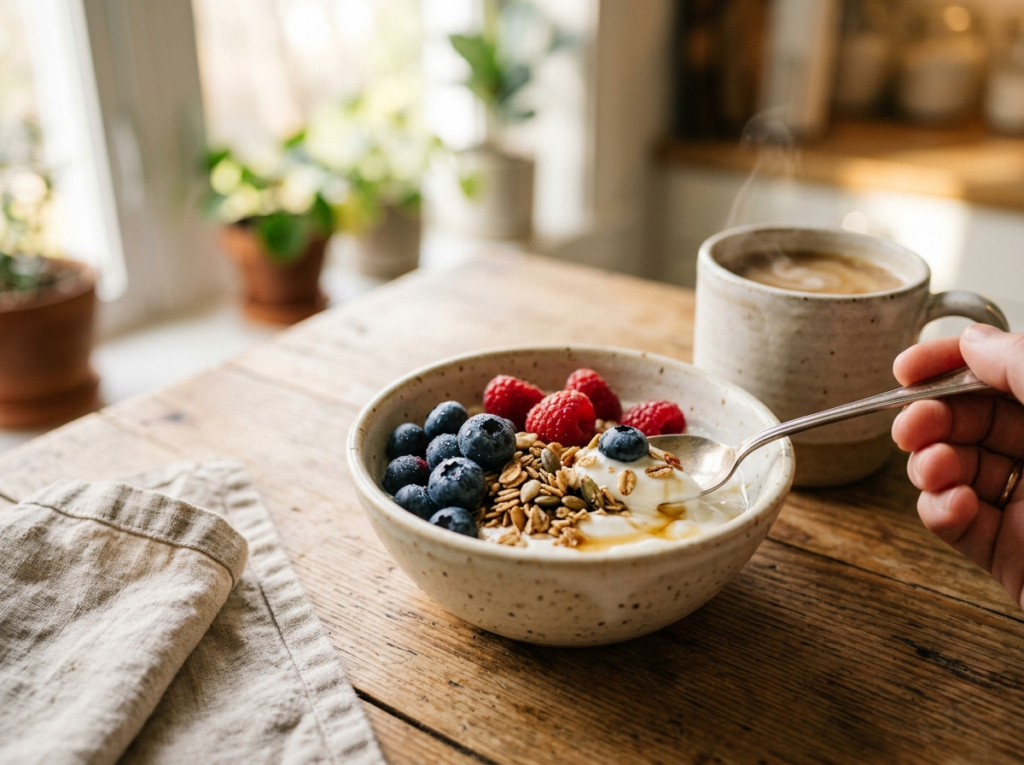
A 2023 survey by the International Food Information Council found that nearly 40% of Americans skip breakfast at least a few times a week — and the top reason isn’t lack of hunger. It’s lack of time and energy. Somewhere along the way, breakfast became this enormous production. Pinterest-perfect açaí bowls. Elaborate egg skillets. Homemade granola with seven kinds of seeds. And if you can’t pull that off at 7 a.m.? You just skip it entirely.
Here’s the thing — breakfast doesn’t have to be a project. It doesn’t need to stress you out, drain your morning, or require a recipe. You can eat well in the morning without turning your kitchen into a restaurant line. And honestly? Once you stop treating breakfast like an obligation and start treating it like fuel that happens to taste good, your whole morning changes.
Let’s talk about why breakfast feels so heavy — and how to lighten the load.
Why Does Breakfast Feel Like Such a Burden?
Think about lunch or dinner for a second. If you threw together a sandwich or reheated leftovers, you wouldn’t feel guilty about it. Nobody posts their Tuesday lunch on social media expecting applause. But breakfast? Breakfast carries this weird cultural weight, like it has to be special or it doesn’t count.
Part of this comes from the old “most important meal of the day” messaging — a phrase that, by the way, was heavily popularized by cereal companies in the early 1900s. Grape-Nuts ran ad campaigns in 1917 literally telling people that skipping breakfast was bad for their health. That marketing stuck, and it evolved into this idea that breakfast must be nutritious, substantial, and carefully prepared.
Then social media turned up the volume. Suddenly your scrambled eggs on toast looked sad compared to someone’s fluffy Japanese soufflé pancakes with hand-whipped cream and edible flowers. The bar kept rising, and the result is a generation of people who feel like they’re either doing breakfast “right” or failing.
The truth? Most professional chefs — the people who cook for a living — eat remarkably simple breakfasts at home. Toast with butter. A piece of fruit. Yogurt straight from the container. They don’t overcomplicate it because they understand something the rest of us forget: not every meal needs to be an event.
The Real Role of Breakfast (No Pressure)
Let’s clear something up. Breakfast matters, but not in the way you’ve probably been told.
Your body wakes up after several hours without food. Blood sugar is low. Your brain needs glucose to get going. Eating something — truly, almost anything reasonable — gives your body what it needs to start functioning well. That’s it. That’s the job description of breakfast.
You don’t need a perfectly balanced macro plate. You don’t need to hit some magical protein-to-carb ratio at 6:45 a.m. A banana and some peanut butter works. A handful of nuts and a glass of milk works. Last night’s leftover rice with a fried egg on top? That works beautifully.
Dr. David Ludwig, a nutrition researcher at Harvard Medical School, has pointed out repeatedly that what you eat matters more than following rigid meal templates. If your breakfast keeps you satisfied until your next meal and doesn’t make you crash by 10 a.m., you’re doing just fine.
The pressure to make breakfast elaborate is cultural, not nutritional. And once you separate those two things, mornings get a lot easier.
What a “Good Enough” Breakfast Actually Looks Like
This isn’t about lowering your standards. It’s about adjusting your expectations to match reality. You’re not a line cook. You’re a person with a job, maybe kids, probably a phone buzzing with notifications before your feet even hit the floor.
A “good enough” breakfast does three things: it gives you energy, it takes minimal effort, and it doesn’t leave you feeling deprived. That’s the whole checklist.
Some mornings, that’s a bowl of oatmeal you made in the microwave in three minutes. Other mornings, it’s a couple of hard-boiled eggs you prepped on Sunday. And some mornings — honestly — it’s a slice of really good bread with butter and a cup of coffee. If the bread is quality and the butter is real, that’s a perfectly respectable breakfast in most of Europe. The French have been doing it for centuries, and they seem to be doing okay.
If you’ve ever enjoyed breakfast in Mexico City’s Roma Norte, you know that some of the best morning meals are the simplest ones — fresh fruit, a warm tortilla, maybe some beans. Nothing fussy. Nothing Instagram-worthy. Just good food eaten without stress.
The point is this: stop measuring your breakfast against a standard that was designed to sell you products or get you to click on content. Measure it against your own life.
Practical Morning Strategies That Actually Work
Okay, so you’re on board with simpler breakfasts. But how do you actually make mornings less chaotic? Let’s get specific.
Prep When You’re Not Rushed
The worst time to think about breakfast is the morning. Your brain is foggy, you’re running late, and every decision feels ten times harder than it should. So don’t make decisions in the morning — make them the night before, or even on the weekend.
Spend 20 minutes on Sunday doing a few small things. Boil a dozen eggs. Wash and cut some fruit. Make a batch of overnight oats in jars. Portion out some nuts and dried fruit into small bags. None of this is cooking. It’s just… organizing. And it makes a dramatic difference. A well-organized kitchen, even a small one, can make morning meals feel almost effortless.
Embrace Repeats
Here’s a secret that productive people rarely talk about openly: most of them eat the same breakfast almost every day. Not because they lack imagination, but because decision fatigue is real. When you remove the daily “what should I eat?” question, you free up mental energy for things that actually matter.
Pick two or three breakfasts you genuinely enjoy. Rotate them throughout the week. That’s your system. You don’t need seven different breakfast recipes for seven different mornings.
Rethink What Counts as “Breakfast Food”
This is a big one. The idea that breakfast must involve eggs, cereal, pancakes, or toast is entirely arbitrary. It’s a Western convention, and even within Western culture, it varies wildly by country.
In Japan, breakfast often includes miso soup, rice, and grilled fish. In many parts of India, it’s savory lentil dishes or stuffed flatbreads. In Colombia, you might start your day with arepas and avocado.
So if you want last night’s soup for breakfast? Go ahead. If a piece of grilled chicken with some greens sounds good at 8 a.m.? Eat it. If you genuinely enjoy a simple consommé in the morning because it’s warm and comforting and light, that’s a perfectly valid breakfast.
The “rules” about breakfast food are made up. You’re allowed to break them.
The Overnight Oats Phenomenon — And Why It Took Off
There’s a reason overnight oats became one of the most popular breakfast trends of the last decade. It’s not because they’re particularly exciting. It’s because they solve the exact problem we’re talking about.
You spend two minutes the night before mixing oats with milk or yogurt in a jar. You add whatever you want — fruit, honey, cinnamon, chia seeds. You put it in the fridge. You go to sleep. In the morning, breakfast is already done. You grab the jar and eat.
No cooking. No decisions. No cleanup beyond rinsing a jar.
This is the template you want to follow, even if overnight oats aren’t your thing. The principle is simple: move the work away from the morning. Any breakfast you can assemble in advance — muffins you baked on the weekend, a frittata you can slice and reheat, pre-made smoothie packs you just blend — follows this same logic.
If you enjoy baking, great bakeries can also inspire you to try making a batch of simple pastries or muffins at home on a lazy Saturday. Then your weekday breakfasts are sorted.
When Skipping Breakfast Is Actually Fine
Let’s address the elephant in the room. Sometimes, you just don’t want breakfast. And despite decades of messaging telling you that skipping breakfast will ruin your metabolism, slow your brain, and make you gain weight — the science is more nuanced than that.
A 2019 review published in The BMJ analyzed 13 randomized controlled trials and found no strong evidence that eating breakfast promotes weight loss or that skipping it leads to weight gain. Another study from the University of Bath found that breakfast eaters and skippers showed similar metabolic rates over a six-week period.
Does this mean breakfast is pointless? No. It means it’s personal. Some people genuinely feel terrible without breakfast — shaky, unfocused, irritable. Others don’t feel hungry until noon and function perfectly well on just coffee or tea until then.
Listen to your body. If you’re forcing yourself to eat at 7 a.m. because you think you “should,” and it doesn’t feel right, it’s okay to wait. You can eat your first meal at 10 a.m. or 11 a.m. and still be a healthy, functional human being.
The goal is to remove the guilt, in both directions. Don’t feel bad about eating a simple breakfast, and don’t feel bad about occasionally skipping one.
Quick Breakfast Ideas for People Who Hate Cooking in the Morning
You don’t need recipes here. You need ideas — quick mental shortcuts that your half-awake brain can handle.
The Two-Minute Options: Toast with avocado and a pinch of salt. A bowl of quality cereal or granola with milk. Greek yogurt with honey and whatever fruit is sitting on your counter. A glass of smoothie (frozen fruit + milk + blender = done).
The Five-Minute Options: Scrambled eggs — just two eggs, butter, and a spatula. Oatmeal in the microwave topped with brown sugar and banana slices. A quesadilla with cheese and maybe some leftover vegetables.
The Zero-Minute Options (prepped ahead): Hard-boiled eggs from the fridge. Overnight oats. A muffin or slice of banana bread you made over the weekend. A protein bar — yes, that counts, and no, you don’t need to feel guilty about it.
The common thread? Nothing here takes more than five minutes. Nothing requires a recipe or a trip to the store for specialty ingredients. You probably already have most of this in your kitchen right now.
The Emotional Side of Breakfast
Here’s something people don’t talk about enough. Breakfast isn’t just about nutrition or convenience. For a lot of people, it’s tied to memories, emotions, and identity.
Maybe your mom always made pancakes on Saturday mornings and now you feel like a failure because you give your kids cereal. Maybe you associate “healthy breakfast” with a diet you were once forced to follow, and the whole concept triggers stress rather than nourishment.
Food carries emotional weight, and taste memories are powerful. That’s real, and it’s worth acknowledging. If breakfast feels like a burden, ask yourself why. Is it genuinely about time? Or is it about something deeper — a standard you’ve internalized, a comparison you’re making, a story you’re telling yourself about what a “good” morning looks like?
Sometimes, simplifying breakfast isn’t just a logistical fix. It’s an emotional one. Giving yourself permission to keep it basic can feel surprisingly freeing.
Teaching Kids (and Partners) That Simple Is Fine
If you have a family, breakfast can feel like even more of a production. Kids want different things. Someone’s picky. Someone else needs to eat in the car. And you’re standing there at 6:30 a.m. trying to make everyone happy while also packing lunches and finding someone’s missing shoe.
Here’s what works for a lot of families: create a “breakfast station.” Stock a low shelf or a designated section of the fridge and counter with grab-and-go options. Fruit, yogurt cups, pre-made muffins, granola bars, cheese sticks. Let everyone — yes, even young kids — pick their own breakfast from the options available.
You’re not being lazy. You’re teaching independence and removing yourself as the bottleneck. When the morning doesn’t revolve around you personally preparing everyone’s meal, the whole household runs smoother.
And honestly? Kids don’t need elaborate breakfasts any more than adults do. A banana, a glass of milk, and a piece of toast will fuel them just fine for a morning of school. The no-plan meal plan approach works for breakfast too — keep the right ingredients around and let the meal come together organically.
A Chef’s Perspective on Morning Simplicity
Professional chefs spend their entire working day creating complex, layered, beautiful dishes. So what do they eat at home in the morning?
Almost universally, the answer is: something dead simple. A piece of toast. Coffee. Maybe an egg. Maybe nothing at all until they get to work. They’ve spent enough hours in kitchens to know that not every meal needs to be a performance.
There’s a broader chef philosophy at play here. Great cooking isn’t about complexity — it’s about intention. A perfectly ripe peach, eaten over the sink at 7 a.m., can be more satisfying than a full brunch spread you stressed over for 45 minutes. Good ingredients treated simply will almost always win.
Apply that thinking to your own morning. Buy good bread. Get decent butter. Use real maple syrup instead of the corn syrup stuff. When your ingredients are quality, you don’t need to do much to them.
What About the Health-Conscious Crowd?
If you’re someone who tracks macros, follows a specific eating plan, or has dietary restrictions, breakfast can feel even more complicated. There’s pressure to hit protein targets, avoid certain foods, or eat within a specific window.
A few things to keep in mind. You can get 20+ grams of protein from a cup of Greek yogurt and a handful of almonds. That takes zero cooking. You can eat healthier with an air fryer by quickly crisping up some turkey sausage or sweet potato rounds in minutes. And if you’re doing intermittent fasting, you already have the simplest breakfast routine of all — you don’t eat one.
The point remains the same regardless of your dietary framework. You can meet your nutritional goals without turning breakfast into a chore. Simple food can be nutritious food. These two things aren’t opposites.
FAQ
Is it unhealthy to eat the same breakfast every day?
Not at all. As long as your overall diet throughout the day includes variety, eating the same breakfast daily is perfectly fine. Many nutritionists actually recommend it because it reduces decision fatigue and helps you maintain consistency. If you’re eating eggs and toast every morning but getting diverse nutrients at lunch and dinner, you’re doing great.
Can leftovers really work as breakfast?
Absolutely. The concept of “breakfast food” is a cultural construct, not a nutritional one. Leftover soup, rice and beans, grilled vegetables, pasta — all of it works. Millions of people around the world eat savory, non-traditional breakfasts every day. If it gives you energy and you enjoy it, it’s a good breakfast.
What if I’m just not hungry in the morning?
That’s more common than you think, and it’s usually fine. Research hasn’t conclusively proven that forcing yourself to eat breakfast provides benefits if you’re not hungry. Start with something small if you want — a few bites of fruit, a handful of nuts — or simply wait until you feel ready to eat. Pay attention to how your body responds and adjust accordingly.
How do I stop feeling guilty about giving my kids simple breakfasts?
Remind yourself that a simple breakfast isn’t a lesser breakfast. A piece of fruit, some yogurt, and a slice of toast provides plenty of nutrition for a growing child. The elaborate breakfasts you see online aren’t the norm — they’re the highlight reel. Focus on consistency and variety across the full day, not perfection at one meal.
Your Mornings Deserve to Be Easier
Breakfast should add to your day, not subtract from it. If the thought of preparing a morning meal makes you groan, something’s off — and it’s probably not you. It’s the unrealistic standard you’ve been measuring yourself against.
Eat something simple. Eat something you prepped ahead. Eat leftovers. Or occasionally, eat nothing at all and have your first meal a little later. All of these are valid choices. The best breakfast is the one you’ll actually eat without dreading it.
Tomorrow morning, try this: don’t open a recipe. Don’t scroll for ideas. Just open your fridge, grab whatever looks good, and eat it. No performance. No production. Just food, doing its job. That’s enough. You’re enough. And your breakfast? It’s just fine.