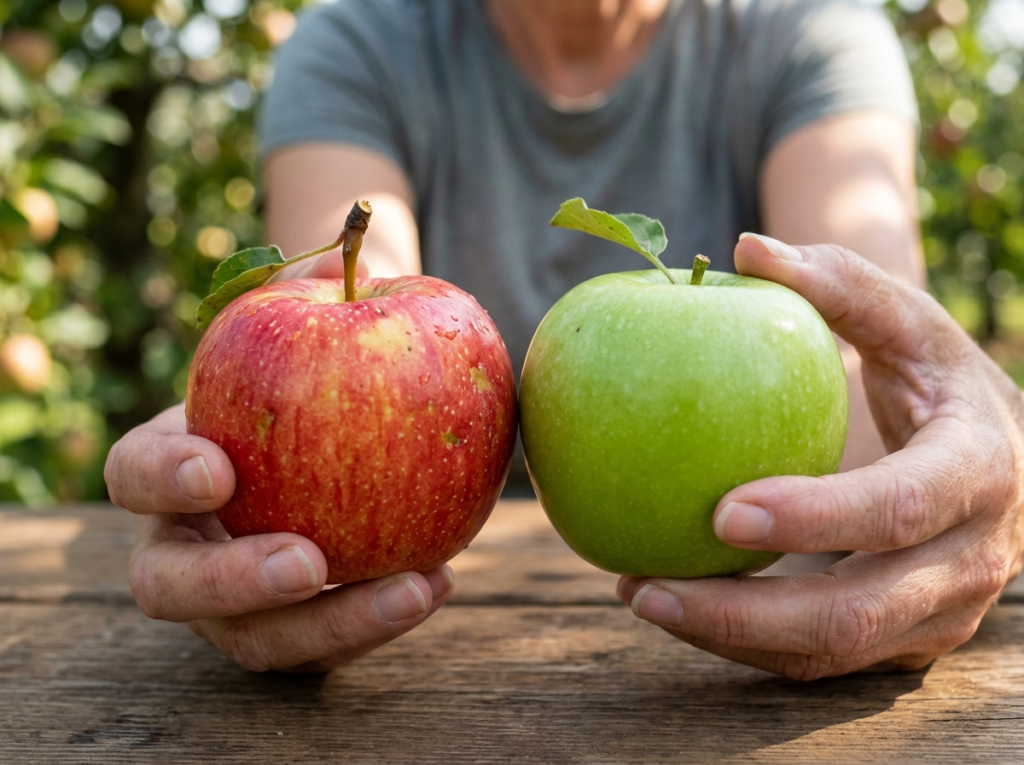
There are over 7,500 apple varieties grown around the world. Walk into any decent grocery store and you’ll find at least 10 to 15 types staring back at you — Honeycrisp next to Granny Smith, Fuji next to Pink Lady, and maybe a few you’ve never even heard of. They all look like apples. They all feel like apples. But they don’t all taste, cook, or behave the same way.
That’s the problem most people run into. You grab whatever looks good, toss it in your cart, and hope for the best. Sometimes it works out. Sometimes you bite into something mealy and disappointing, or your pie filling turns to mush because you picked the wrong variety.
Comparing apples to apples — literally — isn’t as simple as it sounds. And that’s exactly what we’re going to break down here. Not just which apple tastes best (that’s subjective anyway), but how to actually evaluate apple varieties side by side so you make smarter choices at the store, the farmers’ market, or even in your own backyard.
Why Comparing Apple Varieties Actually Matters
You’ve probably heard the phrase “comparing apples to apples” used in everyday conversation. It means making a fair comparison between two similar things. But when you’re actually standing in the produce aisle trying to choose between a Gala and a Fuji, the comparison isn’t always obvious.
Here’s the thing — apples vary dramatically in sweetness, acidity, firmness, juiciness, and how they hold up to heat. A Honeycrisp and a McIntosh might look roughly the same size and color, but they’re built for completely different jobs. One is a spectacular eating apple. The other falls apart beautifully in applesauce but would make a terrible snack for someone who likes crunch.
This matters for three reasons. If you’re cooking or baking, choosing the wrong apple can ruin a dish. If you’re eating fresh, the wrong variety can leave you with a bland, mushy experience. And if you’re buying organic or premium apples at $4 a pound, you want to know your money is going toward something you’ll actually enjoy.
Understanding the real differences between apple varieties gives you a kind of quiet confidence in the kitchen. It’s the same reason a good chef organizes a small home kitchen with intention — because knowing your ingredients and tools changes how you cook.
The Four Things That Actually Separate One Apple from Another
People tend to compare apples by color or size. That’s like judging a book by its cover — it tells you almost nothing useful. The real comparison comes down to four factors that affect everything from snacking to baking to pairing with cheese.
Sweetness vs. Acidity
Every apple sits somewhere on a spectrum between sweet and tart. Fuji and Gala apples land firmly on the sweet end. Granny Smith and Braeburn lean tart. Honeycrisp and Pink Lady sit in that interesting middle zone where you get both — a sweet bite followed by a tangy finish.
This balance of sugar and acid isn’t just about taste preference. It determines how an apple performs in recipes. A very sweet apple with low acidity can taste flat and one-dimensional when baked. A tart apple brightens up a pie filling naturally, without needing extra lemon juice.
The sugar content in apples ranges from about 10% (Granny Smith) to over 15% (Fuji), measured by Brix scale. That’s a significant difference you can genuinely taste.
Texture and Firmness
Bite into a Honeycrisp and you’ll hear it — that loud, satisfying crack. That’s because Honeycrisp cells are larger than those in most other varieties, which creates a unique crunchy texture that literally bursts with juice.
Compare that to a Red Delicious, which often has a softer, sometimes mealy texture, especially if it’s been in storage too long. Or a McIntosh, which is tender by nature and breaks down quickly.
Firmness matters enormously if you’re baking pies or tarts. You want an apple that holds its shape after 45 minutes in a hot oven. Granny Smith and Braeburn do this well. Golden Delicious, despite its name, softens quickly — which is perfect for applesauce but not ideal for a structured tart.
Juiciness
Some apples practically drip when you cut into them. Others are drier and more starchy. Juiciness affects both eating pleasure and cooking results. A very juicy apple can make a pie filling watery if you don’t compensate with thickener. A drier apple won’t give you enough moisture for a good applesauce.
Honeycrisp, Fuji, and Jazz apples rank among the juiciest. Braeburn and Cortland fall somewhere in the middle. Red Delicious, particularly later in the season, can be surprisingly dry — one of many reasons it’s fallen out of favor with serious apple lovers.
Aroma
This one gets overlooked, but it matters more than you’d think. A great apple hits you before you even taste it. Varieties like Macoun, Cortland, and some heirloom types carry a fragrance that’s almost floral. Others, like Gala, have a mild honey-like scent. And some — including many supermarket Red Delicious — smell like almost nothing.
Aroma contributes to the overall flavor experience. When you’re comparing apples to apples honestly, ignoring smell means missing part of the picture.
The Best Apples for Eating Fresh — And Why
Let’s start with the simplest use: you want an apple to eat raw, right now, as a snack or sliced alongside some cheese.
Your top picks here are Honeycrisp, Fuji, SweeTango, Envy, and Cosmic Crisp. These all share a few traits — they’re crunchy, they’re juicy, and they’ve got enough sweetness to satisfy without tasting like candy.
Honeycrisp has dominated the fresh-eating category since the University of Minnesota introduced it in 1991. It’s been America’s bestselling apple by revenue for years, despite costing more than most varieties. The reason is simple: it delivers a consistent, explosive crunch and a balanced sweet-tart flavor that very few apples can match.
Cosmic Crisp, a newer variety developed by Washington State University and released in 2019, is essentially Honeycrisp’s ambitious younger sibling. It’s extremely firm, resists browning better than most apples, and stays crisp in storage for months. If you haven’t tried one yet, you should.
Fuji is the quiet achiever. Originally bred in Japan in the 1930s (a cross between Red Delicious and Ralls Janet), it’s intensely sweet with a dense, fine-grained texture. It’s not as showy as Honeycrisp, but people who prefer sweetness over tartness often rank it number one.
Now, what about the apples that aren’t great for eating raw? Red Delicious has been in steady decline for good reason. It was bred for appearance — that iconic deep red skin and elongated shape — at the expense of flavor and texture. If you’ve ever bitten into one and felt… nothing, you know what I mean. It’s not a bad apple, exactly. It’s just an uninspired one.
The Best Apples for Baking — And Why It’s Not the Same List
Here’s where comparing apples to apples really gets interesting. The perfect snacking apple isn’t always the perfect baking apple. Sometimes they overlap. Often they don’t.
Baking demands an apple that can handle heat without dissolving into puree. You want structure, a good balance of sweet and tart (because sugar is already going into the recipe), and enough moisture to create steam without flooding the pastry.
Granny Smith is the classic baker’s apple for a reason. High acidity, firm flesh, and it holds its shape beautifully under heat. The tartness cuts through butter and sugar in a pie filling, keeping things balanced. Almost every professional pastry chef will tell you Granny Smith is their go-to, or at least part of their blend.
Braeburn is an underrated baking apple. Firm and spicy with hints of cinnamon and nutmeg already baked into its flavor profile (pun intended), it adds complexity to pies that a single-variety filling sometimes lacks.
Jonagold — a cross between Jonathan and Golden Delicious — brings both sweetness and acidity to the table with a tender-firm texture that softens just enough in the oven without falling apart completely.
Pro tip: The best apple pies use a mix of varieties. Try combining Granny Smith with Honeycrisp or Braeburn with Jonagold. You get layers of flavor and texture that a single variety can’t deliver on its own. If you’re the kind of person who cares about crust as much as filling, you might also want to consider using lard for a more perfect pie crust — it makes a genuine difference.
Apples you should generally avoid for baking include McIntosh (too soft, breaks down fast), Gala (too mild, gets mushy), and Red Delicious (not enough flavor or acidity to contribute anything meaningful).
Cooking Beyond Pie: Apples in Savory Dishes
Apples aren’t just for dessert. They show up in pork dishes, salads, chutneys, sauces, and cheese boards all the time. And the variety you choose matters just as much here.
For a pork chop with pan-seared apples, you want something that holds its shape in a hot skillet but offers enough sweetness to complement the meat. Honeycrisp and Pink Lady both work beautifully. Their balance of sugar and acid pairs naturally with pork, and they caramelize nicely without turning to mush.
For salads, you want crunch and visual appeal. Thin slices of Envy or Cosmic Crisp add texture and sweetness without overpowering greens and vinaigrette. Their slow-browning characteristics are a bonus — nobody wants an apple slice that turns brown before the salad hits the table.
For applesauce and butter, you actually want apples that break down easily. McIntosh, Cortland, and Golden Delicious are perfect here. They cook down quickly, and their natural sweetness means you need less added sugar. A slow-cooked apple butter made with McIntosh apples and a touch of cinnamon is one of the simplest, most rewarding things you can make in your kitchen.
Thinking about building flavor in your cooking more broadly? Understanding how acid and fat work as the yin and yang of cooking helps you see why tart apples pair so well with rich, fatty proteins.
How Storage and Seasonality Change Everything
Here’s something most comparison guides skip entirely: apples change over time. An apple you buy in September during peak harvest tastes different from the same variety pulled from controlled atmosphere storage in March.
Most commercial apples in the U.S. are stored in CA (controlled atmosphere) facilities where oxygen levels are reduced and temperatures are kept just above freezing. This can keep apples edible for up to 12 months. But “edible” and “delicious” aren’t the same thing.
Texture suffers first. An apple that was perfectly crisp in October might feel softer and slightly grainy by February. Flavor dulls too, especially in varieties that aren’t bred for long storage. Gala and McIntosh tend to decline faster. Fuji, Granny Smith, and Cosmic Crisp hold up much better over months of storage.
Did you know? The Cosmic Crisp was specifically bred with storage in mind. In testing, it maintained its crunch and flavor for over 10 months in standard refrigeration — an extraordinary shelf life for any apple.
This is why buying apples in season from local orchards and farmers’ markets often gives you a dramatically better experience. A fresh-picked Macoun in early October is a completely different fruit from anything you’ll find in a supermarket in January.
Seasonality also matters for cooking. Early-season apples (August-September) tend to be slightly softer and work well for sauces. Peak-season apples (October-November) are at their firmest and most flavorful — ideal for pies and fresh eating. Late-storage apples (January-April) are best used in cooked applications where texture loss is less noticeable.
The Price Factor: Are Expensive Apples Worth It?
Honeycrisp apples regularly sell for $3 to $4 per pound, sometimes more. Gala and Fuji hover around $1.50 to $2. Organic varieties push prices even higher. So are you actually getting your money’s worth with premium apples?
The honest answer: it depends on how you’re using them.
For fresh eating, where flavor and texture are the entire point, paying more for a Honeycrisp, Envy, or Cosmic Crisp makes sense. You’re paying for a genuinely better eating experience — crunchier, juicier, more flavorful. The breeding programs behind these varieties took decades and millions of dollars. That investment shows up in the apple.
For baking, the premium isn’t always worth it. A Granny Smith at $1.50 a pound makes a pie just as good as — and arguably better than — one made with Honeycrisp at twice the price. The baking process transforms the apple so much that many of the subtle flavor differences you’d notice when eating raw get muted by sugar, spices, and heat.
For sauces and cooking, cheaper varieties work perfectly fine. McIntosh, Cortland, and even imperfect “seconds” from a local orchard give you excellent results at a fraction of the cost.
One more thing worth mentioning: apple pricing is also affected by how difficult a variety is to grow. Honeycrisp trees are notoriously finicky — they’re susceptible to bitter pit (a calcium deficiency that causes brown spots), they require careful thinning, and their branches are brittle. All of that drives up the cost for growers, which passes directly to you.
Regional Differences You Should Know About
Apples aren’t a monolith. The same variety can taste noticeably different depending on where it was grown. Climate, soil, altitude, and sun exposure all play a role.
A Fuji grown in Washington state, where hot days and cool nights create ideal sugar development, will often taste sweeter than a Fuji grown in a milder East Coast climate. Similarly, Granny Smith apples from New Zealand — where the variety originated as a chance seedling in 1868 — carry a slightly different tartness profile than those grown in the U.S.
If you’ve ever traveled and tasted local apple varieties that don’t exist in your home market, you know how eye-opening that can be. It’s a bit like how exploring food in a different region reveals flavors and traditions you’d never encounter otherwise.
Heirloom and heritage varieties deserve a mention here too. Names like Arkansas Black, Esopus Spitzenburg, Newtown Pippin, and Cox’s Orange Pippin might not ring a bell, but these apples offer flavor complexity that most commercial varieties simply can’t touch. They’re harder to find — usually available only at specialty orchards and fall farmers’ markets — but tracking them down is genuinely worth the effort if you care about what your apples taste like.
How to Actually Compare Apples at the Store
So you’re standing in the produce section. Twelve varieties in front of you. What do you actually do?
Start by asking yourself what you need the apple for. That single question narrows your choices dramatically. Snacking? Reach for something with proven crunch and balanced flavor. Baking a pie this weekend? Grab Granny Smith and one complementary variety. Making applesauce for your kids? McIntosh or Cortland, don’t overthink it.
Next, check firmness. Pick the apple up and give it a gentle squeeze. You shouldn’t feel any give at all in a good eating apple. If it yields under light pressure, it’s past its prime for raw eating (though it might still be fine for cooking).
Look at the skin. Small brown patches near the stem end (called “russeting”) aren’t a flaw — they’re actually common in many flavorful varieties and don’t affect taste. But soft spots, wrinkled skin, or bruising are signs of age or poor handling.
Smell the apple near the stem end. A good apple should have a pleasant, faintly sweet aroma. No smell at all usually means limited flavor. An overly sweet or fermented smell means it’s overripe.
Quick fact: The “wax” on many supermarket apples is food-grade and applied to replace the natural wax that gets removed during washing. It’s safe to eat, but if it bothers you, a quick rinse with warm water and a gentle scrub will remove most of it.
Good knife skills also make a difference when you’re prepping apples — clean, even slices ensure uniform cooking and a better presentation, whether you’re making a tart or a simple cheese board.
A Quick Comparison of Popular Varieties
Sometimes you just want the facts laid out clearly. Here’s a straightforward look at the most common varieties you’ll encounter:
Honeycrisp — Sweet-tart balance, explosive crunch, very juicy. Best for: fresh eating, salads. Baking: decent but can release excess juice. Price: premium.
Granny Smith — Tart, firm, holds shape in heat. Best for: pies, tarts, cooking. Fresh eating: great if you like sour. Price: moderate.
Fuji — Very sweet, dense texture, mild flavor. Best for: fresh eating, kids’ lunches. Baking: too sweet for most recipes on its own. Price: moderate.
Gala — Mild sweetness, softer texture, thin skin. Best for: snacking, salads. Baking: not recommended (too soft). Price: affordable.
Pink Lady (Cripps Pink) — Tart-sweet, firm, aromatic. Best for: fresh eating, savory cooking. Baking: good in combination with others. Price: moderate to premium.
Braeburn — Spicy-sweet, very firm, complex flavor. Best for: baking, roasting with pork. Fresh eating: excellent if you like assertive flavor. Price: moderate.
McIntosh — Tender, tart, aromatic. Best for: applesauce, apple butter. Baking pies: not ideal (breaks down too much). Price: affordable.
Cosmic Crisp — Sweet-tart, extremely firm, slow browning. Best for: fresh eating, storage. Baking: holds up well. Price: moderate to premium.
Pairing Apples with Other Foods
Apples are one of the most versatile fruits for food pairing, and the variety you choose changes the pairing dynamic.
Cheese and apples are a classic combination, but not every apple works with every cheese. Sharp cheddar loves a tart Granny Smith — the acidity of the apple cuts through the fat of the cheese. Brie or Camembert pairs better with a sweet, mild apple like Fuji or Gala, where neither flavor overwhelms the other. Blue cheese with a Honeycrisp creates a surprisingly addictive sweet-salty-tangy combination.
When you’re putting together a cheese board or thinking about what wine glass suits your drink, adding the right apple variety turns a simple spread into something genuinely thoughtful.
Apples and pork have been best friends for centuries. The acidity in tart apples helps cut through pork’s richness, and the fruit’s natural sugars caramelize alongside the meat. A roasted pork loin with Braeburn apple slices is simple, satisfying, and hard to get wrong.
For salads, pair crisp, slow-browning varieties (Cosmic Crisp, Envy) with bitter greens like arugula or endive. Add walnuts and a sharp vinaigrette, and you’ve got something that tastes far more sophisticated than the effort required.
FAQ
What’s the best apple variety for beginners who want to start baking pies?
Granny Smith is the safest starting point. It’s available everywhere, holds its shape reliably in the oven, and its tartness balances well with the sugar in most pie recipes. Once you’re comfortable, try mixing in Braeburn or Honeycrisp for more flavor depth.
Do organic apples taste different from conventional ones?
The organic label tells you about farming practices, not flavor. Taste differences between organic and conventional apples of the same variety are usually minimal. What matters far more is freshness, how long the apple has been in storage, and where it was grown. A fresh conventional Honeycrisp from a local orchard will almost always taste better than an organic one that’s been in cold storage for five months.
Why do some apples turn brown faster than others after cutting?
Browning happens when enzymes in the apple flesh react with oxygen — a process called enzymatic oxidation. Varieties with higher polyphenol oxidase activity brown faster. Granny Smith and McIntosh brown relatively quickly. Cosmic Crisp, Envy, and SnapDragon have been bred or selected partly for their slow-browning traits. A quick squeeze of lemon juice on cut surfaces slows browning in any variety.
Can you substitute one apple variety for another in recipes?
You can, but it helps to match the key characteristics. If a recipe calls for a tart, firm apple and you don’t have Granny Smith, use Braeburn or Pink Lady — not Gala or McIntosh. The important thing is matching the sweetness-tartness balance and the firmness level, not the exact variety name.
What’s the best way to store apples at home?
Keep them in the crisper drawer of your fridge. Apples stored at room temperature ripen (and deteriorate) up to 10 times faster than refrigerated ones. Keep them separate from other fruits and vegetables — apples produce ethylene gas, which speeds up ripening in everything around them. A perforated plastic bag helps maintain humidity without trapping too much moisture.
Pick the Right Apple, and Everything Else Gets Easier
The next time you’re standing in front of that wall of apples at the grocery store, you won’t need to guess. You’ll know that the Honeycrisp is for your afternoon snack, the Granny Smith is for Saturday’s pie, and the McIntosh is for that slow-cooker applesauce your family loves.
Comparing apples to apples — really comparing them, honestly and thoughtfully — isn’t about finding one “best” apple. It’s about understanding that each variety has a job it does better than the rest. When you match the right apple to the right use, everything just works. Your pies hold together. Your snacking apples actually crunch. Your applesauce tastes like something you’d be proud to put in a jar and give away.
That’s the real takeaway here. Know your apples. Know what you need them for. And don’t be afraid to try a variety you’ve never picked up before — some of the best food experiences start with a small, curious choice.