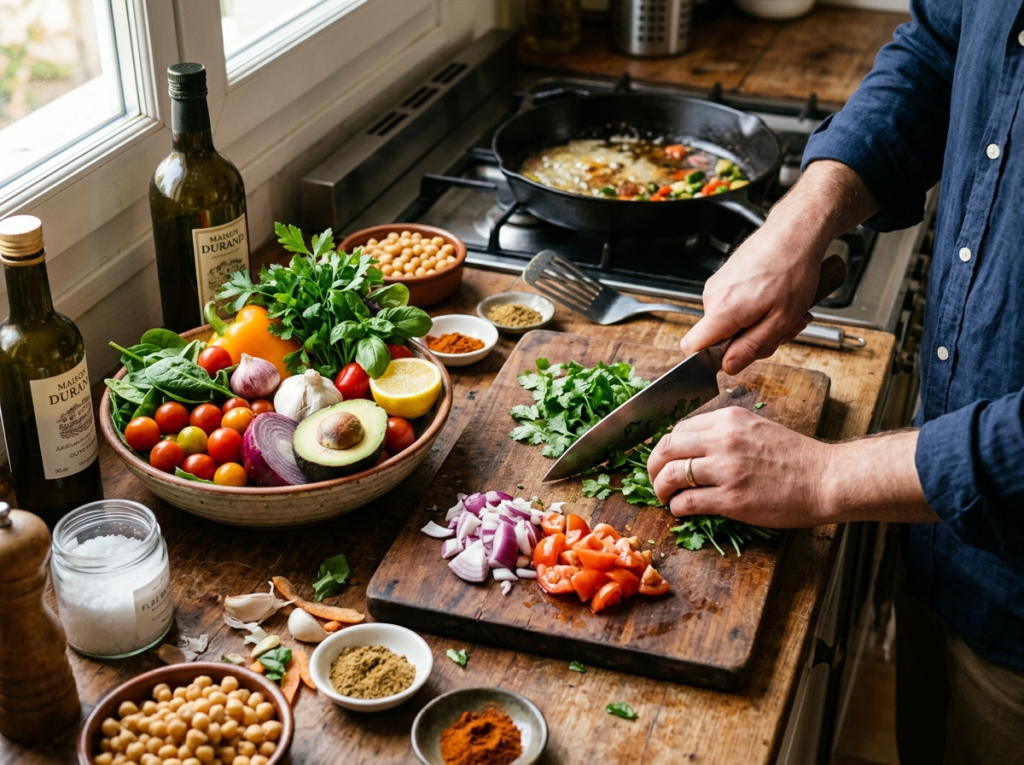
Here’s a number that might make you feel a little less alone: roughly 40% of the food Americans buy ends up in the trash. A lot of that waste starts with good intentions — you sit down on Sunday, build a detailed meal plan for the week, buy everything on the list, and then life happens. By Wednesday, you’re ordering takeout and those bell peppers are quietly rotting in the crisper drawer.
What if the answer isn’t a better plan? What if it’s learning to cook well without one?
That’s the idea behind the no plan meal plan. It’s not about being lazy or careless with your eating. It’s actually about building a different kind of kitchen intelligence — one that lets you open your fridge on any given Tuesday, see what’s there, and turn it into something genuinely good. No Pinterest boards required. No color-coded spreadsheets. Just you, your instincts, and a few smart habits.
Sound too good to be true? Stick around. This approach has more structure than you’d think — it’s just hidden in the right places.
Why Traditional Meal Plans Fall Apart
Let’s be honest about what usually happens with meal planning.
You spend 45 minutes on Sunday deciding what to eat for the next seven days. You write a grocery list. You go to the store. You spend $150. You feel productive and virtuous. Then Monday night arrives and you’re exhausted, and that Thai basil chicken recipe suddenly feels like a chore. Your partner says they’re not hungry. Your kid wants pasta. Again.
By Thursday, you’re staring at ingredients that were supposed to become something specific, but now they just feel like a puzzle with missing pieces. The cilantro has turned to slime. The chicken is sitting at the edge of its use-by date and you’re not sure you trust it anymore.
The problem isn’t willpower. The problem is that rigid meal plans assume your week will go exactly as predicted. They assume your energy, your mood, your appetite, and your schedule will all cooperate. And they almost never do.
Pro Tip: The friction isn’t cooking itself — it’s the gap between what you planned to cook and what you actually feel like making. The no plan meal plan eliminates that gap entirely.
So What Exactly Is the No Plan Meal Plan?
Think of it less as a system and more as a mindset shift.
Instead of planning specific meals for specific days, you stock your kitchen with versatile ingredients and build a loose mental framework for how to use them. You don’t decide on Monday what you’ll eat on Thursday. You decide on Thursday what to eat on Thursday — based on what’s available, what sounds good, and how much energy you’ve got.
It’s how professional cooks actually think, by the way. A chef doesn’t walk into a restaurant kitchen and panic because someone didn’t leave them a recipe card. They look at what’s on hand, consider the techniques they know, and build something. That skill isn’t magic. It’s practice combined with a handful of principles anyone can learn.
The no plan meal plan works on three pillars:
A well-stocked pantry. This is your safety net. The ingredients that don’t go bad quickly and can anchor almost any meal.
Flexible fresh ingredients. Instead of buying very specific produce for very specific recipes, you buy versatile items that can swing in multiple directions.
A few cooking techniques you’re comfortable with. You don’t need twenty. You need maybe four or five that you can execute without thinking too hard.
That’s it. Those three things, working together, are more powerful than any weekly meal plan you’ve ever printed out and stuck to your fridge.
Building Your Pantry Backbone
Your pantry is the foundation of this whole approach. If you get this part right, you’ll always be ten minutes away from a real meal — even when the fridge looks sad and empty.
The key is stocking ingredients that are shelf-stable, versatile, and flavorful on their own. You’re not hoarding ingredients for some future recipe. You’re building a toolkit.
Good olive oil sits at the center of everything. So do a few vinegars — red wine, rice, apple cider. These let you build dressings, deglaze pans, and brighten up anything that tastes flat. A couple of quality dried pastas give you a ten-minute dinner base any night of the week, and understanding the history and proper cooking of pasta makes even a simple bowl of spaghetti taste professional.
Canned goods are your secret weapon here. Canned tomatoes, chickpeas, white beans, coconut milk — these aren’t sad pantry leftovers. They’re what actual cooks reach for constantly. A can of chickpeas with some spices, olive oil, and whatever vegetables you have becomes dinner in twenty minutes.
Grains like rice and couscous cook quickly and absorb whatever flavor you throw at them. Soy sauce, fish sauce, and a decent hot sauce give you the ability to push a dish in completely different flavor directions without buying specialty ingredients.
Did you know? Most professional kitchens operate on a surprisingly small number of pantry staples. The variety comes from technique and seasoning, not from having 200 different ingredients. If you’re curious about how seasoning transforms simple food, the idea behind French seasoning salt is a perfect example of how one blend can do a lot of heavy lifting.
Shopping Without a Recipe List
This is where people get nervous. Walking into a grocery store without a specific list feels reckless if you’ve always been a planner. But you’re not going in blind — you’re going in flexible.
Here’s how to think about it. Instead of buying ingredients for Meal A, Meal B, and Meal C, you’re buying categories.
You grab a protein — whatever looks good and fresh, or whatever’s on sale. Chicken thighs, ground beef, a piece of fish, a block of tofu. You don’t need to know exactly what you’ll do with it yet. You just need it in the fridge.
You pick up some vegetables. Go for a mix of something sturdy that lasts (carrots, cabbage, broccoli) and something that cooks quickly (zucchini, spinach, cherry tomatoes). The sturdy stuff buys you time. The quick stuff gives you options for busy nights.
Eggs. Always eggs. They’re the ultimate no-plan ingredient. Scrambled with leftovers, fried on top of rice, baked into a frittata with whatever vegetables are about to turn. If you’ve ever felt like breakfast doesn’t have to be a production, eggs are the reason why.
Cheese, lemons, fresh herbs if they look good, maybe a loaf of bread. That’s your cart. No recipe dictated it. Everything in it can combine with everything else in multiple ways.
Quick Fact: A study from the Cornell Food and Brand Lab found that shoppers who bought without rigid lists but with general category plans actually wasted less food than strict list-followers — because they bought based on freshness and what they’d realistically use.
The Techniques That Set You Free
Here’s the thing nobody tells you about cooking: recipes are training wheels. They’re useful when you’re learning, but at some point, you need to start riding on your own. The no plan meal plan works because you replace recipe-dependence with technique-confidence.
You don’t need culinary school for this. You need to get genuinely comfortable with a small number of cooking methods, and then everything changes.
Sautéing is probably the single most useful technique for weeknight cooking. Heat a pan, add fat, cook things quickly over high-ish heat. Almost every vegetable tastes better sautéed than it does any other way. Protein cooks fast. You get browning, which means flavor. Fifteen minutes, dinner’s done.
Roasting is your “I don’t want to babysit the stove” technique. Toss vegetables and protein on a sheet pan with oil, salt, and whatever spices you’re feeling. Put it in a hot oven. Walk away. Come back to caramelized, deeply flavored food. You can roast almost anything — and getting confident with techniques like spatchcocking a chicken turns one bird into multiple meals without any fancy planning.
Building a quick sauce separates okay cooks from good ones. After you sauté something, there’s flavor stuck to the bottom of the pan. Add a splash of wine, vinegar, or stock. Scrape it up. Stir in a little butter or cream. You just made a pan sauce, and it probably tastes better than anything that came out of a jar.
Assembling is an underrated skill. Not everything needs to be cooked. A grain bowl with leftover rice, raw vegetables, a protein, and a good dressing is a complete meal. So is a big salad with substance. So is toast with ricotta and whatever’s ripe.
The more you practice these, the less you need anyone to tell you what to make. You just look at your ingredients and your brain starts connecting dots automatically. It’s a lot like what you’d pick up in a chef’s tricks-of-the-trade class — practical techniques, not fussy recipes.
What a No Plan Week Actually Looks Like
Theory is great, but let’s make this concrete. Here’s how a real week might flow.
Saturday, you hit the grocery store or farmers market. You grab chicken thighs, a bag of spinach, some sweet potatoes, onions, garlic, a lemon, a can of white beans, and a block of feta. You didn’t consult a recipe. You just bought food that looked good and felt versatile.
Sunday night, you roast the chicken thighs with some sweet potatoes. Simple — olive oil, salt, pepper, maybe some paprika. You cook all the chicken, even though you only need half tonight. The rest goes in the fridge.
Monday, you shred the leftover chicken and toss it with spinach, white beans, lemon juice, olive oil, and crumbled feta. Dinner in five minutes. No cooking required.
Tuesday, you sauté onions and garlic, throw in the remaining sweet potatoes (diced small so they cook fast), and crack a few eggs into the pan. A loose hash that takes fifteen minutes. The spinach wilts in at the end.
Wednesday, the fridge is getting lighter. You boil some pasta, toss it with olive oil, whatever vegetables are left, maybe some canned tomatoes and a handful of olives from the pantry. Grate some parmesan over it. Done.
Thursday, you might grab a piece of fish on the way home. Sauté it in butter, squeeze lemon over it, serve with rice from the pantry. Seven minutes of active cooking.
Notice what happened? Five dinners, minimal waste, no existential crisis about what to eat. Each meal was decided the night it was made, based on what was available and what sounded appealing. And nothing felt repetitive because the techniques and combinations kept shifting.
Handling the “What’s for Dinner?” Panic
Even with a stocked kitchen, there’s going to be a moment — probably around 5:45 PM on a hard day — where you open the fridge and your mind goes blank. This is normal. It doesn’t mean the system failed. It means you’re human.
Here’s a trick that helps: think in the format of “protein + vegetable + starch + flavor.” That’s the skeleton of most satisfying meals. You’re not looking for inspiration. You’re filling in four blanks.
What protein do I have? Eggs, leftover chicken, a can of chickpeas — anything counts.
What vegetables? Even if it’s just an onion and some frozen peas, that works.
What starch? Rice, pasta, bread, potatoes, tortillas.
What flavor direction? This is where your pantry sauces and spices come in. Soy sauce and sesame oil push you toward Asian flavors. Cumin and lime push you toward Mexican. Olive oil and garlic push you toward Italian. You don’t need recipes for this — you just need to pick a lane.
Understanding how acid and fat interact is genuinely useful here. Once you grasp that most dishes need a balance of richness and brightness, you start seasoning by instinct instead of by instruction.
And if all else fails? Eggs and toast. A quesadilla with whatever cheese you have. A bowl of rice with soy sauce and a fried egg on top. These aren’t failures. They’re Tuesday night. Anyone who tells you every meal needs to be impressive is probably selling you something.
The Leftovers Strategy
The no plan meal plan has a quiet superpower: it turns leftovers from sad reheated containers into actual building blocks.
Most traditional meal plans treat leftovers as “eat the same thing again tomorrow.” That gets boring fast. The no plan approach treats leftover components — roasted vegetables, cooked grains, proteins — as ingredients for something new.
Leftover roasted chicken becomes chicken salad, gets tossed into soup, tops a grain bowl, or folds into a quesadilla. Cooked rice from two days ago gets fried with an egg and vegetables. That half a sweet potato becomes part of tomorrow’s hash.
The trick is cooking components, not complete dishes, when you have the energy. If you’re roasting chicken, roast extra. If you’re making rice, make the whole pot. These aren’t leftovers in the traditional sense — they’re head starts on future meals.
Pro Tip: Keep leftover components in clear containers so you can actually see them when you open the fridge. Food that’s hidden gets forgotten and wasted. And while you’re at it, if you want to organize your kitchen like a pro chef, the same visibility principle applies to your pantry.
When You Should Actually Plan
Let me be upfront — the no plan meal plan isn’t the right approach 100% of the time. And pretending otherwise would be dishonest.
If you’re hosting a dinner party, plan it. If you’re cooking a special holiday meal, plan it. If you’re making something technically complex that requires specific ingredients, you need a recipe and a shopping list. Nobody’s winging a beef Wellington.
The no plan approach is designed for everyday cooking — the 260+ dinners a year that aren’t special occasions. Those are the meals where rigid planning creates the most friction and the most waste. Those are the meals where flexibility saves you time, money, and sanity.
Some people also find that a loose plan helps them — not “Monday is chicken piccata” but more like “I’ll probably make pasta twice this week and do a stir-fry at some point.” That’s totally compatible with this approach. You’re not banning planning. You’re removing the requirement that every meal be predetermined.
Tools That Help Without Taking Over
You don’t need an app or a system. But a few small habits make the no plan approach run more smoothly.
A quick fridge scan before you shop. Take thirty seconds. What needs to be used up? What are you out of? This isn’t planning — it’s awareness.
Keep a running list of pantry staples. Not a meal plan. Just a list of the basics you always want on hand. When you run out of olive oil or rice, it goes on the list. Simple.
A sharp knife and a clean workspace. This sounds trivial, but it isn’t. The reason cooking feels like a chore is often environmental — a cluttered counter, a dull knife that makes chopping frustrating. Investing in your knife skills and keeping your workspace ready removes one of the biggest psychological barriers to just getting started.
The no plan meal plan works best when the path between “I should make dinner” and “I’m actually cooking dinner” is as short as possible. Every bit of friction you remove — a clean kitchen, ingredients you can see, tools that work — makes it easier to skip the planning and start doing.
What This Approach Teaches You Over Time
Something unexpected happens when you cook without a plan for a few weeks. You start to develop what chefs call “kitchen intuition.” You begin to understand why certain flavors work together, not because a recipe told you, but because you’ve tried the combination and tasted it yourself.
You learn that acidity fixes almost everything that tastes flat. You learn that a pinch of sugar balances a sauce that’s too acidic. You learn that toasting spices in oil before adding other ingredients makes a massive difference. You learn that mushrooms need specific handling and that greens shrink to nothing so you always need more than you think.
This kind of knowledge doesn’t come from following recipes. It comes from cooking freely, making mistakes, tasting as you go, and adjusting. It’s the difference between reading about swimming and actually getting in the water.
After a month or two of no plan cooking, you’ll find yourself throwing together meals that genuinely surprise you — not because you followed a brilliant recipe, but because you understood what was in your kitchen and how to make it taste good. That’s a skill that lasts the rest of your life.
FAQ
Do I need to be an experienced cook to try the no plan meal plan?
Not at all. Beginners actually benefit from this approach because it forces you to learn techniques instead of just following recipes step by step. Start simple — eggs, pasta, basic sautés — and build from there. The key is getting comfortable with a handful of methods, not memorizing a hundred recipes. If something doesn’t turn out perfectly, you learn from it and adjust next time.
Won’t I end up eating the same things over and over?
It’s a fair worry, but the opposite tends to happen. When you plan meals a week ahead, you actually repeat the same rotation of “safe” recipes more than you realize. With the no plan approach, you’re responding to what’s fresh and available, which naturally introduces variety. One week you spot beautiful asparagus at the store, the next week it’s a great deal on pork chops. Your meals shift with the seasons and what catches your eye.
How do I make sure I’m eating balanced, nutritious meals without planning?
The “protein + vegetable + starch + flavor” framework handles this naturally. If you’re filling in those four categories at each meal, you’re getting a balanced plate without tracking anything. Keep a variety of vegetables and proteins cycling through your fridge, and you’ll end up eating more diversely than most meal planners do. If you have specific dietary needs or restrictions, you can still hold those as guardrails without scripting every meal in advance.
What if I’m cooking for a family and not just myself?
Families actually do well with this approach because it reduces the “nobody wants what I planned” problem. When you decide what to cook the night of, you can factor in who’s home, what everyone’s in the mood for, and how much time you have. Kids especially benefit from seeing cooking as a flexible, creative act rather than a rigid homework assignment. Let them weigh in on the “what flavor direction tonight?” question — they’ll surprise you.
Your Kitchen, Your Rules
The most freeing thing about the no plan meal plan is that it puts you back in charge. You’re not a servant to a meal plan somebody else designed. You’re not stressed about sticking to a schedule that doesn’t match your actual life. You’re just a person with food in the kitchen, making something good for dinner.
Start small if you want. Pick three nights this week where you don’t plan ahead. Stock a few pantry staples, grab some versatile fresh ingredients, and see what happens. You might fumble the first time. The second time will be better. By the third, you’ll start to feel something that rigid planning never gave you — confidence.
And that confidence doesn’t just change how you cook. It changes how you feel about cooking. It stops being a task on your to-do list and starts being something you actually look forward to — the quiet, creative fifteen minutes at the end of the day where you turn whatever you’ve got into something worth sitting down for.
That’s worth more than any spreadsheet.