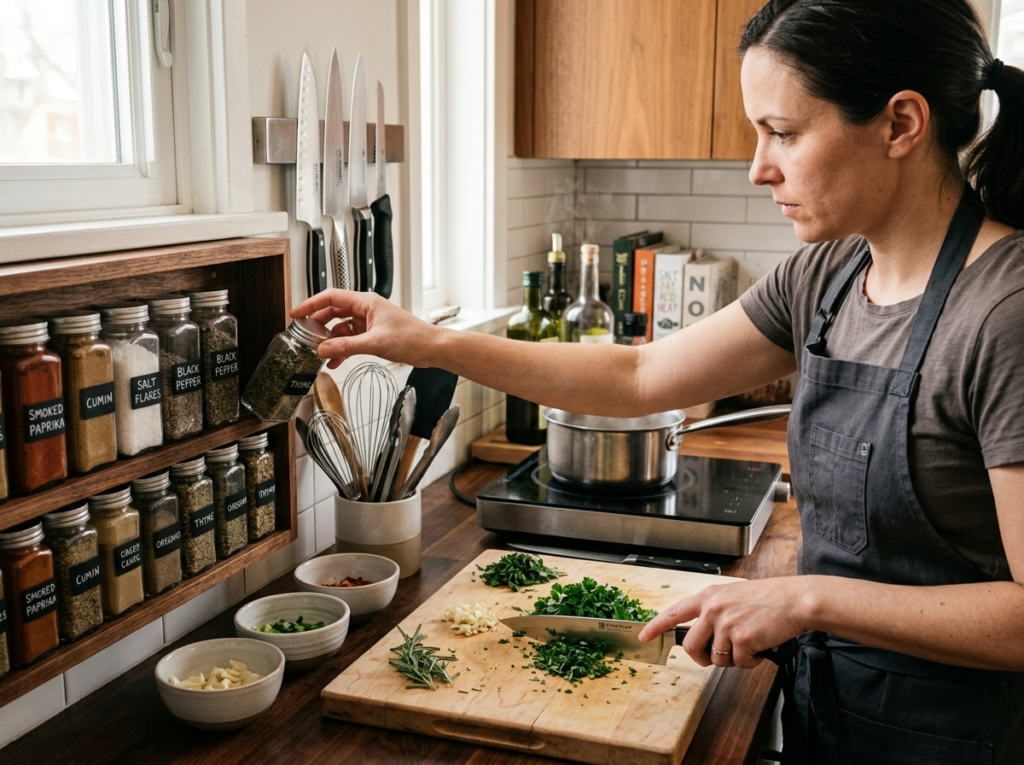
Professional chefs work in some of the most cramped, chaotic kitchen spaces you can imagine. A restaurant line station might give a cook about four feet of counter space to produce 200 plates in a single night. So when a trained chef goes home to a small apartment kitchen, they don’t panic about the lack of space. They already know how to make every square inch count.
The truth is, most home cooks don’t have a space problem — they have a systems problem. You’re not struggling because your kitchen is 80 square feet. You’re struggling because things don’t have a home, your drawers are a junk pile, and you’ve got gadgets from 2014 sitting in prime real estate while your cutting board balances on the edge of your sink.
This isn’t about buying fancy organizers from Instagram ads. It’s about thinking like someone who cooks under pressure every single day and applying those principles to your actual life. Let’s get into it.
The Mise en Place Mindset Starts Before You Cook
You’ve probably heard the phrase mise en place — it’s French for “everything in its place.” In culinary school, they drill this into you on day one. But most people think it only means prepping your ingredients before cooking. It doesn’t. For a pro chef, mise en place is a way of living in the kitchen. It means your tools, your ingredients, your cleaning supplies — everything has a designated spot, and it goes back there every single time.
In a small kitchen, this matters even more. You can’t afford to waste time hunting for your vegetable peeler while onions are burning. You also can’t afford to have three spots where the olive oil “might” be.
Here’s how to start. Pick a slow afternoon. Empty one drawer or one cabinet completely. Look at what’s inside. Ask yourself: do I use this every week? If yes, it stays. If you haven’t touched it in six months, it goes in a box for donation or deep storage. This sounds basic, but you’d be surprised how many people skip this step and jump straight to buying drawer dividers. The dividers won’t help if the drawer is full of things you don’t need.
Once you’ve done this purge — and be honest with yourself during the process — you can start assigning zones.
Zone Your Kitchen Like a Professional Station
Walk into any well-run restaurant kitchen and you’ll notice something right away. Everything is organized by task. The grill station has tongs, spatulas, oil, salt, and proteins within arm’s reach. The pastry station has scales, scrapers, sheet pans, and flour nearby. Nothing crosses zones unless it absolutely has to.
You can do the same thing in a kitchen that’s barely big enough to turn around in. The idea is simple: group items by activity, not by category.
Most people organize by putting “all the pots together” or “all the spices together.” That seems logical, but it doesn’t match how you actually cook. Think about your morning routine. You make coffee, maybe toast, maybe eggs. Where’s your mug? Where’s the coffee? Where’s the pan you use for eggs? If those things are scattered across your kitchen, you’re doing unnecessary laps every morning.
Your prep zone should be near your main cutting area. Keep your knives, cutting boards, mixing bowls, and a small container of salt right here. If you’ve been working on improving your knife skills, you already know how important a clean, uncluttered cutting area is.
Your cooking zone lives around the stove. This is where your most-used pans, cooking oils, spatulas, tongs, and everyday spices belong. A chef at home might keep just three or four pans here — not twelve. We’ll talk about downsizing cookware in a minute.
Your cleaning zone is at the sink. Dish soap, scrub brush, towels, and a small drying rack or mat. That’s it. No decorative soap dispensers. No pile of sponges you bought in bulk.
When your kitchen has clear zones, you move through it with purpose. That alone makes a small space feel twice as big.
Vertical Space Is Your Best Friend
Here’s something chefs know that most home cooks overlook: countertops aren’t storage. Every item sitting on your counter is eating into your workspace. And in a small kitchen, workspace is everything.
Look up. What’s happening on your walls? Probably nothing. That’s wasted real estate.
A magnetic knife strip is one of the single best upgrades you can make. It costs about fifteen dollars, takes ten minutes to install, and instantly frees up a drawer or counter space where your knife block used to sit. Chefs use these in professional kitchens because they’re hygienic, easy to access, and they keep blades from banging against each other in a drawer.
Wall-mounted hooks or a simple rail system (IKEA’s GRUNDTAL line has been a chef favorite for years) can hold your most-used pans, utensils, and even small colanders. Hanging pots and pans isn’t just for farmhouse aesthetics — it’s genuinely practical when cabinet space runs low.
The inside of your cabinet doors is another overlooked spot. Stick-on hooks or small racks can hold measuring spoons, pot lids, or even a folded towel. You don’t need a contractor for this. A few adhesive hooks and five minutes of effort can change how your cabinets function.
One more vertical trick: shelf risers inside cabinets. Most kitchen cabinets have way too much vertical space between shelves. A ten-dollar wire shelf riser lets you stack plates on one level and bowls on another, effectively doubling your usable space. Chefs use this thinking constantly — they see dead air inside a cabinet as a problem to solve.
The Ruthless Edit: Cookware and Gadgets
This is where it gets uncomfortable for a lot of people. You’ve got emotional attachment to that slow cooker your aunt gave you. You’ve got the pasta machine you used exactly once. There’s a spiralizer somewhere in the back of a cabinet that seemed like a great idea in 2019.
A professional chef’s home kitchen usually looks shockingly sparse compared to what you’d expect. Most chefs I know — and I’ve been in quite a few of their kitchens — work with far fewer tools than the average home cook.
Here’s what a typical pro keeps on hand for daily cooking: one good chef’s knife (8 or 10 inches), one paring knife, one serrated bread knife, a 10-inch cast iron skillet, a 12-inch stainless steel sauté pan, one medium saucepan, one large Dutch oven, and one sheet pan. That’s pretty much the core. Everything else is situational.
If you’re torn between a cast iron and an enameled option, this comparison of Le Creuset and Lodge might help you decide what actually fits your cooking style and budget.
The gadget question is even simpler. If a tool does only one thing — and that one thing isn’t something you do at least twice a month — it probably shouldn’t live in your small kitchen. A garlic press? You can mince with a knife. An avocado slicer? A spoon works fine. An electric can opener? Come on.
The exceptions are tools that genuinely save you significant time or do something you truly can’t replicate. A food processor earns its space. A good blender earns its space. A stand mixer earns its space if you bake regularly. Everything else needs to justify its rent.
Pro tip: If you can’t part with something but don’t use it often, store it outside the kitchen. A closet shelf, a high garage shelf, under the bed — anywhere that isn’t taking up prime kitchen space. Your kitchen should only hold what you use regularly.
How Chefs Store Food in Tight Pantries
The food storage situation in most small kitchens is a mess. Half-open bags of rice. Three nearly-empty bottles of soy sauce. Spice jars you can’t see because they’re three rows deep. Sound familiar?
Pro chefs think about food storage differently. In restaurant kitchens, everything follows the FIFO rule — first in, first out. Older items go to the front, newer items to the back. This isn’t just restaurant protocol. It prevents waste at home too. How many times have you found an expired can of beans hiding behind other cans? FIFO solves that.
For dry goods like rice, flour, sugar, pasta, and beans, transfer them out of their bags and into clear, stackable containers. This isn’t about being pretty (though it does look nice). It’s about seeing what you have at a glance and stacking things efficiently. Square or rectangular containers use shelf space far better than round ones. That’s not an opinion — it’s geometry. Round containers waste the corners.
Spices deserve special attention because they’re small, numerous, and easy to lose track of. If you’ve got a drawer available, lay your spice jars on their sides with labels facing up. You’ll see everything at once. No drawer? A small turntable (lazy Susan) inside a cabinet works well, or a wall-mounted spice rack near your stove.
And please — smell your spices. If a spice has no aroma when you open the jar, it’s dead. Ground spices lose their punch after about six months. Whole spices last longer, sometimes up to two years. A chef would never cook with flavorless spices, and neither should you.
If you’re curious about building a more intentional pantry, approaches like the no-plan meal plan show you how to cook flexibly with what you actually have on hand — which becomes much easier when your pantry is visible and organized.
The Fridge and Freezer Strategy
Small kitchens usually mean small fridges. And small fridges become total chaos faster than big ones because there’s zero room for error.
Restaurant walk-ins are organized with military precision. Raw proteins go on the bottom shelves (so they can’t drip onto anything else). Ready-to-eat items go up top. Everything is labeled and dated. You don’t need labels and tape at home, but the logic still applies.
Bottom shelf: Raw meat, poultry, and fish. Always on a plate or in a container to catch drips.
Middle shelves: Dairy, eggs, leftovers, prepped ingredients.
Top shelf and door: Condiments, drinks, items that are least sensitive to temperature fluctuation. (The door is the warmest part of the fridge, by the way. Don’t store milk there.)
Crisper drawers: Fruits in one, vegetables in the other. They have different humidity needs, and most fridges let you adjust the drawer settings separately.
For the freezer, flat-freezing is a chef’s secret weapon. Soups, stocks, sauces, marinated proteins — put them in zip-lock bags, press out the air, and lay them flat on a sheet pan to freeze. Once frozen, they stack like books. You’ll fit three times as much in your freezer this way compared to tossing in bulky containers.
If you’ve ever made a batch of homemade consommé or stock, you know how valuable freezer space is for storing those building blocks.
The Clean-As-You-Go Habit That Changes Everything
Ask any chef what separates a smooth service from a disaster, and they’ll likely say the same thing: cleaning as you go. In French kitchens, they call it keeping a clean station. It doesn’t mean you stop cooking to scrub the floor. It means you wipe down your cutting board between tasks. You put the olive oil back after you use it. You drop your dirty whisk in the sink or dishwater immediately, not on the counter.
In a small kitchen, this habit is non-negotiable. Because if you let mess accumulate in a 60-square-foot kitchen, within twenty minutes you’ll have no workspace left. You’ll be chopping vegetables on top of dirty plates and balancing things on the stove ledge.
Keep a bowl or small bus bin on your counter while cooking for scraps and trimmings. Chefs call this a garbage bowl (Rachel Ray popularized the term, but chefs have been doing it forever). It saves you from making twenty trips to the trash can and keeps your cutting board clear.
A damp side towel — not a paper towel, a proper kitchen towel — should always be within reach. You’ll use it to wipe your board, dry your hands, grip hot handles, and clean small spills. Go through two or three towels per cooking session if needed. That’s normal. Keeping your pots and pans clean during the process also means you’re not facing a mountain of dishes when dinner is over.
This habit takes about two weeks to build, and once it’s automatic, your kitchen will feel calmer even in the middle of a complex recipe.
Smart Countertop Rules
Let’s talk about what actually belongs on your counter. In most small kitchens I’ve seen, the counters are covered with a toaster, a coffee maker, a knife block, a paper towel holder, a fruit bowl, a cutting board, a utensil crock, and maybe a decorative item or two. That leaves about one square foot of actual workspace. No wonder cooking feels stressful.
A pro chef’s approach? Only daily-use items earn counter space. For most people, that’s the coffee maker (if you use it every morning) and maybe a cutting board. That’s about it.
The toaster? If you use it daily, fine. If it’s a three-times-a-week tool, it can live in a cabinet and come out when needed. The utensil crock? Hang your most-used utensils on a wall hook and ditch the crock entirely. The paper towel holder? Mount it on the wall or under a cabinet.
Every inch of clear counter you gain is an inch of workspace. And workspace is what makes cooking enjoyable instead of frustrating. When you’ve got room to spread out, you naturally cook more confidently. You start actually wanting to plate your food nicely instead of just surviving the process.
Small Kitchen, Big Flavors: It’s About Systems, Not Size
A friend of mine — trained at the Culinary Institute of America, worked at a Michelin-starred restaurant in New York — cooks in a Brooklyn apartment kitchen that’s maybe 40 square feet. No island. No pantry closet. A four-burner stove and about three feet of counter space. And she produces meals that would put most restaurant dishes to shame.
Her secret isn’t talent alone (though she’s got plenty of that). It’s that her kitchen runs on a system. Everything has a place. She preps before she cooks. She cleans while she works. She owns exactly the tools she needs and nothing more. She shops with intention — small quantities, high quality — so her tiny fridge isn’t overflowing.
You don’t need a chef’s training to adopt these habits. You just need to look at your kitchen with honest eyes and ask: is this space working for me, or am I constantly working around it?
Start with one change this week. Maybe it’s the purge — pulling everything out of one cabinet and being ruthless about what goes back. Maybe it’s installing a magnetic knife strip. Maybe it’s just committing to wiping your cutting board between tasks.
Small changes compound. A week from now, your kitchen will function a little better. A month from now, you might actually look forward to cooking in it. And that shift — from dreading your kitchen to enjoying it — is what organizing is really about.
It’s not about perfection. It’s about making the space work so you can focus on what matters: the food.
Frequently Asked Questions
What’s the single most important organizing tip for a small kitchen?
Give every item a designated home and return it there after every use. This sounds almost too simple, but it’s the foundational habit behind professional kitchen organization. When everything has a spot, you waste less time searching, your counters stay clear, and your kitchen feels bigger without changing a thing.
How many pots and pans does a home cook really need?
Most pro chefs at home work with about five core pieces: a cast iron skillet, a stainless steel sauté pan, a medium saucepan, a large Dutch oven, and a sheet pan. If you add a stockpot for pasta and soups, that’s six. Anything beyond that should earn its spot by getting used regularly. Specialty pans that sit idle for months are just taking up space.
Should I invest in matching storage containers for my pantry?
You don’t need to buy a matching set from a premium brand. What matters is that your containers are clear (so you can see contents), stackable (so they use vertical space), and preferably square or rectangular (so they don’t waste shelf corners). Any brand that meets those criteria works. The goal is visibility and efficient stacking, not aesthetics.
How do I organize spices in a kitchen with almost no cabinet space?
A wall-mounted magnetic spice rack, adhesive-backed small shelves near your stove, or even a narrow bookshelf placed beside the fridge can all work. If you have even one spare drawer, laying spice jars on their sides with labels up gives you instant visibility. The key is being able to see every jar at a glance — hidden spices are forgotten spices.
How often should I reorganize my small kitchen?
Do a light reassessment every three to four months. Cooking habits change with seasons, new recipes, and life shifts. A quick check-in — Are things still in the right spot? Has clutter crept back? Are there tools I haven’t touched? — keeps your system fresh without needing a full overhaul every time.
Your kitchen doesn’t need to be bigger. It needs to be smarter. Pick one corner, one drawer, one habit — and start there. The pros didn’t get organized overnight either. They just kept refining the system until it worked without thinking. You can do the same thing, one shelf at a time.