Your grandmother didn’t use butter in her pie crust. She used lard. And if you’ve ever tasted a pie from that era — one with a crust so flaky it practically shattered at the touch of a fork — you already know the difference. Somewhere along the way, lard fell out of favor. Health scares, marketing campaigns for vegetable shortening, and a general “ick factor” pushed it to the back of the pantry. But here’s the thing: lard never stopped being the superior pie crust fat. You just stopped using it.
If you’ve been chasing that impossibly tender, flaky crust and can’t figure out what’s missing, this might be your answer. Let’s talk about why lard works, how to use it, and what kind to buy so your next pie is the one everyone remembers.
What Exactly Is Lard, and Why Did We Stop Using It?
Lard is rendered pork fat. That’s it. No additives, no mystery ingredients — just fat from a pig, melted down and strained until it’s smooth, white, and ready to use. For centuries, it was the go-to cooking fat across cultures. American bakers relied on it. Mexican cooks built entire cuisines around it. European pastry chefs swore by it.
So what happened?
In the early 1900s, Procter & Gamble introduced Crisco, a hydrogenated vegetable shortening marketed as a cleaner, more modern alternative to animal fat. The campaign was wildly successful. By the mid-20th century, lard had an image problem. People associated it with unhealthy eating, old-fashioned cooking, and — let’s be honest — the word “lard” itself doesn’t exactly sound appetizing.
Then came the low-fat craze of the 1980s and ’90s, which demonized all fats but hit animal fats especially hard. Ironically, the trans fats hiding in margarine and hydrogenated shortening turned out to be far worse for your heart than lard ever was. Studies published over the last two decades — including research reviewed by the American Heart Association — have significantly softened the stance on saturated fats from whole food sources like lard. It’s not a health food, but it’s not the villain it was made out to be either.
The tide is turning. Lard is showing up in artisan bakeries, on cooking shows, and in the kitchens of chefs who care about flavor and texture above all else. And for pie crust specifically, there’s a strong case that it never should have left.
Why Lard Makes a Better Pie Crust Than Butter
Let’s get specific. What does lard actually do differently in a pie crust?
It creates more flake. Pie crust gets its flaky layers from fat that melts during baking, leaving behind little air pockets between sheets of dough. Lard has a higher melting point than butter — roughly 95–113°F compared to butter’s 90–95°F. That means lard stays solid longer in the oven, giving the dough more time to set around those pockets before the fat melts away. The result? More distinct, crispier layers.
It produces a more tender crumb. Lard coats flour proteins more effectively than butter does. When fat coats those proteins, it prevents them from linking up and forming gluten. Less gluten means a more tender crust — one that yields gently when you bite into it rather than fighting back.
It doesn’t add competing flavor. Butter tastes wonderful, no argument there. But its flavor is strong and specific. Good-quality leaf lard (more on that in a moment) has an almost neutral taste. It lets the filling shine. If you’re making a delicate custard pie or a fruit pie where you want the peaches or apples to be the star, lard steps aside and lets them do their thing.
It’s easier to work with. Because lard doesn’t contain water (butter is about 15–20% water), it doesn’t create steam during mixing that can toughen dough. It also stays pliable at a wider range of temperatures, so your dough is more forgiving. You don’t have to panic about it warming up too fast on the counter the way you do with an all-butter dough.
If you’ve ever picked up tips from a professional chef’s kitchen, you know that the best cooks choose their fats based on what the dish actually needs — not based on habit or trend. Pie crust needs tenderness and flake. Lard delivers both.
Not All Lard Is the Same — Here’s What to Buy
This is where most people go wrong. They grab a block of lard from the grocery store shelf, use it, and wonder why their crust tastes vaguely porky. That’s because commercial shelf-stable lard — the kind sold in boxes next to the shortening — is often hydrogenated, bleached, and made from a mix of fat sources. It’s not great.
What you want is leaf lard.
Leaf lard comes from the visceral fat around a pig’s kidneys and loin. It’s the cleanest, mildest-tasting fat on the animal. When properly rendered, it’s snow-white, nearly odorless, and has zero pork flavor. This is the lard your great-grandmother used for pie crusts, biscuits, and pastries. It’s the gold standard.
Here’s a quick breakdown of your options:
Leaf lard from a butcher or farmer’s market — This is the best choice. It’s usually fresh, minimally processed, and you can ask exactly how it was rendered. Many small farms and heritage pork producers sell it. If you’re near a good butcher, just ask. You might be surprised how easy it is to find.
Rendered leaf lard from specialty brands — Companies like Fatworks and Epic sell high-quality rendered leaf lard online. It’s more expensive than grocery store lard, but the difference in your baking is dramatic. Think of it as the difference between using fresh Parmigiano-Reggiano versus the pre-grated stuff in a green can.
Grocery store lard — If this is all you can get, it’ll still make a decent crust. Just know it won’t be as neutral in flavor and may contain preservatives like BHT. Check the ingredient list. If it says “hydrogenated,” it’s been processed in a way that adds trans fats — which defeats one of the reasons you’re using lard in the first place.
Rendering your own — If you can get raw leaf fat from a butcher, rendering it at home is surprisingly simple. Cut the fat into small pieces, put it in a heavy pot or slow cooker on low heat, and let it melt slowly over a few hours. Strain it through cheesecloth, let it cool, and you’ve got beautiful, pure leaf lard. It stores in the fridge for months or in the freezer for up to a year.
If you’re someone who keeps a well-organized home kitchen, a container of leaf lard in the freezer is the kind of pantry staple that quietly elevates everything you bake.
How to Make a Lard Pie Crust — Step by Step
You don’t need a special recipe. You can use your favorite pie crust recipe and simply swap lard in for butter or shortening. But if you want a starting point, here’s a reliable formula for a double-crust pie:
Ingredients:
- 2½ cups all-purpose flour
- 1 teaspoon salt
- 1 teaspoon sugar (optional, but it helps with browning)
- 1 cup cold leaf lard, cut into small cubes
- 6–8 tablespoons ice water
The Process:
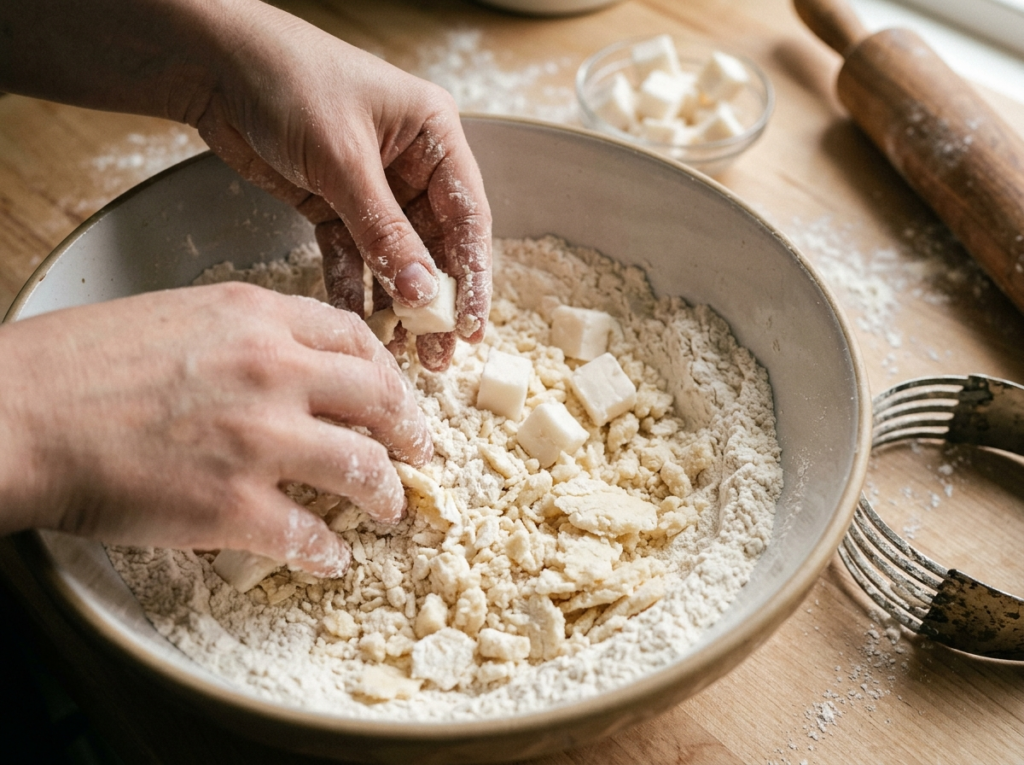
Start by whisking together the flour, salt, and sugar in a large bowl. Add your cold, cubed lard. Using a pastry cutter, two forks, or your fingertips, work the lard into the flour until the mixture looks like coarse meal with some pea-sized chunks remaining. Those chunks are important — they’re what will melt in the oven and create flaky layers.
Drizzle in the ice water one tablespoon at a time, tossing the mixture with a fork after each addition. You want to add just enough water so the dough holds together when you squeeze a handful. It should look shaggy and slightly dry — not smooth and wet. Over-hydrating is one of the most common mistakes in pie crust making, and it leads to a tough result.
Divide the dough in half, shape each half into a flat disc, and wrap them in plastic wrap. Refrigerate for at least one hour, or up to two days. This resting time lets the gluten relax and the fat firm up again, both of which make rolling easier and the final crust more tender.
When you’re ready to roll, work on a lightly floured surface. Roll from the center outward, rotating the dough a quarter turn after every few strokes. Don’t press down hard — let the rolling pin do the work. You want the crust about ⅛ inch thick.
Pro Tip: If your kitchen runs warm, pop the rolled-out crust back into the fridge for 10–15 minutes before fitting it into the pie plate. Cold fat going into a hot oven is the secret to maximum flake.
The Butter-Lard Hybrid: Best of Both Worlds?
Here’s something professional bakers have known for years: you don’t have to choose one or the other. A blend of lard and butter gives you the flakiness and tenderness of lard with the rich, golden flavor of butter.
A common ratio is 60% lard to 40% butter. So if your recipe calls for one cup of fat, use about ⅔ cup lard and ⅓ cup butter. The lard handles the structural work — creating those shatteringly crisp layers — while the butter brings its unmistakable taste and helps the crust brown beautifully.
This hybrid approach is actually what many bakeries known for exceptional pastry use, even if they don’t always advertise it. There’s a reason their crusts taste different from what you make at home with an all-butter recipe. The lard is the quiet workhorse behind the scenes.
If you’re making a savory pie — a quiche, a chicken pot pie, a meat pie — you might even go 100% lard. The neutral flavor pairs perfectly with savory fillings, and the extra flakiness works beautifully as a vessel for rich, hearty ingredients.
Common Mistakes That Ruin a Lard Pie Crust
Even with the right fat, pie crust can go sideways. Here are the errors that trip people up most often.
Using warm lard. The fat needs to be cold. Really cold. If you’re using lard straight from the fridge, cut it into cubes and pop those cubes in the freezer for 15 minutes before you start. Warm fat blends too smoothly into the flour, and you lose those precious pea-sized chunks that create flake.
Overworking the dough. The moment your dough comes together, stop touching it. Every extra knead, fold, or press develops more gluten, and more gluten means a tougher crust. It’s okay if the dough looks a bit rough and imperfect. Perfection in appearance usually means toughness in texture.
Skipping the rest. That hour in the fridge isn’t optional. Cold dough rolls out more evenly, shrinks less during baking, and produces a more tender result. If you’re short on time, even 30 minutes helps. But an hour is better.
Adding too much water. This is the number one pie crust killer. Add water one tablespoon at a time and stop the second the dough holds together when you press a handful. If it’s sticky, you’ve gone too far. A dry, shaggy dough that barely holds together is exactly what you want.
Using the wrong lard. As we covered earlier, hydrogenated supermarket lard and pure leaf lard are very different products. If your crust has an off-putting flavor, it’s almost certainly the lard’s fault — not the technique.
Getting comfortable with technique takes practice. It’s the same patience you’d apply to mastering knife skills or learning to balance acid and fat in a dish. The fundamentals matter more than fancy tricks.
What About Health? Is Lard Actually Okay to Eat?
Let’s address the elephant in the room. Most people hesitate about lard because they’ve been told animal fat is bad for you. The full picture is more nuanced than that.
Lard is about 40% saturated fat, 45% monounsaturated fat (the same heart-friendly fat found in olive oil), and about 11% polyunsaturated fat. Compare that to butter, which is roughly 63% saturated fat. On a gram-for-gram basis, lard actually contains less saturated fat than butter.
It also has no trans fats — assuming you’re using unhydrogenated lard. Crisco and other hydrogenated shortenings, the very products that replaced lard in American kitchens, were loaded with trans fats for decades. (Crisco reformulated in 2007 to remove most trans fats, but the irony remains.)
Lard from pastured pigs is also a natural source of vitamin D. In fact, it’s one of the richest food sources of vitamin D available, with about 1,000 IU per tablespoon depending on the animal’s diet and sun exposure. That’s a significant amount.
None of this means you should eat lard by the spoonful. It’s still a calorie-dense fat, and moderation matters. But if you’re using a cup of fat to make a pie crust that serves eight people, the amount of lard per slice is modest. You’re not eating the whole pie. (Well, probably not.)
The point is this: the health gap between lard and butter is much smaller than most people think, and lard is meaningfully healthier than the hydrogenated shortening that replaced it. You can use it with a clear conscience.
Lard Beyond Pie Crust
Once you’ve got leaf lard in your kitchen, you’ll start finding uses for it everywhere. It makes extraordinarily flaky biscuits — the kind that pull apart in layers and practically float off the baking sheet. It’s perfect for frying because of its high smoke point (around 370°F), producing crispier results than most vegetable oils with less greasy mouthfeel.
Tamales are traditionally made with lard-beaten masa, and the texture is impossible to replicate with butter or oil. If you’ve ever had authentic breakfast in Mexico City, you’ve tasted what lard can do in skilled hands. It’s also a traditional fat in British and Irish baking — think lardy cake, hot water crust for pork pies, and savory pastries.
And if you do any serious cooking with heritage recipes, you’ll notice that lard appears again and again. It was the default fat in most kitchens around the world until very recently in historical terms. We’re the outliers for not using it, not the other way around.
FAQ
Does lard pie crust taste like pork?
Not if you’re using the right kind. High-quality leaf lard, properly rendered, has virtually no pork flavor. It’s clean, mild, and neutral — perfect for both sweet and savory pies. If your crust tastes porky, you’re likely using commercial lard or lard rendered from fatback or other cuts that carry more flavor. Switch to leaf lard and the issue disappears.
Can I substitute lard 1:1 for butter in any pie crust recipe?
Yes, you can swap lard for butter at a 1:1 ratio by weight. Because lard contains no water (butter is about 15–20% water), your dough may need slightly less ice water than the recipe calls for. Add it slowly and stop when the dough just barely holds together. You might also notice the dough feels slightly different — a bit more pliable and less sticky. That’s normal.
Where can I buy leaf lard if my grocery store doesn’t carry it?
Try your local butcher shop, farmer’s market, or a heritage pork farm. Many sell rendered leaf lard or will sell you the raw leaf fat so you can render it at home. Online retailers like Fatworks, US Wellness Meats, and Epic also ship high-quality leaf lard nationwide. If you’re ordering online, buying in bulk and freezing it is the most cost-effective approach.
How should I store lard?
Rendered lard keeps in the fridge for three to six months and in the freezer for up to a year. Store it in an airtight container. It’ll solidify into a smooth, white block in the fridge. You can scoop or cut off what you need and let it come to just barely below room temperature before cubing it for pie crust. Always keep it cold for pastry work, though.
Is a lard crust good for fruit pies?
It’s ideal for fruit pies. Because leaf lard has a neutral flavor, it doesn’t compete with delicate fruit fillings the way butter sometimes can. The extra flakiness also holds up well against juicy fillings — a lard crust stays crisp longer than an all-butter crust, which is a real advantage with something like a cherry or blueberry pie that throws off a lot of liquid.
Your Next Pie Deserves Better Fat
The best pie crust you’ll ever make might come down to one simple change: reaching for lard instead of — or alongside — butter. It’s not a trendy ingredient or a gimmick. It’s the fat that bakers used for generations because it flat-out works better for this particular job.
Pick up some quality leaf lard, keep your ingredients cold, resist the urge to overwork the dough, and give it a real shot. One pie is all it takes to understand why your grandmother’s crust tasted the way it did. And once you know, you won’t go back.