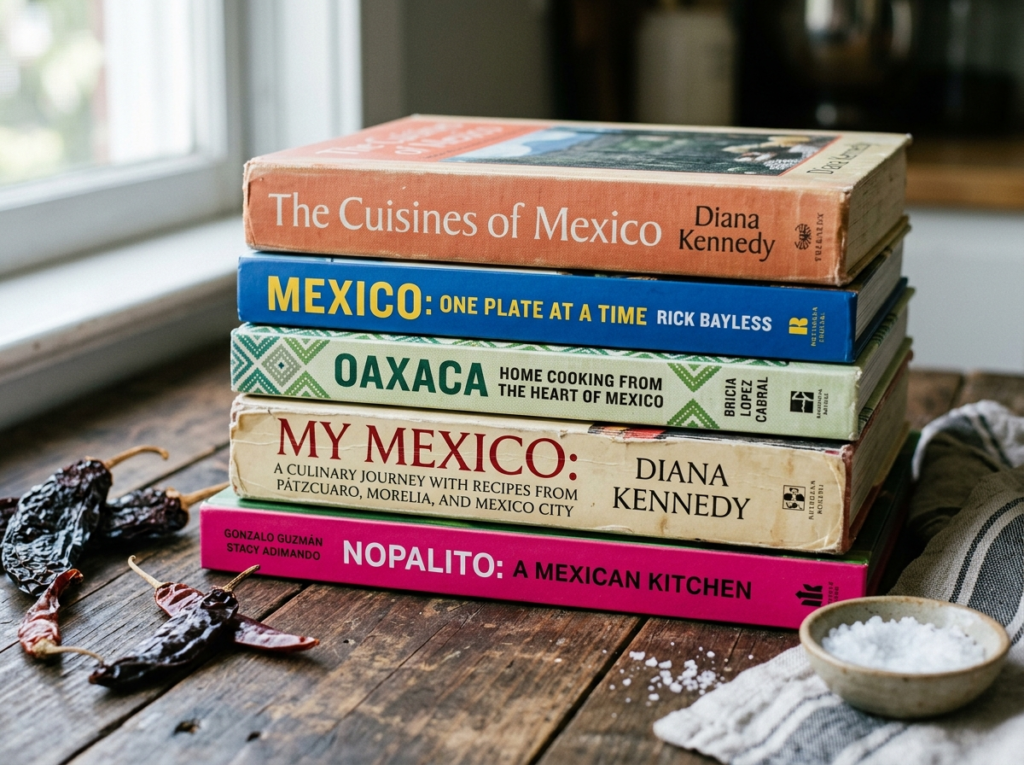
Mexican food is one of the most misunderstood cuisines in the United States. Most people think they know it — tacos, burritos, maybe some guacamole — but the real depth of Mexican cooking stretches across dozens of regional traditions, centuries of Indigenous knowledge, and ingredients that many home cooks have never even heard of. I’ve spent years cooking from Mexican cookbooks, traveling through Mexico, and eating my way through breakfast spots in Roma Norte and market stalls in Oaxaca. And honestly? The right cookbook changed everything for me.
Not every Mexican cookbook deserves a spot on your shelf, though. Some are too complicated. Others are watered down for an audience that doesn’t want to be challenged. The five I’m sharing here are the ones I actually cook from — the ones with sticky pages, chili-stained margins, and dog-eared corners. They’re the books that taught me to think about Mexican food differently and, more importantly, to cook it well.
If you’re tired of the same Tex-Mex routines and want to genuinely understand what makes Mexican cuisine one of the world’s great food traditions, these are where you start.
Why the Right Mexican Cookbook Matters More Than You Think
Here’s something most people don’t consider: Mexican cuisine was designated an Intangible Cultural Heritage of Humanity by UNESCO in 2010. It’s one of only a handful of food traditions in the world to receive that honor. That tells you something. This isn’t just “food.” It’s a living, breathing cultural practice rooted in thousands of years of history — from ancient Mesoamerican corn cultivation to Spanish colonial influences to modern innovation.
So when you pick up a Mexican cookbook, you’re not just picking up recipes. You’re picking up a lens into that culture. And the quality of that lens matters enormously.
A bad Mexican cookbook gives you simplified versions of complex dishes and strips away the context that makes them meaningful. A great one teaches you why you’re toasting those dried chiles before blending them. It explains the difference between a mole negro from Oaxaca and a mole poblano from Puebla — not just in ingredients but in philosophy. It makes you a better, more thoughtful cook.
The five books below do exactly that. Each one approaches Mexican food from a slightly different angle, and together, they give you a remarkably complete education.
1. “The Essential Cuisines of Mexico” by Diana Kennedy
You can’t talk about Mexican cookbooks without talking about Diana Kennedy. She’s often called the Julia Child of Mexican cuisine, and while that comparison oversimplifies her work, it captures her importance. Kennedy, a British-born food writer who spent over 50 years living in Mexico, devoted her life to documenting regional Mexican cooking with a level of rigor that nobody else has matched.
“The Essential Cuisines of Mexico” is actually a compilation of three of her earlier books — The Cuisines of Mexico (1972), The Tortilla Book, and Mexican Regional Cooking — combined and updated into one volume. It’s dense. It’s detailed. And it’s not always the easiest book to cook from on a Tuesday night. But that’s not really the point.
What Kennedy gives you is authority. Her recipes are meticulously researched, often learned directly from home cooks in remote Mexican villages. She doesn’t simplify for convenience. If a recipe calls for epazote or hoja santa, she expects you to find it. If a salsa requires a specific type of dried chile, she’ll explain why a substitute won’t quite work.
Who is this book for? Serious home cooks who want the real thing. If you’ve ever wondered why your mole doesn’t taste like the one you had in Mexico City, Kennedy will show you what you’re missing. Her sections on the regional diversity of Mexican food are worth the price of the book alone.
Pro Tip: Don’t try to cook through this book cover to cover. Pick a region that interests you — say, Veracruz or Michoacán — and work through those recipes. You’ll learn more that way than jumping around.
Diana Kennedy passed away in 2022 at the age of 99, but her work remains the gold standard. If you only buy one Mexican cookbook in your life, this is a strong contender.
2. “Oaxaca al Gusto” by Diana Kennedy
Yes, Diana Kennedy again. But “Oaxaca al Gusto” is such a different book from “The Essential Cuisines of Mexico” that it deserves its own spot. Published in 2010 after years of research, this book focuses entirely on the cooking traditions of Oaxaca — a state in southern Mexico that many food scholars consider the culinary heart of the country.
Oaxacan cuisine is extraordinarily complex. The state is known for its seven moles, its mezcal culture, its chapulines (grasshoppers), its chocolate traditions, and its use of ingredients like hierba santa and chepiche that you won’t find in most other regional cuisines. Kennedy spent years traveling through remote Oaxacan communities, documenting recipes that had never been written down before.
The book itself is almost encyclopedic. It’s large, beautifully photographed, and incredibly thorough. Kennedy organized it by ingredient and technique rather than by course, which makes it feel more like a reference guide than a straightforward cookbook. You’ll find recipes for things you’ve probably never encountered — tamales de rajas wrapped in banana leaves, caldos made with dried shrimp, and multiple variations of mole negro that reflect village-to-village differences.
A word of honest warning: this isn’t a weeknight cooking book. Some of these recipes require ingredients that are genuinely difficult to source outside of Mexico, and the preparation times can be significant. But as a document of a culinary tradition, it’s unmatched. If you care about understanding why Mexican food tastes the way it does — not just how to make it — this book will change how you think about cooking entirely.
I pair this book naturally with my interest in chocolate and its deep cultural roots, since Oaxaca is one of the great cacao regions of the world. Kennedy’s treatment of Oaxacan chocolate drinks and moles that incorporate chocolate is especially enlightening.
3. “My Mexico City Kitchen” by Gabriela Cámara
If Diana Kennedy represents the scholarly, documentary approach to Mexican cooking, Gabriela Cámara represents the modern, restaurant-driven perspective. Cámara is the chef behind Contramar, one of Mexico City’s most celebrated restaurants, and she later opened Cala in San Francisco. Her cookbook, published in 2019, reflects both her deep roots in Mexican tradition and her willingness to adapt those traditions for a contemporary kitchen.
What I love about this book is its practicality. Cámara doesn’t expect you to track down obscure ingredients from a Oaxacan mountain village. Her recipes are thoughtful and flavorful but designed for a home cook who shops at a regular grocery store — maybe with a trip to a Mexican market for a few specialty items. The tostadas de atún (tuna tostadas) that made Contramar famous are here, and they’re surprisingly doable at home.
The book is organized by course — snacks, soups, mains, desserts — which makes it intuitive to use. Her sections on salsas and beans are particularly strong. Cámara treats beans with the respect they deserve in Mexican cooking, and her recipes for frijoles de olla (pot beans) and frijoles refritos are the kind of foundational techniques every cook should know.
There’s also a warmth to her writing that makes the book feel personal. She shares stories about growing up in Mexico City, about the markets she loves, and about how food connects her to her family and community. It’s the kind of book that makes you want to cook and makes you want to visit Mexico.
Who is this book for? Home cooks who want authentic Mexican flavors without needing a specialty pantry. If you’re someone who already knows how to organize a small kitchen efficiently, Cámara’s streamlined approach will feel right at home.
4. “Pati’s Mexican Table” by Pati Jinich
Pati Jinich holds a special place in the world of Mexican food education. Born in Mexico City, she’s the host of the long-running PBS show “Pati’s Mexican Table” and serves as the resident chef at the Mexican Cultural Institute in Washington, D.C. Her cookbook, published in 2013, is the most accessible book on this list — and I mean that as a genuine compliment.
Jinich has a gift for explaining Mexican cooking to people who didn’t grow up with it. She doesn’t dumb things down, but she also doesn’t assume you already know your way around a molcajete. Every recipe comes with clear instructions, helpful headnotes that explain the cultural context, and practical tips for substitutions when you can’t find specific ingredients.
Her enchiladas suizas recipe alone is worth buying this book. And her approach to Mexican home cooking — the everyday food that Mexican families actually eat, not the elaborate restaurant preparations — fills a gap that many other cookbooks leave wide open. You’ll find recipes for chilaquiles, sopa de fideos, albóndigas, and dozens of other dishes that represent real Mexican weeknight dinners.
The book also covers a nice range of difficulty levels. Some recipes take 20 minutes. Others, like her cochinita pibil, require more planning. But Jinich always tells you upfront what to expect, and her instructions are reliable. I’ve never had a recipe from this book fail on me, which is more than I can say for a lot of cookbooks.
Did you know? Pati Jinich has a background in Latin American politics — she studied political science before pivoting to food. That interdisciplinary perspective shows in how she contextualizes dishes within Mexico’s broader social and cultural history.
If you’re someone who appreciates understanding the story behind a dish — the way food can bring people together across cultures — Jinich’s writing will resonate with you deeply.
5. “Tu Casa Mi Casa” by Enrique Olvera
Enrique Olvera is the chef behind Pujol, consistently ranked among the best restaurants in the world. His earlier cookbook, Mexico from the Inside Out, was a beautiful but intensely cheffy book that most home cooks would struggle with. “Tu Casa Mi Casa,” published in 2019, is his answer to a simple question: what does he actually cook at home?
The result is a remarkably personal and surprisingly approachable book. Olvera shares around 100 recipes that represent his own version of everyday Mexican cooking — the food he grew up eating and the food he makes for his family. You’ll find huevos rancheros, tacos de guisado, arroz rojo, and a handful of desserts that reflect both traditional and modern Mexican sensibilities.
What sets this book apart is Olvera’s perspective as a world-class chef who chooses simplicity. He’s not simplifying because he doesn’t know the complicated version. He’s simplifying because he believes great Mexican food doesn’t need to be fussy. His guacamole recipe has five ingredients. His black beans are straightforward. And they’re all fantastic.
The book also includes a useful pantry section that walks you through essential Mexican ingredients — dried chiles, fresh herbs, specific types of corn — and explains how to source and store them. For someone building a Mexican cooking practice from scratch, this section alone is incredibly valuable.
A small caveat: the photography in this book is stunning but quite stylized. Don’t expect your finished dishes to look exactly like the photos. That’s true of most chef-driven cookbooks, though, and it doesn’t diminish the quality of the recipes at all.
I’d recommend this book to anyone who’s already comfortable in the kitchen and wants to elevate their Mexican cooking with a professional’s sensibility. If you’ve been picking up tricks from professional chefs and applying them at home, Olvera’s approach will feel like a natural next step.
How These Five Cookbooks Work Together
One thing I want to emphasize: these books aren’t redundant. They each cover different territory, and together they give you something close to a complete Mexican cooking education.
Diana Kennedy’s two books provide the scholarly foundation — the deep history, the regional specificity, the commitment to authenticity. Gabriela Cámara bridges tradition and modernity, showing you how contemporary Mexican chefs honor the past while cooking for today. Pati Jinich makes Mexican home cooking accessible and joyful for everyday life. And Enrique Olvera adds a chef’s refinement without losing the soul of the food.
If you’re just getting started, I’d suggest beginning with Pati Jinich’s book. It’s the most forgiving and the most practical for a newcomer. Once you feel confident with her recipes, move to Gabriela Cámara for a slightly more ambitious but still accessible experience. Then, when you’re ready to really go deep, pick up Diana Kennedy.
Olvera’s book works at any stage — it’s simple enough for beginners but nuanced enough that experienced cooks will appreciate his choices.
Building Your Mexican Pantry
You’ll notice that all five of these books reference certain ingredients over and over. If you’re serious about cooking Mexican food at home, stock your pantry with these essentials. You don’t need everything at once — build gradually as you cook through recipes.
Dried chiles are the backbone of Mexican cooking. Start with three: ancho (mild, sweet), guajillo (medium, fruity), and chipotle (smoky, spicy). These three will cover the majority of salsas, moles, and adobos you’ll encounter in these books.
Corn products matter too. Masa harina (like Maseca or Bob’s Red Mill) lets you make fresh tortillas, tamales, and gorditas. If you can find fresh masa at a local tortillería or Mexican grocery, even better.
Herbs and aromatics include fresh cilantro (obviously), Mexican oregano (different from Mediterranean oregano — it’s earthier and more citrusy), and epazote if you can find it. Epazote is traditionally used in bean dishes and quesadillas, and it adds a flavor you really can’t replicate with anything else.
Tomatillos are essential. They’re not green tomatoes — they’re a different fruit entirely, wrapped in papery husks. You’ll use them constantly for salsa verde and green moles.
Keep Mexican crema, queso fresco, and cotija cheese in your fridge. They finish dishes in ways that sour cream and cheddar simply don’t.
Understanding the fundamentals of acid and fat in cooking makes a huge difference when working with Mexican cuisine, where lime juice, lard, and vinegar play starring roles.
What About Digital Recipes and Social Media?
I get asked this a lot: with so many Mexican recipes available free online, why buy cookbooks at all?
Fair question. And yes, you can find good Mexican recipes on YouTube, Instagram, and food blogs. But here’s what a cookbook gives you that a random online recipe doesn’t: context and coherence.
A great cookbook teaches you a system. It builds your understanding from the ground up. When Pati Jinich explains how to roast tomatillos for a salsa verde, she’s not just giving you one recipe — she’s teaching you a technique you’ll use in dozens of other dishes. When Diana Kennedy walks you through the process of making a mole from scratch, she’s showing you how flavors layer and develop in a way that a 60-second reel can’t capture.
Cookbooks also go through rigorous recipe testing. Most published cookbooks have their recipes tested multiple times by multiple people before going to print. A random blog recipe? Maybe, maybe not.
That said, I do think YouTube is a fantastic companion to these books. Watching someone toast and rehydrate chiles is genuinely helpful the first time you do it. Just don’t let social media replace the depth that a good cookbook provides.
A Note on Authenticity and Respect
Mexican cooking carries a complicated conversation about authenticity, cultural ownership, and respect. I think it’s worth addressing briefly.
The best approach, I’ve found, is to learn from Mexican voices. Four of the five authors on this list are Mexican. Diana Kennedy, the exception, spent over half a century living in Mexico, learning from Mexican home cooks, and received Mexico’s Order of the Aztec Eagle — the highest honor given to foreigners — for her contributions to preserving Mexican culinary traditions. She earned her place in this conversation through decades of respectful, rigorous work.
When you cook from these books, you’re supporting Mexican culinary voices and learning the right way to prepare these dishes. That matters. It’s the difference between making a pale imitation and making something that honors the tradition.
Cook with curiosity. Ask questions. Visit Mexican grocery stores and talk to the people who work there — they’re usually happy to help you find what you need. And if you get the chance, travel. Eating breakfast at a neighborhood spot in Mexico City’s Roma Norte or browsing a mercado in Oaxaca will teach you things no cookbook can.
FAQ
Which Mexican cookbook is best for beginners?
“Pati’s Mexican Table” by Pati Jinich is the most beginner-friendly book on this list. Her instructions are clear, she offers substitutions for hard-to-find ingredients, and the recipes range from very simple to moderately complex. You won’t feel overwhelmed, and the results are consistently delicious.
Are Diana Kennedy’s cookbooks too difficult for home cooks?
They can be challenging, but they’re not impossible. “The Essential Cuisines of Mexico” includes plenty of straightforward recipes alongside the more ambitious ones. The key is not to start with the most complex mole in the book. Pick simpler dishes first — salsas, soups, egg dishes — and build your skills from there. “Oaxaca al Gusto” is definitely the more advanced of her two books and is better suited to experienced cooks.
Do I need special equipment to cook from these Mexican cookbooks?
Not really. A blender (a regular countertop blender works fine), a cast iron skillet or comal for toasting chiles and tortillas, and a heavy-bottomed pot for beans and stews will cover 90% of what these books ask for. A molcajete (stone mortar and pestle) is nice to have for salsas but isn’t strictly necessary. A tortilla press is useful if you plan to make fresh tortillas regularly, and they’re inexpensive.
Can I find the ingredients these cookbooks call for outside of Mexico?
Most of them, yes. Dried chiles, masa harina, tomatillos, Mexican crema, and cotija cheese are widely available at Mexican grocery stores and increasingly at mainstream supermarkets. A few ingredients in Diana Kennedy’s books — particularly in “Oaxaca al Gusto” — are genuinely difficult to source outside of Mexico. Online specialty retailers can help fill the gaps.
Is Enrique Olvera’s “Tu Casa Mi Casa” a restaurant cookbook?
No, and that’s what makes it special. Olvera’s earlier book, Mexico from the Inside Out, was very much a restaurant cookbook with complex techniques. “Tu Casa Mi Casa” is specifically designed for home cooking. The recipes are straightforward, the ingredient lists are reasonable, and the focus is on the everyday Mexican food that Olvera grew up eating.
Your Kitchen Is Waiting
Five cookbooks might seem like a lot, but think of them as an investment in a cuisine that will reward you for years. Mexican food is endlessly varied — you could cook from these books every week and still discover new dishes a decade from now.
Start with whichever book matches where you are right now as a cook. Don’t worry about getting everything perfect on the first try. Your salsa might be too thin. Your tortillas might look more like amoebas than circles. That’s fine. The point is to keep cooking, keep tasting, and keep learning.
And when your copy of “The Essential Cuisines of Mexico” has chile stains on page 47 and your “Pati’s Mexican Table” won’t close properly because you’ve bookmarked too many pages — that’s when you’ll know these books have done their job.