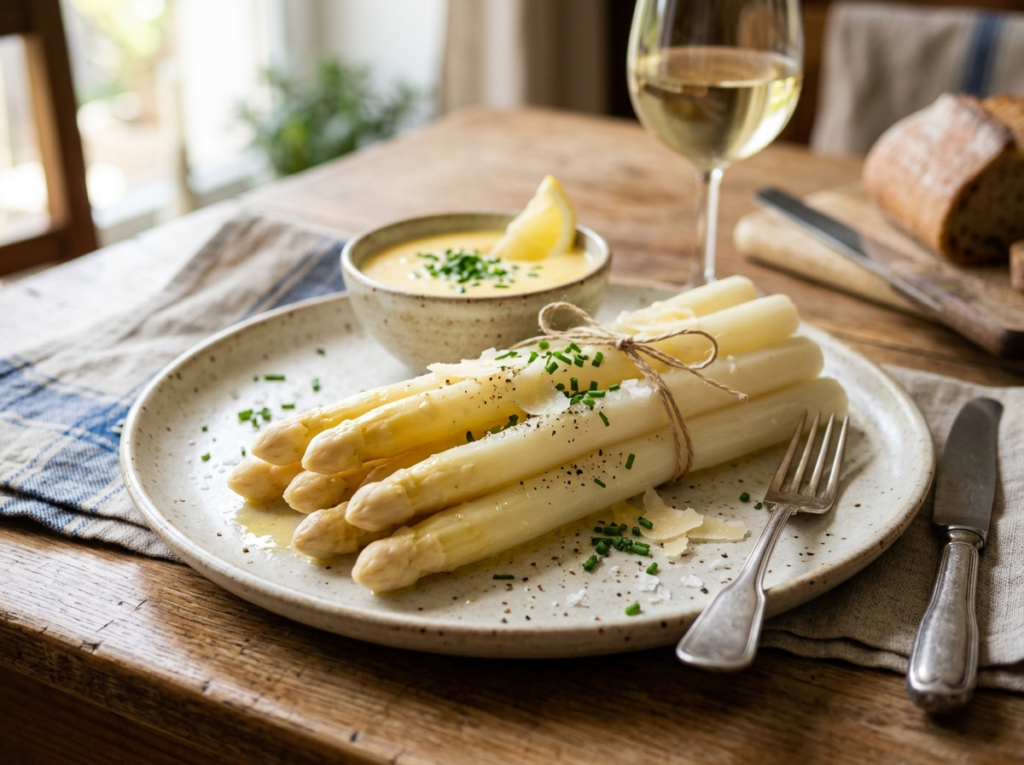
Every spring, something quietly extraordinary shows up at European markets, fine dining restaurants, and specialty grocers. White asparagus — sometimes called “white gold” or Spargel in Germany — has a season so short and so celebrated that entire festivals revolve around it. In Germany alone, the white asparagus harvest generates over 1.5 billion euros annually, and people genuinely plan their meals around its brief window from mid-April through late June.
Yet if you live in North America, there’s a good chance you’ve walked past it, or maybe you picked up a bundle and had no idea what to do with it. You’re not alone. White asparagus isn’t just a paler version of the green spears you’re used to. It tastes different, cooks differently, and demands a bit more respect in the kitchen. But once you understand what you’re working with, it becomes one of the most rewarding seasonal ingredients you’ll ever put on a plate.
Let’s talk about what makes white asparagus special, why the season matters, and exactly how to cook it so you don’t waste a single stalk.
What Exactly Is White Asparagus?
Here’s the thing that surprises most people: white asparagus isn’t a different species. It’s the same plant — Asparagus officinalis — as the green variety you buy year-round. The difference is entirely about sunlight, or rather, the absence of it.
Farmers grow white asparagus underground, buried beneath mounded soil or covered with black tarps. Without exposure to sunlight, the spears never develop chlorophyll. No chlorophyll means no green color. What you get instead is a pale, ivory-white stalk with a slightly different flavor profile, a more tender texture (when cooked properly), and a subtle sweetness that green asparagus doesn’t quite have.
Think of it like this: if green asparagus is a crisp, grassy spring vegetable, white asparagus is its gentler, more refined cousin. The flavor is milder, slightly nutty, with hints of something almost floral. Some people describe it as having a faint bitterness, but that usually means the outer skin wasn’t peeled properly — we’ll get to that.
Quick fact: The technique of growing vegetables without sunlight is called “etiolation,” and it’s been used in European agriculture for centuries. Belgian endive is grown the same way.
Why Does the Season Matter So Much?
You can technically find white asparagus outside its natural season, imported from Peru or preserved in jars. But ask anyone who’s eaten fresh-cut white asparagus during peak season, and they’ll tell you there’s no comparison.
The season runs roughly from mid-April through June 24th — a date the Germans call Spargelsaison or Spargelzeit (asparagus time). June 24th, the Feast of St. John, is traditionally the last day of harvest. After that, farmers let the plants grow freely so they can regenerate energy for next year. It’s a strict cutoff, and it’s one reason the season feels so special. You know it’s ending, so every plate feels a little more precious.
During these few weeks, restaurants across Germany, the Netherlands, France, and parts of northern Europe build entire menus around white asparagus. Germany produces roughly 130,000 tons of white asparagus per year, making it the country’s most-consumed vegetable during spring. There are asparagus queens crowned at local festivals. Roads are lined with pop-up Spargel stands. It’s not subtle.
And the freshness matters enormously. White asparagus loses moisture and sweetness quickly after harvest. A stalk that was cut that morning will taste noticeably better than one that’s been sitting in transit for three days. That’s why locally grown, in-season spears are so prized — and why the jarred or canned versions taste like a completely different vegetable (because, honestly, they sort of are).
How to Pick Good White Asparagus
If you’re lucky enough to find fresh white asparagus at a farmer’s market, specialty store, or European grocer, here’s what to look for:
The squeeze test. Gently squeeze a stalk near the base. It should feel firm and taut, not rubbery or limp. Fresh spears snap cleanly when you bend them — just like green asparagus.
Check the cut end. The bottom of the stalk should look moist and freshly cut, not dried out or brown. If it’s shriveled, the asparagus has been sitting around too long.
Look at the tips. They should be tightly closed and pale, not opening up or turning purple. A slight violet or pinkish tint at the tip is okay — it means the spear just barely poked through the soil before being harvested. But heavy discoloration often signals more bitterness.
Smell it. Fresh white asparagus has a clean, slightly sweet, earthy scent. If it smells sour or off, pass on it.
Size matters — but not how you’d think. Thicker stalks are actually preferable for white asparagus, unlike green asparagus where thinner spears are often more tender. Thick white asparagus has a better ratio of creamy interior to fibrous outer skin, and it holds up much better to peeling and cooking.
How to Cook White Asparagus (Without Ruining It)
This is where most home cooks go wrong. You can’t just treat white asparagus like its green cousin. Throw it on a hot grill or stir-fry pan without prepping it, and you’ll end up with something tough and bitter. A little preparation goes a long way.
Peeling Is Non-Negotiable
The outer skin of white asparagus is fibrous and unpleasant to eat. You must peel it. Use a standard vegetable peeler, starting about an inch below the tip and working downward to the base. Peel all around each stalk, removing a thin but complete layer.
Don’t throw those peels away, either. Simmer them in water with a pinch of salt and sugar for 15 minutes, and you’ve got a light asparagus broth that’s perfect as your cooking liquid — or as the base of a beautiful spring soup.
Trim the Woody Ends
Cut off the bottom inch or so of each stalk. These ends are usually too fibrous even after peeling. Again, toss them into that broth pot if you’re making one.
The Classic Cooking Method
The traditional German approach is simple and hard to beat:
Bring a wide pot of water to a gentle boil. Add a good pinch of salt, a teaspoon of sugar, a squeeze of lemon juice, and a tablespoon of butter. The sugar balances any bitterness. The lemon keeps the stalks white. The butter adds richness to the cooking liquid, which subtly flavors the asparagus as it simmers.
Lay the spears in the water (don’t overcrowd them) and simmer gently for 12 to 18 minutes, depending on thickness. You want them tender enough that a knife slides in easily, but not so soft that they fall apart. Think al dente pasta — you still want a tiny bit of resistance at the core.
Pro Tip: If you have an asparagus pot (a tall, narrow pot with a basket insert), you can cook them standing up with the tips above the waterline. The thicker bottoms cook in the boiling water while the delicate tips steam gently. It’s the traditional method, and it works beautifully.
Other Ways to Cook Them
Once you’ve got the basics down, you can experiment. Roasting peeled white asparagus at 400°F (200°C) with olive oil, salt, and a touch of honey for about 20 minutes brings out a lovely caramelized sweetness. Pan-searing them in brown butter with a splash of white wine is another great option — it gives you some color and a nuttier flavor.
Grilling works too, but only if you’ve peeled the stalks first and you’re using medium heat. High, direct flame will char the outside before the inside cooks through.
If you’re into the art of building clean, elegant flavors from scratch, white asparagus broth is a wonderful starting point for refined spring soups and sauces.
Classic Pairings — What Goes With White Asparagus?
One of the beautiful things about white asparagus is that it plays well with rich, simple accompaniments. You don’t need to over-complicate it.
The Traditional German Plate
In Germany, the classic Spargel plate is practically sacred: a generous portion of boiled white asparagus, hollandaise sauce (or drawn butter), boiled new potatoes, and a few slices of smoked or cured ham — often Schwarzwälder Schinken (Black Forest ham). That’s it. Nothing fancy, nothing fussy. The asparagus is the star.
If you’ve been working on your knife skills in the kitchen, this is a dish where clean, precise cuts on those potatoes and ham actually make a visual difference on the plate. Presentation doesn’t need to be complex — just intentional.
Hollandaise: The Perfect Match
Hollandaise sauce is the classic companion for a reason. The buttery richness, the tang of lemon, the slight warmth from cayenne — it all wraps around the delicate asparagus flavor without drowning it. If you’ve never made hollandaise from scratch, white asparagus season is your excuse to learn. It’s easier than you think: egg yolks, clarified butter, lemon juice, and a bit of patience with a double boiler.
Warning: Don’t use the packet hollandaise. Just don’t. You’ll taste the difference immediately, and it defeats the purpose of cooking with a premium seasonal ingredient.
Eggs in Every Form
Poached eggs, soft-boiled eggs, fried eggs — all of them work. There’s something about a runny yolk breaking over warm white asparagus spears that feels like spring on a plate. A classic French preparation serves white asparagus with a poached egg and shaved Parmesan, dressed with a light vinaigrette. Simple, elegant, satisfying.
Wine Pairing
White asparagus has a reputation for being tricky with wine, but it doesn’t have to be. Stick with crisp, mineral-driven whites. German Riesling (especially trocken/dry styles), Grüner Veltliner from Austria, or a dry Alsatian Pinot Blanc all complement the asparagus without competing with it. Avoid heavy oaked Chardonnay or big reds — they’ll overwhelm the delicate flavor. If you’re curious about how to choose the right glass for your wine, that can actually make a difference with lighter whites like these.
White Asparagus Around the World
Germany is the undisputed capital of white asparagus culture, but it’s far from the only place that celebrates this ingredient.
The Netherlands goes almost as wild for witte asperges as Germany does. Dutch preparations tend to feature it with smoked salmon, egg mimosa (chopped hard-boiled egg), and melted butter. You’ll find it on nearly every restaurant menu from late April through June.
France treats white asparagus as a refined luxury. It’s often served cold with a mustardy vinaigrette or warm with a mousseline sauce (hollandaise lightened with whipped cream). The Alsace region, given its proximity to Germany, shares much of the Spargel enthusiasm.
Spain grows excellent white asparagus in Navarra, where it’s traditionally preserved in jars — and the jarred Navarran asparagus is actually quite good, unlike most canned versions. You’ll find it served simply with good olive oil and sea salt, or as part of a Basque-inspired meal alongside cured meats and local cheeses.
In the United States, white asparagus remains a niche ingredient, but it’s becoming easier to find. Some farms in California, Washington state, and Michigan grow it seasonally. Farmer’s markets are your best bet, or specialty grocers like Whole Foods during peak season.
Storing White Asparagus (Keep It Fresh)
You bought a beautiful bundle. Now what? Don’t let it sit in the fridge unwrapped for three days. White asparagus is more perishable than green, and every hour matters.
Wrap the stalks in a damp kitchen towel, then loosely in plastic wrap or place them in a zip-top bag. Store them in the crisper drawer. They’ll stay good for two to three days this way, but ideally, you want to cook them the day you buy them.
Another trick: stand them upright in a container with about an inch of water, like a bouquet of flowers, and cover the tips loosely with a damp paper towel. This keeps them hydrated and firm.
Don’t freeze raw white asparagus. The texture suffers badly. If you absolutely must preserve them, blanch the peeled spears for 2 minutes, ice bath them immediately, dry thoroughly, and then freeze. They won’t be quite the same, but they’ll be usable in soups and purées.
A Simple Recipe to Get You Started
If you’ve never cooked white asparagus before, start here. This is the no-fuss, classic approach that lets the ingredient speak for itself.
White Asparagus with Brown Butter and Crispy Capers
Peel 1 pound of white asparagus and trim the ends. Simmer in salted water with a pinch of sugar and squeeze of lemon for 14-16 minutes until just tender. While the asparagus cooks, melt 3 tablespoons of unsalted butter in a skillet over medium heat. Let it foam and turn golden — you’ll smell a nutty aroma when it’s ready. Add 2 tablespoons of drained capers to the butter. They’ll sizzle and pop and get beautifully crispy in about 90 seconds. Add a squeeze of lemon juice to the pan (careful, it’ll sputter) and swirl.
Drain the asparagus, plate it, and spoon the brown butter and crispy capers over the top. Finish with flaky sea salt and maybe a few shavings of Parmesan if you’re feeling fancy.
That’s it. Ten minutes of active cooking, and you’ve got a dish that looks and tastes like it came from a restaurant. If you’re someone who values simple plating techniques that elevate home cooking, this is a great dish to practice with — the white spears look stunning against a dark plate.
White vs. Green vs. Purple: A Quick Comparison
People sometimes ask whether white asparagus is better than green. It’s not a matter of better — it’s a matter of different.
Green asparagus grows above ground, develops chlorophyll, and has a grassy, slightly vegetal flavor. It cooks fast, works beautifully grilled or roasted, and doesn’t need peeling (unless the stalks are very thick). It’s versatile and forgiving.
White asparagus is milder, sweeter, and more subtle. It requires peeling, takes longer to cook, and pairs best with rich, buttery sauces. It’s a more deliberate ingredient — you build a dish around it rather than tossing it into a stir-fry.
Purple asparagus is the wild card. It’s sweeter than both and has a gorgeous color, but it turns green when cooked, which disappoints some people. It’s best eaten raw or barely blanched to preserve both color and crunch.
If you’re someone who enjoys hunting for wild asparagus in spring, you know that asparagus in all its forms is one of those ingredients that connects you directly to the season. White asparagus just takes that connection one step further — into the realm of something genuinely special and fleeting.
Why White Asparagus Costs More
You’ll notice the price tag before anything else. White asparagus typically costs two to four times more than green, and there are real reasons for that.
Growing it is labor-intensive. Farmers have to mound soil over each row or install light-blocking covers. Every single spear is harvested by hand — workers use a special curved knife to cut them below the soil surface without damaging the crown of the plant. You can’t see the spears until you dig for them, so experienced harvesters literally feel for them in the dirt.
The harvest window is narrow. You’ve got roughly 8 to 10 weeks of production, and after that, you stop cutting to let the plant recover. Shorter season means limited supply. Limited supply, high demand, labor-intensive harvest — the price makes sense.
There’s also the perishability factor. White asparagus needs to get from field to plate fast. Long supply chains and overseas shipping add cost and reduce quality. That’s partly why it’s still more of a European thing — the economics of freshness work better when the farm is 50 kilometers away, not 5,000.
FAQ
Is white asparagus healthier than green asparagus?
Both types are nutritious, but green asparagus has a slight edge because of the chlorophyll and higher vitamin C content that comes from sun exposure. White asparagus still provides good amounts of folate, potassium, fiber, and vitamins A and E. The calorie count is nearly identical — roughly 20 calories per 100 grams. Neither is a superfood, but both are solid, healthy vegetables.
Can you eat white asparagus raw?
Technically yes, but most people don’t enjoy it. Raw white asparagus is quite fibrous and mildly bitter. If you want to try it, shave it very thin with a mandoline and dress it with a lemon vinaigrette — it can work as part of a composed salad. But cooking is where white asparagus really shines.
Why does my white asparagus taste bitter?
The most common reason is that you didn’t peel it thoroughly enough. The outer skin contains compounds that taste bitter, especially near the base. Peel generously — it’s better to remove a little too much than not enough. The other culprit is old asparagus. The longer it sits after harvest, the more bitter compounds develop. Buy the freshest spears you can find and cook them quickly.
Where can I buy white asparagus in the US?
Your best bets are specialty grocery stores, European delis, farmer’s markets (especially in California and the Pacific Northwest), and online gourmet food retailers. Some Whole Foods and Trader Joe’s locations carry them seasonally. If you can’t find fresh, Navarran jarred white asparagus from Spain is a decent backup for salads and side dishes — just don’t expect it to taste like the fresh stuff.
How do I know when white asparagus is done cooking?
Insert a sharp knife into the thickest part of a stalk, near the base. It should slide in with gentle resistance — similar to testing a potato. The asparagus should bend slightly when you lift it with tongs but shouldn’t flop limply. If it droops like a wet noodle, it’s overdone. Aim for that sweet spot between firm and tender.
Your Move
White asparagus season is short. Depending on where you are, you might have a few weeks left — or it might be just starting. Either way, don’t let it pass without trying at least one batch of properly peeled, carefully simmered, butter-sauced white asparagus.
It’s one of those seasonal pleasures that reminds you why cooking with the calendar matters. Not everything should be available year-round. Some things are better because they’re temporary. White asparagus is proof of that.
So find the freshest stalks you can, peel them with care, cook them simply, and sit down to something that people across Europe have been celebrating for centuries. If you’re someone who already cares about mastering the fundamentals in your kitchen, this is exactly the kind of ingredient that rewards that attention. A little effort, a little knowledge, and a whole lot of flavor waiting under the surface.