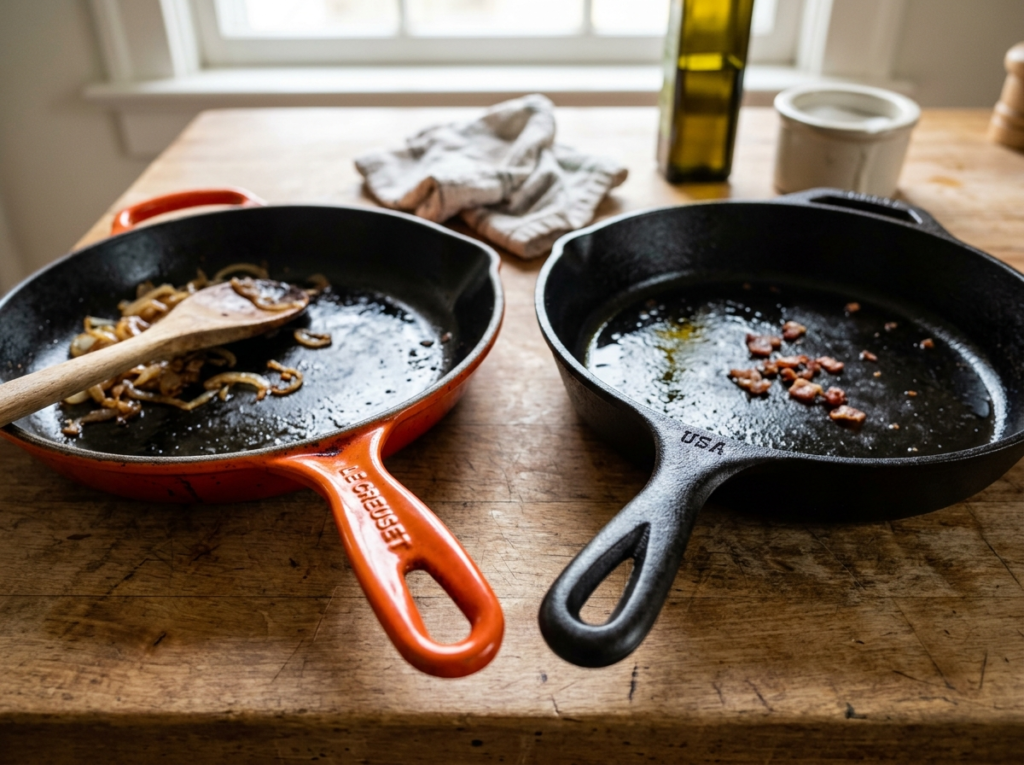
A single Lodge skillet costs about $25. A single Le Creuset Dutch oven can run you $380 or more. That’s not a typo — we’re talking about a 15x price difference between two brands that both make cast iron cookware. And here’s the part that trips people up: both brands have fiercely loyal fans who’ll swear their choice is the only one that makes sense.
So what’s actually going on here? Is Le Creuset worth the splurge, or is Lodge the smarter pick? The answer isn’t as simple as “buy the expensive one” or “save your money.” It depends on how you cook, what you cook, and what you actually need your cookware to do. Let’s break this down honestly — no sales pitch, no brand loyalty, just straight talk about two very different approaches to cast iron.
The Real Difference Between Le Creuset and Lodge
Before you can pick a side, you need to understand that Le Creuset and Lodge aren’t really making the same product. Yes, they both use cast iron. But comparing them is a bit like comparing a hand-built Italian sports car to a reliable pickup truck. Both get you from point A to point B, but the experience — and the price tag — couldn’t be more different.
Lodge makes traditional bare cast iron cookware. Their skillets, griddles, and Dutch ovens are made in South Pittsburg, Tennessee, where they’ve been producing cast iron since 1896. The iron is cast in sand molds, pre-seasoned at the factory with vegetable oil, and sold at prices that feel almost too good to be true.
Le Creuset makes enameled cast iron. Their pieces start as cast iron, but they’re coated with layers of porcelain enamel — inside and out — at their foundry in Fresnoy-le-Grand, France, where they’ve been at it since 1925. Each piece goes through multiple quality inspections, and the enamel is what drives both the performance characteristics and the significantly higher price.
This enamel coating changes everything about how the cookware behaves. It’s not just a cosmetic choice — it affects seasoning requirements, maintenance, heat behavior, and what you can cook in it. That’s where the real comparison gets interesting.
Heat Performance: How They Actually Cook
Both Le Creuset and Lodge excel at what cast iron does best — holding heat. Cast iron is dense. Once it gets hot, it stays hot, which is exactly what you want for searing a steak or building a deep, caramelized fond in a braise. But the two brands handle heat a little differently.
Lodge bare cast iron is a direct heat conductor. You season the pan, it heats up, and the food sits directly on that seasoned iron surface. Over time, with proper use, a Lodge skillet develops a naturally non-stick surface that rivals any Teflon pan — sometimes even surpasses it. That seasoning layer is basically polymerized oil baked into the iron’s pores, and it gets better with every use.
Le Creuset’s enamel creates a barrier between your food and the iron. The enamel surface is smooth, non-reactive, and doesn’t require seasoning. It heats evenly (the enamel helps distribute heat a bit more uniformly), and it won’t interact with acidic ingredients the way bare cast iron does.
Here’s a practical example. If you’re making a long-simmered tomato sauce or a wine-based braise — something you’d do while working on a classic consommé or a rich demi-glace — Le Creuset wins. Acidic foods can strip the seasoning off bare cast iron and sometimes pick up a metallic taste. The enamel coating sidesteps that problem entirely.
But if you want the absolute best sear on a ribeye? A well-seasoned Lodge skillet, screaming hot, is hard to beat. That bare iron surface gets ripping hot and develops contact points that enameled surfaces can’t quite match.
Pro Tip: Neither brand heats up fast. Cast iron — enameled or bare — needs time. Start on low heat and build up gradually. Cranking a cold cast iron pan over high heat can cause hot spots, and with Le Creuset, thermal shock can damage the enamel.
Maintenance and Daily Use
This is where a lot of people make their decision, and honestly, it’s the most practical factor to consider.
Lodge cast iron requires seasoning. If you’re new to cast iron, that can feel intimidating, but it’s genuinely not complicated. You cook with it, you clean it (hot water and a brush work fine — yes, a little soap is okay despite what purists say), you dry it completely, and you rub on a thin layer of oil. That’s it. The pan does the rest over time.
The catch? Lodge is more temperamental. Leave it soaking in the sink, and you’ll get rust. Cook something very acidic for too long, and you’ll damage the seasoning. Forget to dry it thoroughly, and you’ll wake up to orange spots. None of these problems are permanent — rust can be scrubbed off, seasoning can be rebuilt — but it does require a certain mindfulness.
Le Creuset is lower maintenance in the day-to-day sense. The enamel doesn’t rust. It doesn’t need seasoning. You can wash it with soap and water every single time without thinking twice. Acidic foods aren’t a concern. If you tend to be the kind of person who hates doing dishes, the Le Creuset cleaning routine will feel much more forgiving.
But Le Creuset has its own vulnerabilities. The enamel can chip if you bang it around or drop it. It can stain over time — the light-colored interior enamel shows marks from high-heat cooking or dark sauces. And once the enamel chips significantly, the piece is essentially done. You can’t re-enamel it at home the way you can re-season a Lodge skillet.
Think of it this way: Lodge rewards attention. Le Creuset rewards gentleness. Both ask something of you, just different things.
Weight, Handling, and Ergonomics
Here’s something people don’t talk about enough: cast iron is heavy. Both brands are heavy. But there are differences that matter, especially if you cook every day.
A Lodge 12-inch skillet weighs about 8 pounds. A Le Creuset 5.5-quart Dutch oven weighs roughly 11 pounds — empty. Fill that Dutch oven with a beef bourguignon, and you’re muscling around 20+ pounds from stovetop to oven.
Le Creuset has paid more attention to handle design and ergonomics. Their handles are wider, their lids fit more precisely, and the overall design feels more refined in your hands. Lodge’s handles are functional but more utilitarian. On their newer pieces, Lodge has improved handle design, but there’s still a noticeable difference in how the two brands feel during use.
If you have any wrist or grip issues, this matters more than you might think. A well-organized kitchen can help — keeping heavy pans at counter level rather than in overhead cabinets — but the weight itself is something you’ll deal with every time you cook.
What Should You Actually Cook in Each?
This is where practical experience beats marketing copy every time. Both brands are versatile, but each has a sweet spot.
Lodge Shines Here
A bare cast iron Lodge skillet is your best friend for high-heat cooking. Searing steaks, crisping chicken skin, making smash burgers, baking cornbread, frying eggs (once the seasoning is built up) — this is Lodge territory. The direct iron-to-food contact creates a crust and caramelization that enameled surfaces struggle to replicate.
Lodge is also the better campfire and outdoor cooking option. You don’t have to worry about enamel cracking from direct flame or campfire coals. Take it camping, throw it on a grill, use it over an open fire — it doesn’t care.
If you’ve ever been to a real meat-focused cooking weekend, you’ve probably seen Lodge skillets everywhere. There’s a reason for that — professional cooks and serious home cooks reach for bare cast iron when they want maximum Maillard reaction.
Le Creuset Shines Here
Le Creuset Dutch ovens are built for braising, slow cooking, soups, stews, and baking bread. Anything that involves liquid, long cook times, or acidic ingredients works better in enameled cast iron.
A Le Creuset is ideal for dishes like coq au vin, chili, fresh pasta sauces, and no-knead bread. The enamel surface won’t absorb flavors the way bare cast iron can, so you can go from a curry to a fruit cobbler without any flavor carryover.
The tight-fitting lids on Le Creuset Dutch ovens also trap moisture exceptionally well. For braised meats where you want the liquid to barely reduce over hours, that precision lid design pays for itself.
Did you know? Le Creuset tests every single lid-to-pot fit by hand at their foundry. If the gap is too wide or the fit is off, the piece gets rejected. That quality control is part of what you’re paying for.
The Price Question — And Whether It Matters
Let’s address the elephant in the room. Le Creuset is expensive. A 5.5-quart Signature Dutch oven retails for around $380–$420 depending on the color. Lodge’s comparable 6-quart enameled Dutch oven (yes, Lodge makes enameled pieces too) runs about $60–$80. And Lodge’s classic bare cast iron 12-inch skillet? About $25–$35.
So is Le Creuset worth 5–10 times the price?
Here’s the honest answer: it depends on what “worth it” means to you.
If you cook frequently, care about aesthetics (Le Creuset looks stunning going from oven to table), and plan to keep the piece for decades, the per-use cost of a Le Creuset drops dramatically over time. People pass Le Creuset Dutch ovens down through generations. A piece bought in 1975 still works perfectly in 2025 if it’s been treated well.
Lodge also lasts decades — potentially longer, since bare cast iron is essentially indestructible. A chipped Le Creuset is compromised. A damaged Lodge skillet? Strip it, re-season it, and keep going. Your great-grandmother probably did exactly that.
If you’re on a budget and want to start building a cast iron collection, Lodge is the clear entry point. You can buy a Lodge skillet, a Lodge Dutch oven, and a Lodge griddle for less than the cost of a single Le Creuset piece. That’s money you could spend on quality ingredients, a good cookbook, or even a cooking class to sharpen your knife skills.
Quick Fact: Lodge produces over 100 million pounds of cast iron cookware annually at their Tennessee foundry. Le Creuset produces each piece individually at their single foundry in northern France. Volume vs. craftsmanship — that difference drives a lot of the pricing.
The Middle Ground Nobody Talks About
Here’s what most comparison articles miss: you don’t have to pick one brand for everything.
The smartest cast iron setup for most home cooks is actually a combination. A Lodge 10- or 12-inch bare cast iron skillet for searing, frying, and high-heat work. And a Le Creuset (or Le Creuset-style enameled) Dutch oven for braising, soups, and bread baking.
That combination covers about 90% of what you’ll ever need to cook. The Lodge skillet handles the tasks where bare iron excels — tasks that would actually be worse in enameled cookware. The enameled Dutch oven handles the liquid-heavy, acidic, long-cook dishes where bare iron falls short.
A pro chef organizing their home kitchen would likely tell you the same thing. You don’t need a matched set. You need the right tool for the right job.
And if Le Creuset’s price truly doesn’t fit your budget? Lodge’s enameled Dutch oven line is genuinely good. It’s heavier, the enamel isn’t quite as refined, and the color options are limited compared to Le Creuset’s rainbow of choices. But it performs well at a fraction of the cost.
What About Staub, Cuisinart, and Other Options?
We should at least mention that Le Creuset and Lodge aren’t the only players. Staub (also French-made) is Le Creuset’s closest competitor in enameled cast iron. Staub Dutch ovens have a matte black interior enamel (instead of Le Creuset’s light cream), self-basting lids with spikes that drip condensation back onto food, and slightly lower price points.
Many professional chefs actually prefer Staub for braising because that dark interior enamel handles high-heat browning better than Le Creuset’s light enamel. If you’re choosing between Le Creuset and Staub, it often comes down to aesthetics and whether you prefer a light or dark cooking surface.
Brands like Cuisinart, Tramontina, and Amazon Basics also make enameled cast iron Dutch ovens at budget-friendly prices. They work fine for casual use, but the enamel quality and long-term durability don’t match Le Creuset or Staub. If you braise a few times a year, a $40 Tramontina will serve you well. If you braise every week, invest in something built to last.
How to Decide: A Practical Framework
Rather than telling you which brand to buy, here are the questions that actually matter:
What do you cook most often? If your regular rotation includes steaks, fried eggs, and cornbread, start with Lodge. If you’re making stews, braises, and soups multiple times a week, an enameled Dutch oven should be your first purchase.
How much maintenance are you willing to do? Be honest with yourself. If you know you’ll leave a pan in the sink overnight, bare cast iron will punish you for it. Enameled cast iron is more forgiving.
What’s your budget right now? Don’t go into debt for a Dutch oven. A Lodge skillet that you use three times a week is infinitely more valuable than a Le Creuset that sits in your cabinet because you’re afraid to scratch it.
Are you cooking for presentation? Le Creuset’s beauty isn’t trivial. If you like to serve directly from the pot — bringing a gorgeous flame-orange Dutch oven to the dinner table alongside the right wine glasses — that visual appeal adds to the experience. Lodge doesn’t have the same table presence.
How long do you want it to last? Both brands last decades. But a Lodge skillet can survive almost anything, including neglect, and be brought back. Le Creuset is durable but not indestructible — chips and cracks in the enamel are permanent.
FAQ
Can I use Le Creuset on an induction cooktop?
Yes. Le Creuset’s cast iron base works perfectly on induction, gas, electric, and ceramic cooktops. The iron core is magnetic, which is what induction cooking requires. Lodge cast iron also works on induction. Both brands are oven-safe too, though Le Creuset recommends staying under 500°F to protect the enamel and their phenolic knobs (which can be swapped for stainless steel knobs for higher temperatures).
Is Lodge cast iron safe for cooking acidic foods like tomato sauce?
It’s safe from a health standpoint — a small amount of iron leaching into food isn’t harmful for most people and can actually be a dietary benefit. But prolonged cooking of acidic foods (tomato sauces, wine reductions, citrus-based dishes) can strip the seasoning you’ve built up and may give the food a slight metallic taste. For anything that simmers in acid for more than 20–30 minutes, enameled cast iron is the better choice.
How do I fix a rusty Lodge skillet?
Scrub the rust with steel wool or a chain-mail scrubber until you’re back to clean iron. Wash and dry the pan completely. Apply a very thin layer of vegetable oil or flaxseed oil to the entire surface. Place it upside down in a 450°F oven for one hour with a sheet of foil on the rack below to catch drips. Let it cool in the oven. You can repeat this process 2–3 times to build up a solid seasoning layer. It’s much simpler than it sounds, and a rusty Lodge skillet is never a lost cause.
Does Le Creuset ever go on sale?
Rarely at full retail, but you can find deals. Le Creuset’s factory-to-table sales (check their website for locations and dates) offer significant discounts on pieces with minor cosmetic imperfections that don’t affect performance. Williams Sonoma, Sur La Table, and Amazon occasionally discount specific colors. Discontinued colors often drop in price too. Patience pays off if you’re not set on a specific shade.
Your Cast Iron, Your Call
The Le Creuset vs. Lodge debate doesn’t have a single right answer — and anyone who tells you otherwise is probably trying to sell you something. Both brands have earned their reputations over nearly a century each. Both will outlast virtually every other piece of cookware in your kitchen.
If you’re just starting your cast iron journey, grab a Lodge 12-inch skillet. Cook with it regularly, learn how seasoning works, and see if cast iron suits your cooking style. That $30 investment will teach you everything you need to know.
If you already love cooking with cast iron and want to add a Dutch oven that’ll handle braising, bread baking, and beautiful table presentation for the next 30 years, that’s where Le Creuset earns its price tag.
And if you can swing it? Get both. A Lodge skillet and a Le Creuset Dutch oven sitting side by side on your stove might just be the most capable two-piece cookware setup any home cook could ask for. Now go cook something worth talking about.