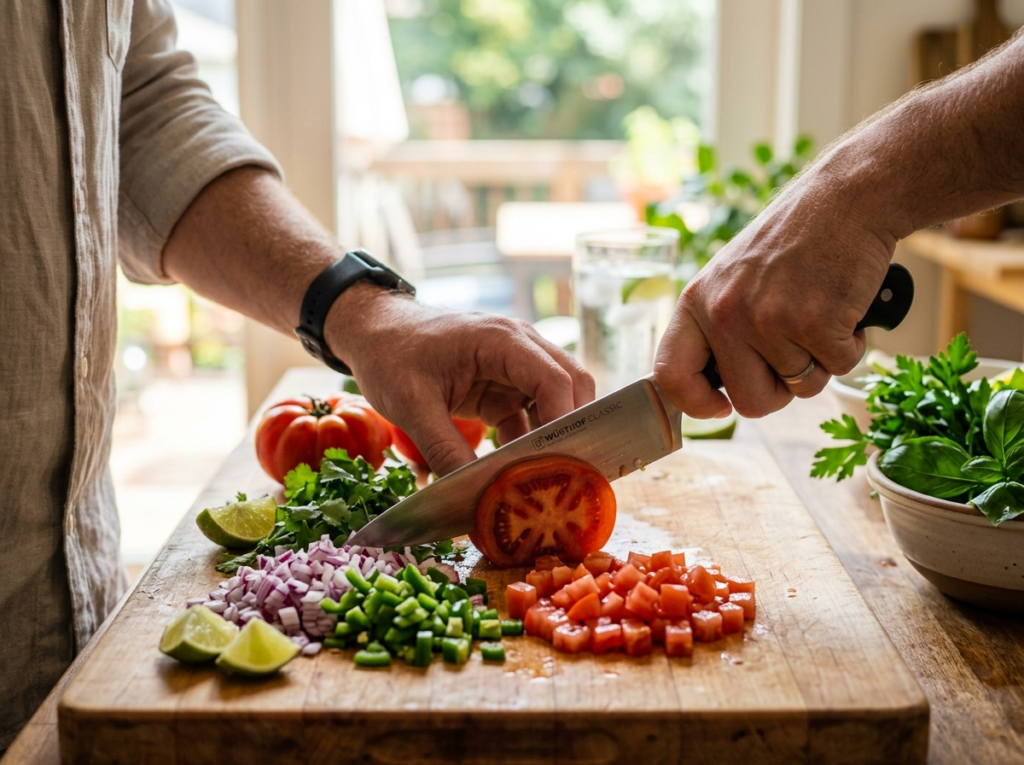
Summer drops a mountain of fresh produce on your kitchen counter — tomatoes so ripe they practically split open, watermelons the size of a small child, bundles of herbs from the farmer’s market, and enough zucchini from your neighbor’s garden to fill a wheelbarrow. And here’s the thing: almost none of it needs much actual cooking. What it does need is someone who can break it all down with a knife, cleanly and confidently.
That’s what makes summer the best season to work on your knife skills. You’re not hiding sloppy cuts under a heavy sauce or burying them in a long braise. A summer salad, a fresh salsa, a beautifully sliced tomato plate — they put your cuts front and center. Every chop, every slice, every dice is on full display. If that sounds a little intimidating, don’t worry. That’s exactly why this is the perfect time to practice.
Why Summer Is the Ideal Season to Practice
You might wonder why the season even matters. Can’t you practice knife skills any time of year? Sure, you can. But summer offers something no other season does — an abundance of soft, juicy, oddly shaped produce that genuinely challenges how you handle a blade.
Think about it. A butternut squash in November is hard and dense. You wrestle it more than you cut it. A summer tomato? It’s delicate. If your knife isn’t sharp or your technique is off, you’ll crush it instead of slicing it. Herbs like basil bruise easily if you chop too aggressively. Strawberries turn to mush if you hack at them.
Summer produce forces you to be precise and gentle at the same time. That combination builds real skill faster than anything else.
There’s also a practical side. Summer cooking is lighter. You’re throwing together quick dishes — ceviche, gazpacho, grain bowls, fruit salads, bruschetta toppings. These meals are basically knife work plus seasoning. The cutting is the cooking. So every meal becomes a mini practice session without you even realizing it.
The Cuts You Actually Need to Know
You don’t need to memorize every French culinary term to be good with a knife. Professional kitchens use a lot of specific cut names, but for home cooking, there are really just a handful you should feel comfortable with. Master these and you’ll handle almost anything summer throws your way.
The Basic Dice is your workhorse. You’re cutting something into roughly even cubes — could be a quarter inch, could be half an inch. Doesn’t matter exactly, as long as they’re consistent. Consistency matters because even pieces cook at the same rate and look better on the plate. For summer, you’ll dice tomatoes for salsa, cucumbers for salads, and stone fruit for salsas or desserts.
The Chiffonade sounds fancy but it’s dead simple. Stack your leafy herbs or greens, roll them up like a little cigar, and slice thin ribbons across the roll. This is how you cut basil without bruising it, and it creates those beautiful little ribbons that look great scattered over pasta, pizza, or a Caprese salad.
The Julienne gives you thin matchstick-shaped strips. You’ll use this for carrots, bell peppers, and summer squash. It’s great for slaws, stir-fries, and those colorful vegetable platters that are basically summer party staples.
The Bias Cut means slicing at an angle instead of straight across. Try this on green onions, cucumbers, and zucchini. You get more surface area with each cut, which looks more elegant and lets dressings or marinades cling better.
If you want a deeper foundation in technique, Gabriel’s Gate has a knife skills class that walks you through all of these and more. It’s their most popular class for a reason — these skills change how you cook everything.
Summer Produce That Will Challenge You (In a Good Way)
Not all fruits and vegetables are created equal when it comes to knife work. Some practically cut themselves. Others fight you every step of the way. Here’s where summer gets interesting.
Tomatoes
A ripe summer tomato is the ultimate test. Too much pressure and you squash it. A dull knife will slide right off the skin before suddenly plunging through and making a mess. The trick is a sharp knife and a gentle sawing motion to break through the skin before you let the blade glide down. If you can dice a ripe heirloom tomato into clean, even cubes without losing half the juice on your cutting board, your knife skills are genuinely solid.
Pro Tip: Use a serrated knife if your chef’s knife isn’t razor sharp. There’s no shame in it. Even professional cooks reach for a serrated blade for really ripe tomatoes.
Watermelon
Watermelon is a different kind of challenge — sheer size and that hard rind. You need a confident, long stroke with a big knife. Most home cooks make the mistake of using short, choppy motions, which gives you jagged, uneven pieces. Place the watermelon flat side down after cutting it in half, then work through it in smooth, decisive cuts. The reward? Perfect cubes for a watermelon-feta salad that actually looks like you know what you’re doing.
Fresh Herbs
Herbs separate the careful cooks from the rushed ones. Parsley, cilantro, mint, dill — they all need a different approach than hard vegetables. The key is to keep your knife sharp and avoid going back and forth over the same pile repeatedly. That repeated chopping bruises the herbs, turns them dark, and makes them taste bitter. One or two clean passes is all you need.
Basil deserves special mention. Don’t chop basil. Chiffonade it (remember that rolling technique?) or tear it by hand. Chopped basil turns black almost immediately.
Stone Fruit
Peaches, nectarines, plums, and apricots are everywhere in summer. Cutting them isn’t hard once you know the approach: slice around the pit following the natural seam, twist the two halves apart, pop out the pit, then slice or dice the flesh. The challenge is that really ripe stone fruit is soft and slippery. A wet, juicy peach half can slide right out from under your knife. Place it cut-side down on the board for stability and work slowly.
Corn on the Cob
Stripping corn kernels off the cob is one of those tasks that looks easy until kernels start flying all over your kitchen. Here’s a trick that works: place a small bowl upside down inside a larger bowl. Stand the cob on top of the small bowl so the kernels fall neatly into the larger bowl as you slice downward. Angle your knife slightly — you want to cut close to the cob but not into it, or you’ll get tough, woody bits mixed in with the sweet kernels.
Building Speed Without Sacrificing Safety
Let’s talk about the elephant in the room: speed. Everyone who’s ever watched a cooking show has that little voice saying, “I should be cutting faster.” And look, speed does come with practice. But chasing speed before you’ve nailed accuracy is how people end up with bandaged fingers and a trip to urgent care.
The correct order is always accuracy first, then consistency, then speed. Get your cuts even. Then get them even every time. Speed follows naturally once your hands develop muscle memory. Trying to rush the process just builds bad habits that are hard to break later.
That said, there are a few things that genuinely help you work faster without taking risks.
Your grip matters enormously. The “claw grip” on your guiding hand — where you curl your fingertips under and let your knuckles guide the blade — exists for one reason: it keeps your fingertips out of the way. Use it every single time, even when you’re just cutting one onion for dinner. Make it a habit so deeply ingrained you don’t even think about it.
Your knife grip matters too. Don’t hold the handle like a tennis racket. Pinch the blade just above the handle between your thumb and forefinger, with the remaining fingers wrapped around the handle. This gives you far more control and actually reduces fatigue because you’re guiding the knife instead of muscling it.
And please, keep your knives sharp. A dull knife is genuinely more dangerous than a sharp one because you have to use more pressure, and when the blade finally gives, it goes wherever it wants. A sharp knife goes where you want. You can pick up a basic honing steel or whetstone for under $20, and spending five minutes maintaining your blade before a big cooking session makes a noticeable difference.
If you want to see how a pro organizes their tools and workspace for efficient cutting, this guide on organizing a small home kitchen has practical ideas you can steal immediately.
Recipes That Are Basically Knife Skills Practice in Disguise
The best way to practice isn’t to sit down and dice twenty onions. It’s to cook things you actually want to eat — dishes where the knife work is the star and you can see (and taste) your improvement.
Pico de Gallo
This is the ultimate knife skills drill. You’re dicing tomatoes, onions, jalapeños, and cilantro, and they all need to be roughly the same small size. No cooking involved. No sauce to hide behind. Just raw, precisely cut ingredients with lime juice and salt. Make a batch this weekend and be honest with yourself about how even your cuts are. Then make another batch next weekend and compare. You’ll be surprised how fast you improve.
Gazpacho
Cold Spanish soup that requires you to finely dice a lot of different vegetables. Tomatoes, cucumbers, bell peppers, onions — everything gets cut small. Some recipes have you blend the base but top each bowl with a finely diced garnish. That garnish is where your skills show. A well-made gazpacho on a scorching July evening is worth every minute you spend at the cutting board.
Knowing how to make a proper consommé is the wintertime equivalent of this kind of careful, detail-oriented kitchen work — and it’s another skill worth having in your back pocket.
Thai Mango Salad
Julienned green mango, thinly sliced shallots, chiffonaded mint, and chopped peanuts. Every component uses a different cut. It’s like a knife skills sampler platter that happens to taste incredible with a fish sauce-lime dressing.
Crudité Platters
Don’t underestimate the humble veggie tray. Cutting carrots, celery, radishes, bell peppers, and cucumbers into attractive, uniform pieces for a platter is honest knife work. And it’s a crowd-pleaser at every summer barbecue and pool party. The difference between a sad grocery-store veggie tray and one you cut yourself is enormous — both in taste and presentation.
Speaking of making food look good, these simple plating tips can take your summer dishes from “that’s nice” to “you made this?!” territory.
The Knife You’re Using Matters (But Maybe Not How You Think)
People get obsessed with buying expensive knives, and the knife industry is happy to encourage that obsession. Here’s the truth: a $40 knife that you keep sharp will outperform a $200 knife that you’ve neglected for six months. Every single time.
That said, you do need the right knife for the job, not necessarily the most expensive one.
For 90% of summer kitchen work, you really just need three knives. A chef’s knife (8-inch is the most versatile size for most people) handles the bulk of your chopping, dicing, and mincing. A paring knife takes care of smaller detail work — hulling strawberries, deveining shrimp, peeling kiwi. And a serrated bread knife doubles as your tomato knife and your watermelon knife.
That’s it. Three knives. If someone tries to sell you a 15-piece knife block with a “santoku” and a “boning knife” and a pair of kitchen shears shaped like a bird, politely decline. You can always add specialty knives later once you actually know what you need.
Quick Fact: According to most professional chefs and culinary instructors, the average home cook uses only two to three knives regularly, regardless of how many they own. Put your money toward quality in those two or three rather than quantity across twelve.
Common Mistakes That Hold People Back
A few habits tend to plague home cooks year after year. Recognizing them is half the battle.
Using a glass or ceramic cutting board. These look pretty and are easy to clean, but they destroy your knife’s edge almost instantly. Use wood or plastic. Wood is gentler on your blade and has natural antibacterial properties. A good wood cutting board is an investment that pays for itself in knife longevity.
Lifting the knife too high. You don’t need to raise your knife a foot above the board like you’re chopping firewood. Small, controlled motions are faster and safer. Keep the tip of the knife on or near the board and use a rocking motion for most tasks.
Not letting the knife do the work. If you’re pressing down hard and muscling through every cut, something is wrong — either your knife is dull or your technique needs adjustment. A sharp knife should glide through most produce with minimal downward pressure.
Crowding the cutting board. This is a big one. If your board is cluttered with scraps, your workspace shrinks, your cuts get sloppy, and you’re more likely to nick yourself. Keep a bowl nearby for scraps and clear your board regularly. Professional chefs call this “mise en place” — everything in its place — and it makes a huge difference in how smoothly your cooking goes.
Getting the Whole Family Involved
Summer is also a great time to teach kids (and partners, and friends) some basic knife skills. Start with softer produce and age-appropriate tools. A 7-year-old can cut bananas and strawberries with a butter knife or a nylon kids’ knife. A 10-year-old can handle a small paring knife with supervision. Teenagers can absolutely learn on a real chef’s knife — they just need someone patient to show them proper grip and the claw technique.
Cooking together in summer is lower pressure than the holidays. Nobody’s stressing about getting a Thanksgiving turkey on the table by 4 PM. You’re making fruit salad, or cutting vegetables for the grill, or prepping a salsa. There’s time to go slow, correct mistakes, and actually enjoy the process.
Did you know? Studies consistently show that kids who participate in meal preparation eat a wider variety of fruits and vegetables. Getting them comfortable with a knife isn’t just a life skill — it changes their relationship with food.
If the kitchen feels a bit chaotic when multiple people are cooking, learning how to organize a small kitchen can make the space work for everyone.
Taking It to the Next Level: Grilling Prep
Here’s where your knife skills meet summer’s other great tradition: the grill.
Proper grill prep is almost entirely knife work. You’re butterflying chicken breasts so they cook evenly. You’re cutting vegetables into pieces big enough that they won’t fall through the grates but small enough that they cook through. You’re slicing onions into thick rings that hold together over high heat. You’re spatchcocking a whole chicken so it lies flat and cooks in half the time.
Each of these tasks requires you to think about why you’re cutting something a certain way, not just how. That shift — from “I’m cutting this because the recipe said so” to “I’m cutting this thick because it needs to hold up on a hot grill” — is what separates someone who follows recipes from someone who actually understands cooking.
FAQ
What’s the single most important knife skill for a beginner?
Learn the proper claw grip on your non-cutting hand. It protects your fingers and gives you control. Every other skill builds on this foundation. Once the claw grip is second nature, everything else — dicing, mincing, julienning — becomes safer and easier to learn.
How often should I sharpen my kitchen knife?
Hone your knife with a honing steel every time you use it — it only takes 30 seconds and keeps the edge aligned. Actually sharpen it on a whetstone or with a professional service every few months, depending on how often you cook. You’ll know it’s time when honing doesn’t restore that clean, effortless cut anymore.
Can I improve my knife skills without taking a formal class?
Absolutely. Cooking dinner every night is practice in itself. Focus on consistency — try to make every piece the same size — and gradually your speed and confidence will build. That said, even one good class can correct habits you didn’t know you had, and the improvement can be dramatic. If you’re near Gabriel’s Gate, their knife skills class is a fantastic starting point.
What cutting board material is best?
Wood and high-density plastic are your best options. Wood is easier on knife edges and naturally resists bacteria. Plastic is dishwasher-safe and cheap to replace. Avoid glass, marble, and ceramic — they dull knives almost immediately and can cause blades to slip dangerously.
Your Cutting Board Is Waiting
Summer won’t last forever, and neither will the perfect peaches at your farmer’s market. Every time you stand at your counter with a knife in hand this season, you’re not just making dinner — you’re building a skill that’ll make you a better, faster, more confident cook for the rest of your life.
Pick up one recipe from this article. Make it this week. Pay attention to your grip, your cuts, your consistency. Then make it again next week and notice the difference. That’s really all it takes — repetition, attention, and produce worth eating.
Now go find the sharpest knife in your kitchen and get to work.