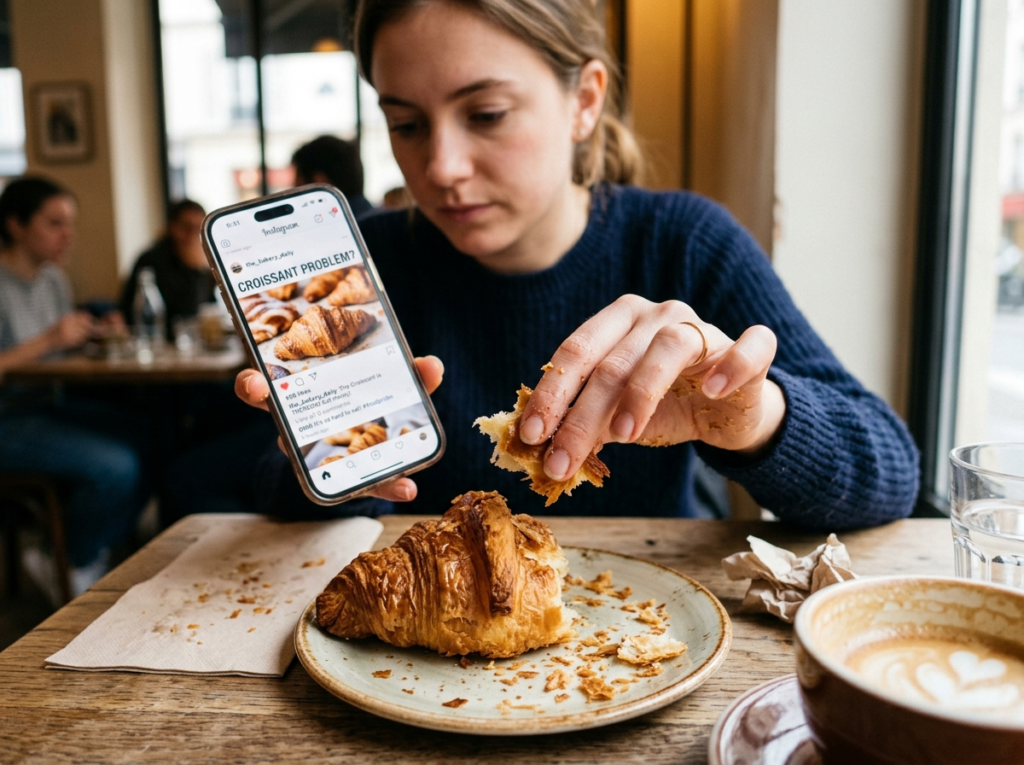
A golden, impossibly flaky croissant sits on a marble countertop. The light catches every buttery layer. The crumb is so open, so honeycomb-perfect, it looks like it was designed by an architect. You double-tap, save it, maybe even screenshot it for “inspiration.” And then you try to make one at home, or you walk into your local bakery, and what you see looks… nothing like that.
Welcome to the internet’s croissant problem.
It’s not really about croissants, of course. It’s about what happens when a deeply traditional, stubbornly difficult pastry collides with a culture that rewards visual perfection above everything else. But croissants have become the poster child for this collision — and the fallout is real. It’s warping how people bake, how bakeries market themselves, and how we all judge food that’s been made by human hands.
Let’s unpack this. Because once you see the problem clearly, you can’t unsee it.
What Exactly Is the “Croissant Problem”?
Scroll through Instagram, TikTok, or YouTube Shorts and you’ll notice a pattern. The croissants that get millions of views share a very specific look: dramatic honeycomb crumb shots, extreme oven spring, deeply caramelized exteriors, and layers so distinct they look like geological strata. These clips are satisfying to watch. They’re engineered to be.
But here’s the thing most people don’t realize — a lot of those viral croissants aren’t actually great croissants.
Some are over-proofed to get that exaggerated open crumb. Some are brushed with extra egg wash (or even shellac-like glazes) to achieve an unnatural shine. Some are shot at very specific angles, under studio lighting, right out of the oven before they deflate or settle into their natural shape. And some are just straight-up AI-generated images that never existed as real food at all.
The problem isn’t that people love croissants. The problem is that the internet has created a single visual standard for what a “good” croissant looks like, and that standard is disconnected from how croissants actually taste, feel, and behave in real life.
A genuinely wonderful croissant — one that a French baker would be proud of — might have a tighter crumb, a more modest rise, or an exterior that’s lighter in color. It might look a little imperfect. But when you bite into it, the butter flavor floods your mouth, the texture shatters and then melts, and you understand immediately why this pastry has survived centuries without needing a filter.
That croissant doesn’t go viral. The shiny, impossibly perfect one does.
How Social Media Rewired Our Croissant Expectations
Think about what social media algorithms actually reward. Bright colors. Movement. Surprise. Extreme close-ups. The “money shot.” A video of someone tearing open a croissant to reveal a dramatic honeycomb interior performs because it triggers a visceral response — almost like a magic trick. Your brain sees those layers and thinks, wow, that must taste incredible.
But visual drama and actual flavor are two completely different things.
Professional pastry chefs have been saying this quietly for years. Amaury Guichon and Cédric Grolet — two of the most-followed pastry figures online — create work that’s visually staggering, but they’re also classically trained and understand the difference between performance and product. The problem starts when home bakers or less experienced creators watch those videos and conclude that the look is the goal, not the taste.
And so you get a wave of content where the croissant itself becomes secondary to the content. The recipe gets tweaked not to improve flavor, but to produce a more photogenic result. Extra sugar in the dough for darker color. Over-lamination for more visible layers. Extreme proofing times to get bigger, puffier shapes that look great on camera but taste like sweet air.
Did you know? A traditional French croissant recipe uses just six ingredients: flour, butter, sugar, salt, yeast, and milk. The magic isn’t in complexity — it’s in technique and patience. Most viral “hacks” actually complicate something that’s already refined to near-perfection.
The Bakery Side of the Problem
If you think this only affects home bakers filming TikToks in their kitchens, think again. Real bakeries — the ones that wake up at 3 AM to laminate dough by hand — are feeling the pressure too.
Walk into any artisan bakery and watch what happens. Customers pull out their phones before they take a bite. They photograph the crumb. They compare it, mentally or literally, to what they’ve seen online. If the layers aren’t dramatic enough, some customers assume the bakery isn’t very good.
This creates a painful incentive for bakeries. Do you make the croissant that tastes best? Or do you make the one that photographs best and keeps your Yelp reviews glowing? Some bakeries worth seeking out are sticking to their standards, but the pressure is real, especially for small shops trying to compete for attention.
One bakery owner in Brooklyn shared (anonymously, on a baking forum) that she started slicing her croissants in half before displaying them — just so customers could see the crumb without asking. Sales went up 20%. Not because the recipe changed. Because the performance changed. Think about what that means.
And it’s not just traditional croissants. The internet’s obsession has spawned an entire category of “croissant-adjacent” creations — cruffins, croissant cubes, supreme croissants stuffed with cookie dough and cereal, cronuts that are deep-fried and glazed within an inch of their life. Are some of these delicious? Sure. But they’re often more about spectacle than pastry craft.
The original croissant — simple, buttery, perfectly laminated — gets lost in the noise.
Why Croissants Became the Internet’s Favorite Pastry
You might wonder: why croissants specifically? Why not sourdough bread, or macarons, or tarts?
Part of it is the cross-section. When you cut a croissant open, you reveal a hidden structure. That’s inherently satisfying content. It’s the same reason geode cakes and galaxy resin art go viral — the reveal matters.
Part of it is the difficulty factor. Everyone knows croissants are hard to make. So when someone posts a perfect one, there’s an implied flex: I did this. I conquered laminated dough. That earns respect, comments, shares.
And part of it is sheer aesthetic versatility. A croissant can be styled rustic (flour-dusted, on a wooden board) or luxurious (gold leaf, pistachio cream, marble slab). It fits every visual brand. Cozy cottage kitchen? Croissant. Minimalist Scandinavian café? Croissant. French fantasy life? You already know.
Sourdough had its pandemic moment in 2020. Macarons dominated Pinterest circa 2015. But croissants have had remarkable staying power online because they hit every content trigger at once — skill, beauty, aspiration, and that irresistible tear-and-reveal shot.
The irony is that real croissant-making is one of the most humbling things you can do in a kitchen. The dough fights you. The butter breaks through the layers if your kitchen is too warm. The timing is brutal — a well-organized kitchen helps, but even professionals have bad batches. None of that struggle makes it into a 30-second clip.
What Actually Makes a Great Croissant (Forget What You Saw Online)
Let’s talk about what genuinely matters in a croissant, according to people who’ve spent their careers making them.
Butter quality is everything. European-style butter with at least 82% fat content creates the best layers. Cheaper butter has more water, which creates steam in the wrong places and muddles the lamination. In France, many boulangeries use beurre de tourage — a special high-fat butter designed specifically for laminated doughs. The flavor difference is enormous.
Temperature control matters more than technique. You can watch a hundred YouTube tutorials on folding and turning, but if your kitchen is 80°F, the butter will melt into the dough and you’ll end up with a brioche-like texture instead of distinct flaky layers. Professional bakeries keep their lamination areas around 65°F. Most home kitchens aren’t even close.
The crumb should be varied, not uniform. This is where the internet really gets it wrong. A perfect honeycomb with identically-sized holes looks great on camera, but it often signals over-proofing. A naturally well-made croissant will have a mix of larger and smaller air pockets, with some areas slightly denser. That variation is what gives you both the shattering exterior and the soft, slightly chewy interior.
Flavor should hit in waves. First, the butterscotch-like caramelization of the crust. Then the rich, almost tangy butter flavor from the laminated layers. Then a faint yeastiness underneath it all. If a croissant just tastes “sweet” or “bready,” something went wrong — no matter how pretty it looks.
Pro Tip: If you’re evaluating a croissant from a bakery, pick it up first. A great croissant should feel surprisingly light for its size. If it feels dense or heavy, the lamination probably isn’t there — regardless of how golden and shiny the exterior is.
The Bigger Picture: Content Culture vs. Craft Culture
The croissant problem is really a symptom of something larger. We’re living through a moment where how something looks on screen has become more important than how it performs in real life. This isn’t limited to food. It’s happening with furniture (gorgeous but falls apart), skincare (aesthetic packaging, mediocre formulas), and travel (Instagram-perfect destinations that are overcrowded nightmares in person).
But food feels particularly personal. When you eat a croissant, there’s no screen between you and the experience. You taste it, you feel the texture, you know instantly whether it’s good or not. No amount of editing can change that moment. And yet, so many people are chasing the image of a perfect croissant rather than the experience of one.
There’s a culinary tradition worth studying here. In regions where food culture runs deep — France, the Basque Country, parts of Mexico, Japan — the emphasis has always been on what happens in your mouth. Presentation matters, sure, but it serves the food. Online, the relationship has flipped. The food serves the presentation.
This creates a strange disconnection. You have people who can identify a “perfect” croissant by sight but have never actually tasted one made properly. They’ve consumed hundreds of croissant videos but couldn’t tell you the difference between laminated and enriched dough. They know the aesthetic but not the substance.
And honestly? That’s a loss — for them and for the bakers who do the real work.
What Home Bakers Can Do Differently
If you’re someone who wants to actually make great croissants at home (not just ones that look great on camera), here’s what’ll help you more than any viral recipe.
Start with the basics and be patient. A classic croissant recipe isn’t complicated in terms of ingredients. It’s complicated in terms of timing, temperature, and feel. Your first batch will probably look ugly. Your second batch might be worse. That’s normal. Getting back to fundamentals always beats chasing shortcuts.
Use a thermometer. Seriously. Measure your dough temperature, your butter temperature, and your kitchen temperature. The “it should feel like cool clay” advice is nice and poetic, but a thermometer removes the guesswork. Aim for butter and dough to both be around 60-65°F when you start laminating.
Don’t chase the honeycomb. If your croissant has good flavor, a nice shatter on the outside, and a tender interior, you made a great croissant — even if the cross-section wouldn’t go viral. The honeycomb obsession pushes people toward over-proofing, which actually weakens flavor and structure.
Find one recipe and stick with it. The internet is full of “best ever” croissant recipes, and they all contradict each other. Pick a trusted source — Claire Saffitz, Bruno Albouze, or a classic French pastry textbook — and make the same recipe ten times before you change anything. You’ll learn more from repetition than from recipe-hopping.
Accept imperfection as part of the craft. Even the best bakeries in Paris have “off” days. Laminated dough is sensitive to weather, humidity, flour batch variations, and a dozen other factors. Pro chefs know this well — consistency comes from experience, not from perfection.
The Role of AI and Fake Food Content
There’s another layer to this problem that’s getting worse in 2025: AI-generated food images. Platforms are flooded with pictures of croissants that literally don’t exist. They were generated by Midjourney, DALL-E, or similar tools, and they look almost — but not quite — real.
These AI croissants are often too perfect. The layers are mathematically even. The color gradient is suspiciously smooth. There are no crumbs, no imperfections, no human fingerprints anywhere. And yet, they get saved, shared, and held up as benchmarks.
Some food accounts use AI images without disclosure, mixing them with real photography. Others use them knowingly as “inspiration boards.” Either way, they push the visual standard even further from reality. You’re now comparing your homemade croissant not just to a professional bakery’s best work, but to a computer-generated fantasy that no human could replicate.
⚠️ Warning: If a food photo looks too perfect — perfectly symmetrical, no crumbs, impossibly smooth surfaces — it might not be real. Look for subtle tells: slightly melted butter spots, uneven browning, a natural shadow. Real food has character. AI food doesn’t.
How to Enjoy Croissants Again (Online and Off)
So what’s the answer? You don’t have to quit Instagram or stop watching baking videos. But a little awareness changes everything.
When you see a croissant video, watch it for what it is — entertainment. Enjoy the visually satisfying tear. Appreciate the craft when it’s genuine. But don’t let it become your measuring stick for every croissant you encounter.
When you visit a bakery, taste first. If your local spot uses quality ingredients and traditional techniques, support them — even if their croissants don’t look like they belong on a magazine cover. The bakeries that prioritize flavor over aesthetics are the ones that need your loyalty most.
When you bake at home, bake for yourself. Not for the ‘gram. If you want to film it, fine — but let the recipe decisions be about taste, not about what’ll perform in the algorithm. Your ugly-but-delicious croissant is worth more than a photogenic failure.
And maybe, next time you’re somewhere with a real food culture worth exploring, pay attention to how people there relate to their food. In most food-centric cultures, the conversation is about flavor, memory, and technique — not about whether the cross-section would get likes.
FAQ
Why do internet croissants look so different from bakery croissants?
Most viral croissant content is shot under controlled conditions — professional lighting, specific angles, and often right at the moment the croissant comes out of the oven (when it looks most dramatic). Some creators also adjust their recipes to produce more photogenic results, like extended proofing for bigger holes or extra egg wash for extra shine. A bakery croissant sitting in a display case for an hour will naturally look different, even if it tastes better.
Can you really make good croissants at home?
Absolutely, but expect a learning curve. Home ovens, warmer kitchens, and less practice mean your first several attempts probably won’t look like what you see online. That said, many home bakers produce genuinely excellent croissants with practice. The key is controlling temperature, using good butter, and being patient with the process. Don’t judge your results by social media standards — judge them by how they taste.
What’s the difference between a croissant and other laminated pastries?
Croissants use a yeasted dough (pâte levée feuilletée), which means the dough both rises from yeast and puffs from steam created by butter layers. Puff pastry (pâte feuilletée) uses no yeast — it relies entirely on steam. Danish dough is similar to croissant dough but typically has eggs and more sugar. All are laminated, but the results are quite different in texture and flavor. Understanding the role of fat in pastry helps you see why butter quality matters so much across all of them.
Are stuffed and hybrid croissants (cruffins, supreme croissants) worth trying?
They can be fun and delicious, but they’re a different experience from a traditional croissant. A well-made supreme croissant — filled with pastry cream and topped with a glaze — is basically a flavored pastry that borrows the croissant’s shape. Nothing wrong with enjoying them. Just don’t let them replace your appreciation for the plain, butter-forward original, which is where a baker’s real skill shows.
The internet didn’t ruin croissants. Croissants are still out there — warm, buttery, imperfect, and extraordinary when made with care. What the internet did is create a distorted mirror that reflects a version of pastry perfection no one can (or should) live up to.
Your job is simple: eat more croissants, watch fewer croissant videos, and trust your mouth over your eyes. The best croissant you’ll ever have probably won’t be the prettiest one. And that’s exactly the point.