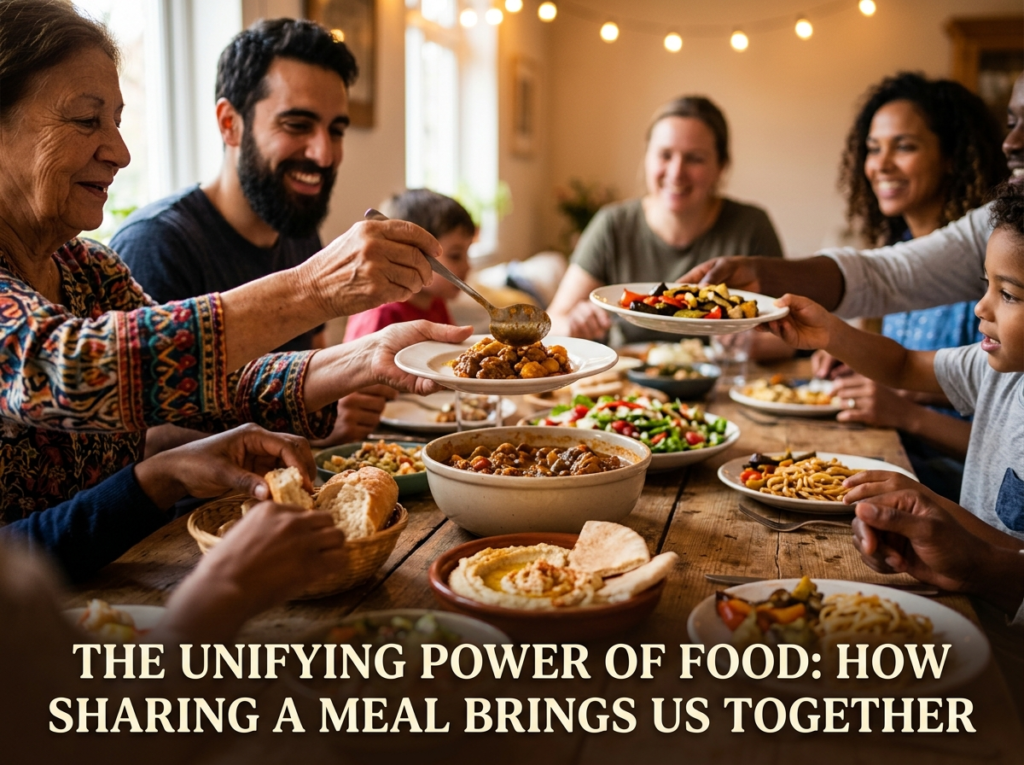
There’s a moment that happens at almost every table — someone passes the bread, someone pours the wine, and suddenly a group of strangers starts talking like old friends. No agenda. No ice-breaker exercise. Just food.
It’s not a coincidence. Humans have been gathering around food for as long as we’ve existed. Long before restaurants, dinner parties, or food Instagram, our ancestors sat around fires and shared whatever they had. That ritual never really left us. It just changed its setting.
What’s remarkable is how quickly a shared meal can shift the atmosphere in a room. Tension softens. Conversations go deeper. People who couldn’t agree on anything suddenly find themselves laughing over a shared dish. Food does something that speeches, emails, and meetings can’t — it puts people at ease without even trying.
Why Food Has Always Been More Than Just Fuel
Ask any anthropologist and they’ll tell you the same thing: the act of eating together is one of the defining behaviors of human civilization. It’s not just about calories. It’s about trust.
When you sit across from someone and eat the same food, you’re sending a very old, very primal signal — I trust you enough to be vulnerable with you. Eating requires you to lower your guard. You can’t be defensive with a mouthful of pasta.
Robin Dunbar, the British anthropologist famous for “Dunbar’s Number” (the idea that humans can maintain roughly 150 stable relationships), has spent years studying social bonding. His research found that shared meals are one of the strongest predictors of social closeness. More than shared hobbies. More than proximity. The people you eat with regularly tend to be the people you trust most.
That’s not a soft, feel-good idea. That’s behavioral science.
And when you think about it historically, every major peace negotiation, business deal, and family reconciliation has had a meal somewhere in the story. There’s a reason diplomats hold state dinners and not state PowerPoint presentations.
The Table as a Universal Language
Every culture on earth has its own version of the communal meal. And what’s striking isn’t the differences — it’s the similarities.
In Japan, the concept of ichiju sansai (one soup, three sides) is built around balance and sharing small dishes. In Ethiopia, eating together from a single injera platter isn’t just practical — it’s a symbol of kinship. In Mexico, Sunday family meals can stretch for hours, with dishes arriving slowly and conversation filling the gaps. If you’ve ever had the pleasure of sitting through a long, leisurely breakfast in Mexico City’s Roma Norte, you already know how food can anchor an entire morning — and an entire relationship.
Even the physical act of passing food — handing someone a bowl, pouring a drink, offering a second helping — is a form of non-verbal communication. It says: I see you. I want you to have enough. You’re welcome here.
That’s why it feels so cold to eat alone in front of a screen, even if the food is exactly the same. The nourishment is there. The connection isn’t.
What Happens to People When They Eat Together
Here’s where it gets interesting.
A 2017 study by Oxford University’s Social Body Lab found that people who eat with others report higher levels of happiness, greater life satisfaction, and stronger feelings of trust and engagement with their communities compared to those who frequently eat alone. The food itself was almost irrelevant. The togetherness was the active ingredient.
There’s also something neurological happening. Shared meals trigger the release of endorphins — the same chemicals released during laughter, singing, and physical touch. Eating together, especially when there’s some element of ritual or rhythm (passing dishes, a toast, even just sitting in a regular spot), activates the brain’s reward system in ways that solitary eating simply doesn’t.
And then there’s the oxytocin factor. Often called the “bonding hormone,” oxytocin levels rise during positive social interactions. Sharing food — especially food you’ve cooked yourself or that carries emotional significance — appears to amplify this response.
This isn’t just abstract neuroscience. You’ve felt it. Think about the last time you had a genuinely good meal with people you care about. You probably don’t remember every dish. But you remember the feeling in the room.
Cooking Together Is the Next Level
If eating together builds connection, cooking together does something deeper. It adds collaboration, patience, and creative problem-solving to the mix — all things that require you to actually show up for another person.
When two people stand at a counter chopping vegetables, the conversation that happens is different from one at a restaurant table. There’s something about having your hands busy that lowers people’s defenses. You end up talking about real things.
A lot of couples, families, and even corporate teams have figured this out — which is why cooking classes and shared kitchen experiences have grown so much in popularity. There’s a reason planning a private cooking event for your next corporate or social outing has become a genuine team-building staple. Something changes when you make the food together before you eat it together.
Pro Tip: If you want to really connect with someone — a new partner, a distant family member, a new colleague — cook something with them. Don’t order in. The process matters as much as the result.
Even something as simple as making a stock from scratch, like a proper consommé, becomes a kind of shared meditation. You’re both working toward something. That shared purpose is quietly doing a lot of emotional work.
Food as a Bridge Across Difference
Here’s the thing about shared meals that doesn’t get said enough: food has a way of making differences feel smaller without erasing them.
You don’t have to share someone’s politics, religion, or background to share their table. And something shifts when you do. You might not change your mind about anything — but you leave with a slightly more human picture of the person across from you.
Culinary travel works on this principle entirely. When travelers go somewhere genuinely new — somewhere like Basque Country for a culinary immersion, or even a surprisingly rich food scene in Ireland — what they’re really doing is opening themselves up to another culture’s values, rhythms, and worldview through the medium of food. It’s one of the least threatening ways to encounter something unfamiliar.
This is also why immigrant communities often preserve their culinary traditions long after language and dress have adapted. The food carries memory. It carries identity. And when you share it with someone outside the community, it’s an act of generosity that goes beyond hospitality.
Think about how many friendships have started with “you have to try this.”
The Quiet Rituals That Hold People Together
Not every unifying meal is a big occasion. In fact, some of the most bonding ones are the smallest.
Tuesday night dinner. Saturday morning pancakes. The soup someone makes whenever you’re sick. These repeated, ordinary rituals are doing invisible structural work in your relationships. They create rhythm. They create shared reference points. They create the low-stakes intimacy that makes big conversations easier when they need to happen.
Psychologists sometimes call this “relationship maintenance behavior” — the small, regular acts that keep bonds healthy over time. A shared meal is one of the most effective forms of this. It’s built into daily life. It doesn’t require planning. It just requires showing up.
Did you know? Research from the University of Minnesota found that families who eat dinner together regularly — even just a few nights a week — have children who score higher on academic achievement, show lower rates of depression, and report feeling more emotionally supported. The food isn’t the point. The ritual is.
The same principle applies to adult friendships and partnerships. Regular meals together — not special occasion dinners, just regular Tuesday nights — keep people connected in ways that the occasional big event simply can’t.
When Food Carries Memory and Meaning
Some meals mark a moment. You remember exactly where you were, what you ate, and who you were with. That’s not just nostalgia — that’s how memory works.
The brain encodes experiences more strongly when they involve multiple senses simultaneously. Smell, taste, texture, temperature — a meal activates all of them at once. This is why certain dishes can transport you instantly back to a specific place and time. Marcel Proust wrote an entire volume about it. Your grandmother’s kitchen probably makes the same point more efficiently.
This is also why food at funerals, after births, during illness, and at celebrations feels so essential. Food says things we struggle to put into words. It’s presence. It’s care. It’s I showed up.
These taste memories are among the most durable ones we carry. They shape what we consider comfort, what we call home, and often, who we feel closest to.
How to Use Food More Intentionally to Build Connection
You don’t need to throw a dinner party or take a cooking class to put this into practice. Small, consistent choices are enough.
Eat away from screens. Even once a day. Even if it’s just you and one other person. The absence of distraction changes the quality of a shared meal completely.
Cook something that requires effort occasionally. Not every night — that’s not realistic. But putting real time into a meal sends a clear message to whoever you’re cooking for: you’re worth this.
Share what the food means to you. Talk about where a recipe came from, what it reminds you of, who taught you to make it. This turns a meal into a story, and stories are how we understand each other.
Be curious about other people’s food. Ask questions. Try things you wouldn’t normally try. The willingness to eat someone else’s food is, on some level, the willingness to enter their world.
If you’re looking for where to start in the kitchen, sometimes it’s worth revisiting the basics of a really good chef’s approach — not because you need to impress anyone, but because cooking with confidence makes you more present and more generous at the table.
FAQ
Q: Can a shared meal really help repair a strained relationship?
A: It’s not magic, but it genuinely helps. Eating together creates a neutral, low-pressure environment where people are less likely to be defensive. The physical act of sharing food activates social bonding mechanisms that make difficult conversations slightly easier. It’s not a substitute for honest communication — but it creates a better setting for it. Many therapists actually recommend it as a starting point for reconnecting with someone you’ve drifted from.
Q: Why do people feel more relaxed and open during meals?
A: Several things happen simultaneously. Your body is focused on digestion, which activates the parasympathetic nervous system — the “rest and digest” state, as opposed to “fight or flight.” You’re sitting down, which is physically less guarded than standing. And the act of eating together triggers endorphin and oxytocin release. All of this adds up to a physiological state where people are genuinely more open and at ease.
Q: Does the type of food matter, or just the act of sharing it?
A: The act of sharing matters far more than what you’re eating. A bowl of rice eaten together meaningfully will do more relational work than an elaborate meal eaten in silence with phones on the table. That said, food that requires effort — whether that’s a long recipe, a dish with personal significance, or something unfamiliar and adventurous — tends to generate more conversation and more memorable experiences. The food gives you something to talk about, to react to, to explore together.
Q: How often should families or couples eat together to see a real benefit?
A: Research suggests even three to four shared meals per week makes a measurable difference in relationship quality and children’s wellbeing. You don’t need to aim for perfection. Consistency matters more than frequency. Three real, present, distraction-free dinners a week will do more than seven rushed meals eaten while scrolling.
The Table Is Always Open
Every culture, every era, every family eventually finds its way back to the same place: sitting together with food between them. That’s not coincidence. That’s something deep in us recognizing what we actually need.
You don’t need a special occasion to use food as a way to connect. You just need a table, something worth eating, and the willingness to put the phone down for an hour.
The meal doesn’t have to be elaborate. The company doesn’t have to be perfect. What matters is that you showed up, you shared something, and for a little while, the distance between people got smaller.
That’s always been the point.