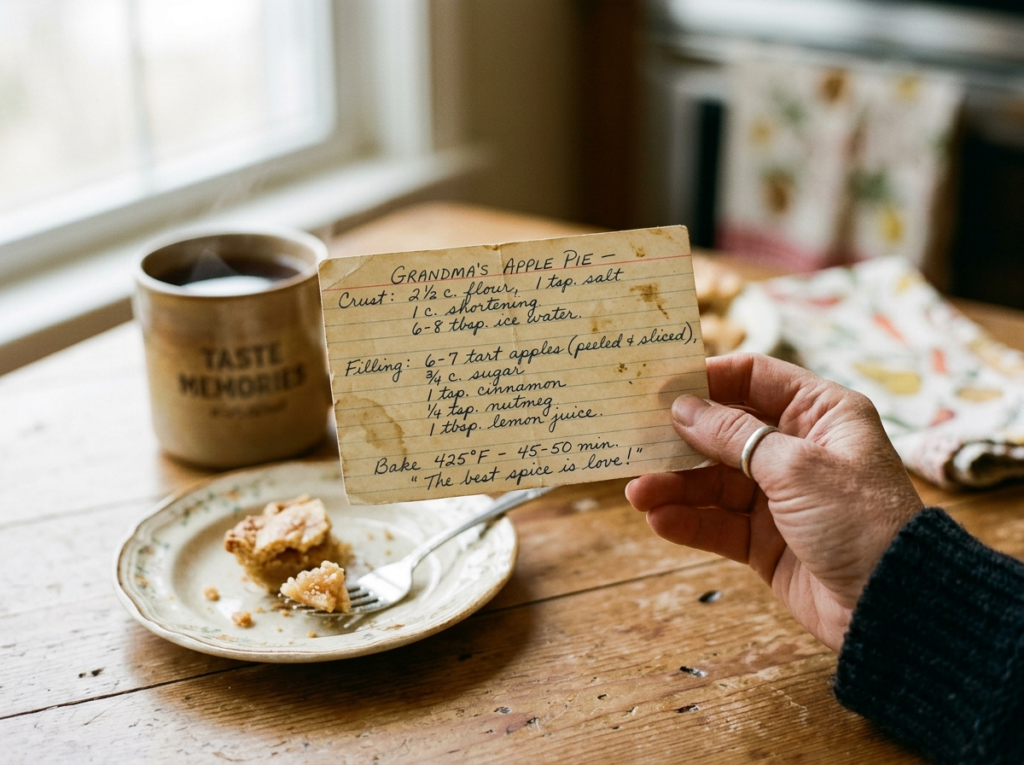
One spoonful of your grandmother’s chicken soup, and suddenly you’re eight years old again. You’re sitting at her kitchen table, legs swinging because your feet don’t touch the floor, and everything feels safe. That’s a taste memory — and it’s more powerful than almost any photograph, song, or souvenir you own.
Your brain stores flavor experiences differently than other memories. They hit faster, feel deeper, and stick around longer. A single bite of something you haven’t eaten in twenty years can flood your mind with emotions you thought you’d forgotten. And here’s the thing — this isn’t just sentimental talk. There’s real science behind why food and memory are so tightly woven together.
If you’ve ever wondered why a particular dish makes you emotional, why you keep chasing your mom’s version of a recipe, or how you can create taste memories worth holding onto, this is for you.
What Exactly Are Taste Memories?
A taste memory is your brain’s way of linking a specific flavor, aroma, or texture to an experience or emotion from your past. It’s not just remembering what something tasted like — it’s reliving how it made you feel.
Think about the difference between recalling that you ate pizza last Tuesday and the visceral, full-body reaction you get when you smell a wood-fired pie that reminds you of that tiny restaurant in Naples on your honeymoon. The first is a factual memory. The second? That’s a taste memory in action.
These memories are stored in parts of the brain closely tied to emotion and survival. Your hippocampus handles the factual side — where you were, what year it was, who you were with. But your amygdala processes the emotional charge attached to that moment. When a flavor triggers both at once, the result feels almost cinematic. You don’t just remember the meal. You re-enter it.
Did you know? Marcel Proust wrote one of literature’s most famous passages about a taste memory — a madeleine cake dipped in tea — back in 1913. Scientists now call involuntary sensory-triggered memories “Proustian memories” in his honor.
The Science Behind Flavor and Memory
You might think your tongue does most of the work during a meal, but that’s only part of the story. Taste, smell, texture, temperature, and even the sounds around you contribute to how your brain encodes a food experience.
Smell Is the Real Heavy Lifter
Your sense of smell is directly wired to your olfactory bulb, which sits right next to the hippocampus and amygdala. No other sense has this kind of direct line to your memory and emotion centers. This is why a whiff of cinnamon can transport you to a holiday morning from 1997 before your conscious mind even catches up.
Research published in the journal Chemical Senses has shown that odor-evoked memories tend to be more emotional and vivid than memories triggered by visual or auditory cues. You might not remember what your childhood kitchen looked like in perfect detail, but you probably remember exactly how it smelled on Thanksgiving morning.
Taste Works as a Team
Your tongue picks up five basic tastes: sweet, salty, sour, bitter, and umami. That sounds limited, but when you combine those with the hundreds of aroma compounds your nose can detect — plus texture, temperature, and visual cues — you get an experience as complex as any symphony. Your brain files this entire package as one unified memory.
This is why replicating a dish at home sometimes falls flat. You might nail the recipe exactly, but without the ocean breeze, the laughter of your cousins, or the particular ceramic bowl your aunt always used, something feels off. The flavor memory included more than just flavor.
Your Brain Prioritizes Food Memories for Survival
There’s an evolutionary reason for all of this. Early humans needed to remember which foods were safe and which were dangerous. A single bad experience with a toxic berry could mean death, so the brain developed a system to stamp food experiences with strong emotional markers.
This survival wiring is why food aversions can form after just one bad experience. If you got violently sick after eating shrimp at age twelve, there’s a good chance your brain still sends warning signals when you smell shrimp — even decades later, even when you know logically that the shrimp itself wasn’t the problem.
Why Childhood Taste Memories Hit the Hardest
Ever notice that the foods with the strongest emotional pull are almost always from childhood? There’s a reason for that, and it goes beyond simple nostalgia.
Between roughly ages five and twelve, your brain is in a period of rapid development. Neural pathways are forming at an extraordinary rate. The experiences you have during this window get encoded more deeply and with more emotional weight than experiences later in life. Psychologists call this the “reminiscence bump” — a well-documented tendency for people to recall memories from childhood and early adolescence more vividly than memories from other periods.
Your palate is also more impressionable during childhood. You’re tasting many things for the very first time, and first experiences carry disproportionate weight in memory formation. That first bite of a ripe summer peach, eaten standing in your grandparent’s garden with juice running down your chin — your brain treated that as significant information and stored it accordingly.
This is also why so many people spend years trying to recreate a parent’s or grandparent’s recipe and can never quite get it right. The dish itself might be perfect, but the taste memory includes layers that no recipe can capture: the feeling of being young, cared for, and unburdened. You’re not really chasing a flavor. You’re chasing a feeling.
Pro Tip: If you want to capture a family recipe as faithfully as possible, cook alongside the person who makes it. Watch their hands, not just their measurements. Most home cooks with pro-level instincts don’t measure — they pinch, shake, taste, and adjust. That’s the part that gets lost when you just write down ingredients.
Culture, Identity, and the Foods That Define Us
Taste memories don’t just connect you to individual moments — they anchor you to your culture, your heritage, and your sense of belonging.
Think about diaspora communities around the world. Families who’ve been away from their homeland for generations still cook the dishes their ancestors ate. The recipes might shift slightly with local ingredient availability, but the core flavors persist. A particular spice blend, a fermentation technique, a way of rolling dough — these aren’t just cooking methods. They’re cultural DNA, passed down through hands and taste buds rather than textbooks.
Food anthropologist Dr. David Sutton spent years studying how people in Greece used food to maintain communal memory. His research showed that shared meals create collective taste memories — not just individual ones. When a whole community eats the same dish for the same festival year after year, the flavor becomes a shared reference point, a kind of edible tradition that holds people together across generations.
You see this play out in every culture. The culinary traditions of Mexico’s breakfast tables, the pasta-making rituals of Italian families, the precise spice layering in Indian kitchens — each one carries the weight of countless taste memories, stacked on top of each other like geological layers.
When someone says “this tastes like home,” they’re not being vague. They’re describing one of the most emotionally precise experiences a human can have.
How Taste Memories Change the Way You Cook
Here’s where things get really interesting. Whether you realize it or not, your taste memories are quietly directing your cooking decisions every single day.
You Cook Toward a Flavor in Your Head
When you make tomato sauce, you’re not following a recipe blindly. You’re steering toward a flavor target — and that target was set by whatever tomato sauce defined “correct” for you as a child. If your family’s version was bright and acidic with fresh basil, you’ll instinctively add more tomato and less sugar. If it was long-simmered, sweet, and meaty, you’ll reach for the paste and the sausage without thinking twice.
Professional chefs operate on this principle at a much higher level. They’ve accumulated thousands of taste memories across different cuisines, techniques, and ingredients, and they use this mental library constantly. When a chef tastes a dish and says “it needs something,” they’re scanning their taste memory bank for the missing note. The right balance of acid and fat often solves it — but knowing that comes from experience, not theory.
You Resist Changes to Emotional Recipes
Try suggesting to someone that their grandmother’s pie crust would be better with butter instead of shortening, and watch what happens. People guard emotionally significant recipes fiercely, even when they know objectively that modifications might improve the result.
This isn’t stubbornness. It’s love. Changing the recipe feels like editing the memory, and nobody wants to do that. If you’ve ever used lard for a more perfect pie crust because that’s how your family always did it, you understand this instinct completely. The technique isn’t just a preference — it’s an inheritance.
Your Taste Memories Shape What You Won’t Eat, Too
Just as positive taste memories draw you toward certain foods, negative ones create lasting aversions. And they don’t have to be rational. A food that made you gag during a childhood illness can stay on your “absolutely not” list for life, even though the food had nothing to do with getting sick.
People who have strong opinions about olives or other polarizing ingredients often trace those feelings back to a specific early experience. The olive itself isn’t the issue — the memory attached to it is.
Creating New Taste Memories Worth Keeping
You can’t force a taste memory any more than you can force yourself to fall in love. But you can create the conditions that make meaningful ones more likely.
Be Present During Meals
This sounds obvious, but think about how many meals you eat while scrolling through your phone, watching TV, or rushing between tasks. Your brain can’t form a rich memory from an experience you weren’t really paying attention to. The meals you’ll remember twenty years from now are the ones where you were fully there — tasting, talking, laughing, noticing.
Cook With Other People
Some of the strongest taste memories form not from eating but from making food together. The act of cooking with someone — bumping elbows in a small kitchen, arguing about how much garlic is too much, sneaking bites before dinner is ready — creates a multi-sensory experience that your brain encodes deeply. If you’ve ever organized a tight kitchen for shared cooking, you know that the constraints sometimes make the experience more memorable, not less.
Travel With Your Taste Buds
Eating in unfamiliar places forces your brain into heightened attention mode. Everything is new — the ingredients, the preparation, the setting — and novelty is one of the strongest drivers of memory formation. A meal eaten on a culinary trip through Basque Country or at a street stall in an unfamiliar city will stamp itself into your memory with far more force than dinner at your usual Tuesday restaurant.
Even local exploration counts. Seeking out a bakery worth waiting in line for in your own city can create a taste memory just as vivid as one formed overseas — because you broke your routine and paid attention.
Let Seasonal Foods Mark Time
There’s a reason seasonal eating creates such strong memories. When you only eat something during a specific window — white asparagus in spring, fresh peaches in August, roasted chestnuts in December — that scarcity makes each encounter special. Your brain treats limited-availability experiences as more significant, and the memories stick harder.
This is something industrial food systems have eroded. When you can buy strawberries in January, they stop being an event. But when you wait all year for the first local strawberries of the season and eat them warm from the sun, your brain files that under “important.” And it stays there.
The Connection Between Taste Memory and Comfort Food
Comfort food is really just taste memory wearing sweatpants. When you reach for mac and cheese during a stressful week or make your mom’s soup when you’re sick, you’re not making a nutritional decision. You’re self-medicating with memory.
Research from the University of Buffalo found that comfort food consumption often increases feelings of social belonging, even when you’re eating alone. The food acts as a proxy for the relationships and situations originally associated with it. Eating your dad’s chili doesn’t just warm your stomach — it briefly restores the feeling of being in his kitchen, safe and taken care of.
This explains why comfort food choices vary so wildly from person to person. There’s no universal comfort food. Your comfort food is whatever your taste memories have flagged as “safety.” For some people it’s a specific bowl of consommé made the way their mother taught them. For others it’s a gas station hot dog eaten on road trips with their best friend. The quality of the food itself is almost irrelevant — what matters is the quality of the memory attached to it.
When Taste Memories Get Complicated
Not all taste memories are warm and fuzzy. Food memories can carry grief, loss, and complicated emotions just as easily as comfort and joy.
After losing someone you love, the foods they used to make can become simultaneously precious and painful. Eating your late grandmother’s recipe might bring you closer to her — or it might sharpen the ache of her absence. Many people avoid certain dishes for years after a loss, and that’s a completely valid response.
Taste memories can also be wrapped up in difficult life chapters. Food and personal upheaval are more connected than most people admit, and a dish associated with a hard time can trigger emotions that have nothing to do with the actual flavor.
If you find that certain foods bring up difficult feelings, you’re not being dramatic. Your brain is working exactly as designed — linking sensory experience to emotional truth. Sometimes the most generous thing you can do for yourself is acknowledge the memory, sit with it for a moment, and then decide whether you want to keep eating or put the fork down.
Passing Taste Memories to the Next Generation
Every time you cook a family recipe for your children, you’re doing something quietly extraordinary. You’re giving them a sensory anchor to this moment in their lives — something they’ll carry in their bodies, not just their minds, long after the details of their childhood blur.
You don’t need to be a great cook to do this. The meals that become taste memories for kids are rarely the fancy ones. They’re the Tuesday night dinners, the weekend breakfasts made with whatever’s in the fridge, the slightly burnt cookies you decorated together. Consistency and presence matter more than perfection.
If your family has recipes that have been passed down, write them down. Record them on video if you can. But more importantly, cook them with the people you want to remember them. Taste memories transfer best through shared experience — standing side by side, hands in the same dough, tasting from the same spoon.
And if you don’t have family recipes to pass down? Start your own. The unifying power of food doesn’t require a long lineage. It requires showing up, cooking something with love, and sharing it with people who matter.
FAQ
Can you lose taste memories?
Taste memories are remarkably durable, but they can fade if they’re never reactivated. The more frequently you encounter a flavor associated with a memory, the stronger that neural pathway stays. Certain neurological conditions, like Alzheimer’s disease, can erode taste memories along with other types of memory — though smell and taste-triggered memories are often among the last to go, because of how deeply they’re encoded.
Why can’t I recreate a dish exactly the way I remember it?
Because your taste memory includes more than flavor. It includes the temperature of the room, your emotional state, the people around you, your age, even how hungry you were. Your palate also changes over time — you have fewer taste buds as an adult than you did as a child. So even if the recipe is chemically identical, the experience of eating it is different because you are different.
Do taste memories affect what foods I crave?
Absolutely. Cravings are often driven by taste memories, especially during periods of stress, homesickness, or emotional vulnerability. Your brain remembers which foods were associated with comfort and safety, and it nudges you toward those foods when it senses you need soothing. This is why people living abroad often crave specific dishes from home — they’re not just hungry for food, they’re hungry for belonging.
Can you form strong taste memories as an adult?
Yes, though it takes more effort than during childhood. The key is novelty and emotional engagement. A meal eaten during a significant life event — a first date, a celebration, a trip to an unfamiliar place — has a much higher chance of becoming a lasting taste memory than a routine dinner. Travel, in particular, is one of the strongest adult taste-memory generators.
Something to Carry With You
Your entire life history is stored, at least partly, in flavor. Every meal you’ve loved, every kitchen you’ve stood in, every person who’s ever cooked for you — they left traces that live somewhere between your tongue and your heart.
You don’t need a fancy recipe or an expensive ingredient to create a taste memory worth keeping. You need attention. You need presence. You need to actually taste what you’re eating, notice who you’re eating it with, and let the moment register.
Next time you sit down to eat something that moves you — really moves you — pause for a second. Don’t reach for your phone. Don’t rush to the next thing. Just taste it. Because twenty years from now, that single bite might be the door that takes you right back to this exact moment. And you’ll be grateful it’s there.