Most people have never tasted a proper consommé. And honestly? That’s a shame. Because this crystal-clear, deeply flavored broth is one of the most elegant things you’ll ever eat — and also one of the most misunderstood dishes in home cooking.
Here’s the thing about consommé: it looks deceptively simple. It’s just a clear soup, right? A golden, see-through liquid sitting in a white bowl, maybe with a few perfectly cut vegetables floating on top. But that simplicity hides a process that has humbled professional chefs for over a century. The French culinary tradition considers consommé a true test of technique. Auguste Escoffier, the legendary chef who shaped modern French cuisine, wrote extensively about it. If your consommé isn’t perfectly clear, deeply flavorful, and completely free of fat, you haven’t made consommé — you’ve made stock.
So let’s break down exactly how you make it, why it works, and what mistakes trip people up. Whether you’re a culinary student, a passionate home cook, or just someone curious about classic French cooking, this guide will walk you through the entire process without overcomplicating things.
What Exactly Is Consommé?
Before you start cooking, you need to understand what you’re aiming for.
Consommé is a clarified soup made from richly flavored stock. The word itself comes from the French “consommer,” meaning to complete or to concentrate. And that’s a perfect description. You’re taking a good stock — beef, chicken, veal, fish, even game — and refining it into something intensely flavorful yet perfectly clear. You should be able to read a newspaper through a well-made consommé. That’s the standard chefs at places like Le Cordon Bleu and the Culinary Institute of America still use today.
It’s not broth. It’s not stock. It’s the perfected, finished version of both.
A proper consommé has three defining qualities. It’s completely transparent with a rich amber or golden color. It has a concentrated, clean flavor with no muddiness. And it’s entirely free of fat and sediment. If any of those qualities are missing, you don’t have consommé.
The magic behind that clarity? Something called a “raft” — but we’ll get to that in a moment.
Start With an Excellent Stock
You can’t clarify bad stock into good consommé. It doesn’t work that way. The clarification process will clean up the appearance, but it won’t fix weak or off-putting flavors. Your stock is the foundation, and it needs to be solid.
For a classic beef consommé, you want a rich, well-made beef or veal stock. For chicken consommé, start with a deeply flavored chicken stock. The stock should already taste good on its own — well-seasoned, properly cooked, and strained.
A quick note: if you’re working with homemade stock, make sure it’s been thoroughly chilled. Cold stock is much easier to work with during the clarification process. If you’ve got a layer of fat sitting on top of your chilled stock, scrape it off. You want to remove as much fat as possible before you even begin.
If you’re curious about building layered flavors in your cooking, understanding how a professional chef organizes a small home kitchen can genuinely help. Prep and organization matter enormously for dishes like consommé.
The Clarification Mixture: Building Your Raft
This is where consommé gets interesting — and where the science comes in.
The clarification mixture (also called the “clearmeat”) is a combination of ingredients that you’ll mix into your cold stock before heating it. As the mixture heats up slowly, it forms a solid mass on the surface called a raft. This raft acts as a natural filter, trapping all the tiny particles, proteins, and impurities that make stock cloudy.
Here’s what goes into a classic clarification mixture for about 2 quarts (roughly 2 liters) of stock:
Egg whites are the star of the show. You’ll need about 4 to 5 large egg whites for every 2 quarts of stock. The proteins in the egg whites coagulate as they heat, and as they rise to the surface, they grab onto all those microscopic particles floating in your stock. Think of them like a net that catches everything cloudy on its way up.
Ground meat adds flavor and also contributes protein that helps with clarification. For beef consommé, use lean ground beef — about 8 to 10 ounces. For chicken consommé, use ground chicken. The meat needs to be lean because you don’t want to add more fat into the mix.
Mirepoix — that’s your diced onion, carrot, and celery — brings aromatic depth. Dice everything small, roughly a quarter inch. You want about one cup total. The smaller the cut, the more flavor releases during the slow cooking process.
Acid from tomatoes helps with both flavor and clarification. The acid assists the egg whites in coagulating more effectively. Use about half a cup of crushed fresh tomatoes or canned tomato product. For chicken or fish consommé, some chefs substitute lemon juice.
Herbs and aromatics round things out. A bouquet garni — a bundle of parsley stems, thyme, and bay leaf — is traditional. You can also add a few whole peppercorns and maybe a clove or two. Don’t go overboard here. The goal is to enhance, not overpower.
The Step-by-Step Process
Alright, here’s where we actually make this thing. Pay close attention to the technique — especially the heating process. Rushing consommé is the number one reason it fails.
Prepare the Clearmeat
Take a large mixing bowl. Combine your egg whites, ground meat, mirepoix, tomatoes, and herbs. Mix everything together thoroughly. Some chefs lightly whip the egg whites first to incorporate a bit of air, which can help the raft form more effectively. Others just stir everything together. Both approaches work.
Now add a small amount of your cold stock to this mixture — maybe a cup — and stir it in. This tempers the mixture and helps it blend more easily when it hits the pot.
Combine With Cold Stock
Pour your remaining cold stock into a heavy-bottomed stockpot. The heavy bottom is important because it distributes heat evenly and reduces the chance of scorching. Stir the clearmeat mixture into the cold stock.
Here’s a critical detail: the stock must be cold when you combine everything. If you add the clearmeat to hot stock, the egg whites will coagulate immediately in stringy clumps before they have a chance to form a proper raft. You’ll end up with cloudy soup and a mess. Cold stock gives the proteins time to slowly distribute and do their job.
Heat Slowly and Stir Gently
Place the pot over medium to medium-low heat. Stir the mixture gently and frequently as it heats. You’re not being aggressive here — just enough stirring to keep the clearmeat moving so it doesn’t stick to the bottom and burn.
As the stock heats up, you’ll notice it starts looking cloudier. Don’t panic. That’s the egg whites beginning to coagulate and capture impurities. The mixture is doing exactly what it’s supposed to do.
Let the Raft Form
This is the moment that separates a good consommé from a ruined one. As the liquid approaches a simmer — you’ll start seeing gentle bubbles forming around 160°F to 180°F (about 71°C to 82°C) — stop stirring completely.
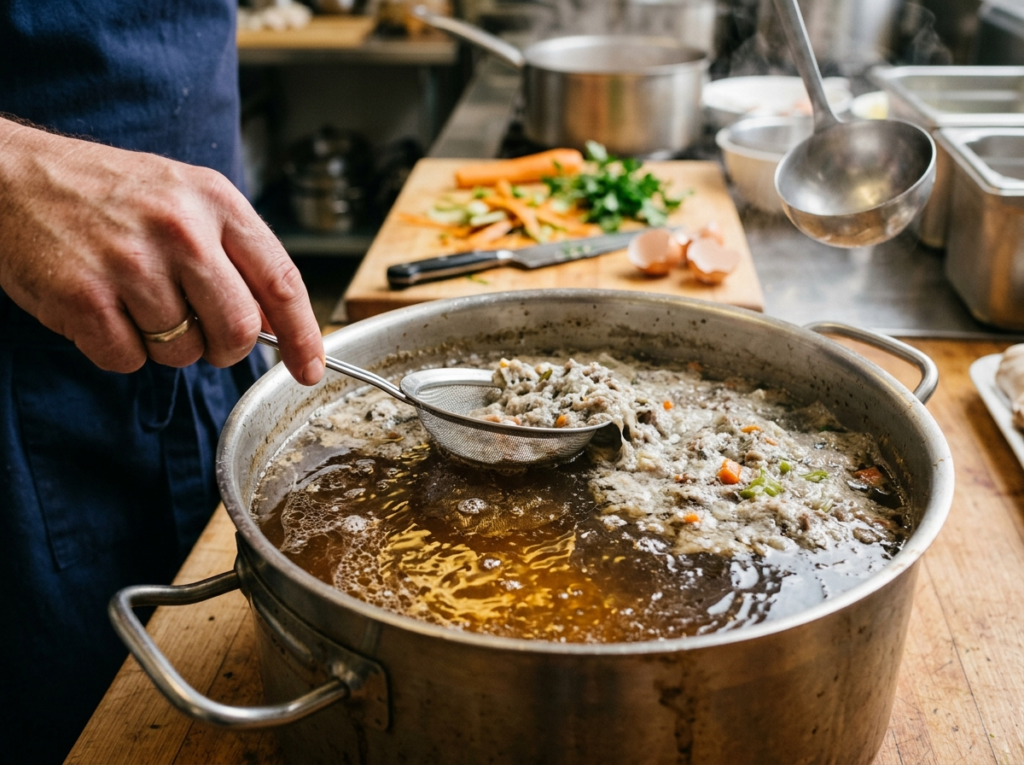
The coagulated proteins, meat, and vegetables will start rising to the surface and knitting together into a solid mass. This is your raft. It looks like a thick, grayish-brown cap sitting on top of the liquid. Let it form on its own. Don’t poke it. Don’t push it. Don’t touch it.
Once the raft has fully formed and sealed across the surface, you need to make a small hole — about the size of a quarter — using a ladle or spoon. Do this carefully. This hole allows the simmering liquid to bubble up through the raft, almost like a small volcano. As the consommé percolates up through the raft and then seeps back down through it, it gets filtered again and again. The raft is essentially cleaning and flavoring your consommé simultaneously.
Maintain a Gentle Simmer
Keep the consommé at a very gentle simmer — never a boil — for about 60 to 90 minutes. You should see lazy bubbles breaking through the hole in the raft, not a rolling boil. If it boils hard, the raft will break apart, all those trapped impurities will get released back into the liquid, and you’ll have to start over. There’s no fixing a broken raft.
Maintain your heat carefully. If you have a gas stove, this is one of those rare times when the precision of a low flame really matters. Keep checking that the simmer stays gentle. Walk away for too long and you might come back to a full boil that ruins an hour’s worth of work.
This patience — this willingness to let the process happen at its own pace — is why consommé is considered such a test of a cook’s discipline. Knowing the tricks professional chefs rely on can make a big difference with techniques like this.
Strain Carefully
After simmering, turn off the heat. Now you need to strain the consommé without disturbing the raft too much. Set up a chinois (a fine-mesh conical strainer) or a regular fine-mesh strainer lined with several layers of damp cheesecloth over a clean pot or large container.
Using a ladle, gently scoop the clear liquid from the hole in the raft and pour it through the strainer. Work slowly and carefully. Don’t dump the pot — you’ll send all that trapped sediment right back into your beautiful, clear consommé.
Once you’ve ladled out as much liquid as you can, you might carefully tilt the pot to get the remaining consommé from underneath the raft. Some chefs skip this last bit entirely because it increases the risk of cloudiness.
What you’re left with should be a gorgeous, crystal-clear liquid with a deep, clean flavor. Hold it up to the light. If it’s transparent with a warm golden or amber hue, congratulations — you’ve made consommé.
Seasoning and Serving
Taste your consommé. It should have a concentrated, satisfying flavor, but it likely needs a final adjustment of salt. Season carefully. Because the liquid is so clean and pure, every grain of salt matters. Add a little, stir, taste again.
Traditionally, consommé is served hot in warmed bowls or cups, often with a simple garnish. Classic garnishes include brunoise-cut vegetables (tiny, precise dice of carrot, celery, turnip), fresh herbs like chervil, or small shapes cut from cooked crêpes or egg custard. The French have named specific consommés based on their garnishes — Consommé Julienne features julienned vegetables, Consommé Celestine has thin crêpe strips, and Consommé Royale contains cubes of savory egg custard.
The garnish should complement, not compete. You’ve spent a lot of effort achieving that clarity — don’t muddy it up with a heavy hand.
And here’s something worth noting: consommé is also fantastic chilled. When properly made, it sets into a delicate jelly because of the natural gelatin from the stock. Chilled consommé, sometimes called gelée, is a classic summer starter in French fine dining. A spoonful of crème fraîche or a few drops of good sherry can finish it beautifully.
Why Does Consommé Fail? Common Pitfalls
Let’s be honest. Consommé doesn’t always work on the first try. Here are the things that trip people up most often.
Starting with warm or hot stock is probably the most common mistake. If your stock isn’t cold, the egg whites seize too fast and you never get a proper raft. Always start cold.
Boiling instead of simmering will break your raft apart. Once those impurities get released, there’s no getting them back. Gentle bubbles only.
Stirring after the raft forms breaks it up. Once you stop stirring, commit to it. Hands off.
Using fatty stock introduces grease that can cloud your consommé. Skim your stock thoroughly before starting the clarification. If you’re chilling your stock overnight (which is ideal), that solidified fat on top peels right off.
Rushing the straining process sends sediment through. Use a ladle, not a pour. Line your strainer with damp cheesecloth for extra insurance.
Under-seasoning the stock before clarification is a subtler issue. Once the raft is formed and filtering, you can’t really add flavors to the liquid underneath. Make sure your base stock is well-seasoned from the start. The clearmeat adds some flavor, but it shouldn’t be carrying the entire load.
Consommé Variations Worth Exploring
Once you’ve mastered the basic technique, a whole world of variations opens up.
Chicken consommé is slightly lighter and more versatile than beef. It pairs well with delicate garnishes and works beautifully as a base for other soups. Use ground chicken in your clearmeat and a rich, golden chicken stock as your foundation.
Fish consommé (consommé de poisson) uses a well-made fish fumet as the base and ground white fish in the clearmeat. It’s more delicate and cooks faster — usually only about 30 to 45 minutes of simmering. This one is trickier because fish stock can turn bitter if overcooked.
Game consommé made from venison, duck, or pheasant stock brings a rich, earthy depth that’s stunning in fall and winter menus. If you’ve ever spent time exploring the culinary traditions of the Basque Country, you know how deeply certain food cultures appreciate this kind of careful, flavor-forward cooking.
Double consommé is exactly what it sounds like — a consommé that’s been clarified twice, resulting in an even more concentrated and pristine result. It’s rare outside of professional kitchens, but if you’re feeling ambitious, it’s a remarkable experience.
Consommé vs. Broth vs. Stock: What’s the Difference?
People confuse these all the time, so let’s clear it up quickly.
Stock is made from bones (and often some meat, mirepoix, and aromatics) simmered for hours. It’s the foundation. It’s rich in gelatin and has body, but it’s not usually served on its own.
Broth is lighter, often made from meat rather than bones, and it’s typically seasoned enough to drink or serve as a simple soup.
Consommé starts as a stock and goes through the clarification process we’ve just described. It’s the most refined of the three — concentrated in flavor, completely clear, and fat-free. It’s a finished product, ready for the table.
Understanding these distinctions isn’t just culinary trivia. It actually affects how you cook. If a recipe calls for consommé and you substitute regular stock, you’ll get a different result — cloudier, less concentrated, with a different mouthfeel. If you’re building your fundamental cooking skills, understanding how acid and fat interact in your cooking and how base ingredients like stocks function will level up everything you make.
Can You Shortcut the Process?
Look, I know what you’re thinking. This is a lot of effort for a bowl of clear soup. And you’re right — it is. Consommé is not a weeknight dinner project. It’s a weekend labor of love, or a special-occasion flex for people who genuinely enjoy the craft of cooking.
That said, there are a few things that make the process easier without compromising quality.
Make your stock a day or two ahead and refrigerate it. Cold stock is easier to degrease and much easier to work with during clarification. You can even freeze stock in advance and thaw it when you’re ready for the consommé project.
Invest in a good heavy-bottomed pot if you don’t have one. Even heat distribution makes a huge difference. If you’re curious about what cookware makes the biggest impact in your kitchen, the cast iron debate between Le Creuset and Lodge is worth reading, though for consommé specifically, a good stainless steel stockpot is your best friend.
Practice your knife skills before you start. The mirepoix for the clearmeat needs to be diced small and evenly. If you’re serving consommé with a brunoise garnish, those tiny vegetable cuts need to be precise. A sharp knife and clean technique save time and produce better results.
But the actual clarification? There’s no real shortcut. The slow heating, the raft formation, the gentle simmer — these steps are what they are. You either do them right or you don’t get consommé.
The History and Why It Still Matters
Consommé has been part of the French culinary repertoire since at least the 18th century, though versions of clarified broth appeared even earlier. By the time Escoffier codified French cooking in “Le Guide Culinaire” (first published in 1903), consommé had dozens of named variations, each with a specific garnish and presentation.
For decades, it was a standard first course in fine dining restaurants around the world. As food trends shifted toward bolder, more rustic cooking in the late 20th century, consommé fell out of fashion. It was seen as fussy, old-school, and overly formal.
But here’s the thing — it’s been quietly making a comeback. Modern chefs who focus on technique-driven cooking and clean flavors have rediscovered consommé. Some use it as a base for ramen-style presentations. Others serve it in small cups as an amuse-bouche. A few have even played with unconventional consommés — tomato water consommé, mushroom consommé, even beet consommé with its stunning jewel-like color.
The technique itself remains relevant because it teaches you patience, precision, and respect for ingredients. If you can make a good consommé, you understand heat control, protein science, stock making, seasoning, and presentation. It’s a skill that makes everything else you cook a little better.
FAQ
How long does it take to make consommé from start to finish?
If you’re starting from scratch with homemade stock, the entire process can take two days — one day for the stock (which needs to chill overnight) and another 2 to 3 hours for the clarification, simmering, and straining. If you already have cold stock ready, the consommé process itself takes about 2 hours.
Can I freeze consommé?
Yes, consommé freezes beautifully. Portion it into airtight containers or even ice cube trays and freeze for up to 3 months. Thaw it gently in the refrigerator or over low heat. It’s a great thing to have on hand for quick, elegant soups or as a cooking liquid for risotto and braised dishes.
What do I do if my consommé is cloudy?
If the cloudiness is minor, you can try passing it through a cheesecloth-lined strainer one more time. For more significant cloudiness — usually caused by a broken raft or boiling — you can attempt a second clarification with fresh egg whites, though the results aren’t always perfect. The best approach is prevention: keep the simmer gentle, start with cold stock, and don’t stir once the raft begins forming.
Is consommé the same as bone broth?
No. Bone broth is typically a long-simmered stock made from roasted bones, and it’s usually cloudy with a rich, hearty character. Consommé is a clarified, refined product — it’s transparent, lighter in body (though still intensely flavored), and goes through a specific purification process that bone broth does not.
Can I make vegetable consommé?
Yes, though it requires a slightly different approach. Since there’s no animal protein to help the raft form, you rely entirely on egg whites combined with finely diced vegetables and sometimes mushroom or tomato for depth. Vegetable consommé is more delicate and can be trickier to pull off, but it’s absolutely doable.
Your Next Move
Making consommé isn’t about impressing anyone — though it absolutely will. It’s about understanding one of cooking’s most fundamental principles: that real flavor and real clarity come from patience and attention. There’s something deeply satisfying about holding up a ladle of liquid that’s perfectly transparent, knowing that you coaxed it into existence through technique alone.
Start with a stock you’re proud of. Take your time with the clarification. Don’t rush the simmer. And when you finally taste that first spoonful — clean, warm, deeply savory — you’ll understand why chefs have been obsessing over this dish for centuries.
If you want to keep building your kitchen fundamentals, exploring how a demi-glace comes together is a natural next step. The two techniques share a lot of DNA, and mastering both gives you a foundation that changes how you approach cooking entirely.