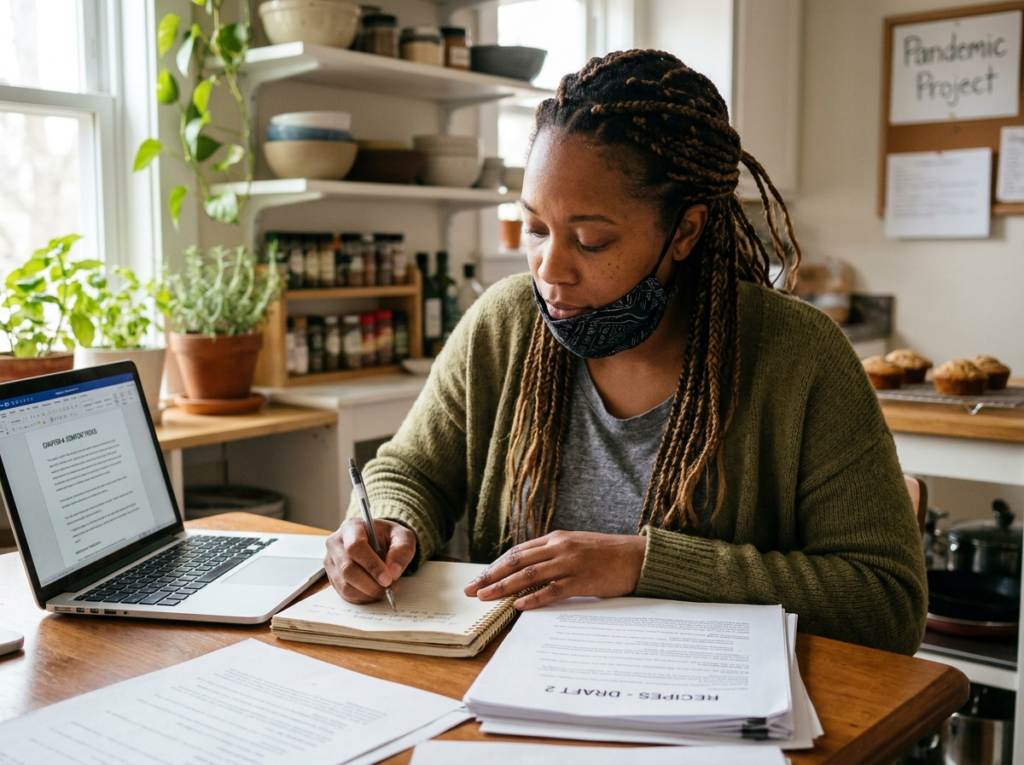
Most people spent the pandemic stress-baking banana bread and rewatching Netflix. Shanika Graham-White sat down and wrote a cookbook.
Not just any cookbook — a deeply personal, culturally rich collection of recipes rooted in Black culinary tradition. While restaurants closed, kitchens went quiet, and the food industry held its breath, she turned uncertainty into something permanent. Something you can hold in your hands, cook from, and pass down.
That says a lot about who she is.
Who Is Shanika Graham-White?
Shanika Graham-White is the woman behind Orchids + Sweet Tea, a food blog she built from scratch that sits at the intersection of Southern comfort food, Caribbean flavors, and modern plant-forward cooking. Her audience found her online, but her cookbook — Healthier Together: Recipes for Two — Nourish Your Body and Your Relationships — brought her story to a much wider table.
She’s a Black woman entrepreneur in an industry that hasn’t always made room for voices like hers. And she didn’t wait for an invitation.
Her blog grew out of a genuine love for food and a frustration with health content that felt either too clinical or completely disconnected from the flavors she grew up with. She wanted to show that eating well doesn’t mean abandoning your roots. That Black cooking — rich, soulful, layered — can also be nourishing in every sense of the word.
When the pandemic hit in 2020, many creators hit pause. Shanika did the opposite.
Writing a Cookbook During a Pandemic: What That Actually Looks Like
Here’s something most people don’t realize — writing a cookbook is brutal under normal circumstances. You’re testing each recipe multiple times, photographing it, writing headnotes, dealing with a publisher, managing timelines, and doing all of this while also running a blog, managing social media, and — in Shanika’s case — doing it all during a global health crisis.
The pandemic brought a specific kind of chaos to food creators. Supply chains were disrupted, which meant certain ingredients were simply unavailable at times. Grocery stores were unpredictable. Photoshoots that might have involved a team suddenly had to happen solo or with minimal contact.
And yet, the pandemic also created something unexpectedly useful: time. Time to be in the kitchen without rushing. Time to sit with a recipe and understand it deeply before moving on. Time to think about what food means — not just what it tastes like.
For Shanika, that slowdown became a creative opening. She’s talked about how the pandemic forced a kind of focus that’s hard to manufacture in a busy, distracted world. The urgency of normal life disappeared, and what was left was the work itself.
There’s something profoundly human about that. When everything external falls away, you find out what actually matters to you. For her, it was the food, the stories behind it, and the people she wanted to cook for.
The Food Philosophy Behind the Book
Shanika’s cooking philosophy doesn’t fit neatly into a single box — and that’s exactly what makes it interesting.
She draws heavily from Jamaican cuisine, which shows up in her use of bold spices, fresh herbs, and layered seasoning that builds flavor from the ground up. But she also brings in Southern American cooking traditions, the kind passed down through generations of Black families in the United States — slow-cooked, generous, and unapologetically rich.
What she adds to this foundation is a modern lens focused on plant-based ingredients and whole foods. Not in a preachy, joyless way — but in a “what if we made this feel good AND taste incredible” way.
This combination is rarer than it should be. Most health-forward cookbooks strip away cultural identity along with the butter. Shanika’s work refuses to do that. She argues — through the recipes themselves — that Black food traditions already contain incredible wisdom about using whole ingredients, building complex flavors without shortcuts, and cooking with intention.
Her approach to food for two (the core concept of her book) also comes from a personal place. Cooking for a smaller household is genuinely different from scaling down a family-sized recipe. The portioning is different, the emotional experience is different, and the mindfulness required is different. She treats that as a feature, not a limitation.
If you’ve ever felt like most cookbooks assume you’re feeding a small army, her work will feel like a relief. Think of it the way a thoughtful no-plan meal approach can make everyday cooking feel less stressful — she brings that same energy to a more structured format.
Black Excellence Isn’t a Marketing Term — It’s a Standard
The phrase “Black excellence” gets used a lot. Sometimes it’s a genuine celebration. Sometimes it’s empty. In Shanika’s case, it means something specific.
It means doing something extraordinarily difficult — writing and publishing a cookbook — in extraordinarily difficult circumstances, while also carrying the weight of representing a community that has historically been underrepresented in mainstream food publishing.
The cookbook industry has a well-documented diversity problem. For years, the overwhelming majority of cookbooks published by major houses featured white authors. The food they documented was treated as universal. Black culinary traditions — even when they were the origin of techniques and dishes later credited to others — were often sidelined or reframed as regional curiosities rather than foundational contributions to American cuisine.
Shanika’s presence in this space matters because of that history, not in spite of it.
When a Black woman builds a food blog to 1M+ monthly readers, then converts that into a published cookbook that gets real shelf space and real attention, it shifts the conversation. It tells other Black food creators that there is an audience for their stories, their recipes, and their perspective — and that they don’t have to dilute any of it to get there.
If you’re curious about how culinary identity shapes a cookbook’s voice, it’s worth spending time with resources that connect food to culture and place — the same way exploring Mexican cookbook traditions reveals how deeply food is tied to identity and heritage.
What the Pandemic Revealed About Food and Community
There’s a broader story here that goes beyond one cookbook.
The pandemic exposed something most food professionals already knew: cooking is not just a practical skill — it’s an emotional anchor. When restaurants closed and social gatherings stopped, people turned to their kitchens with a kind of desperation. They wanted comfort. They wanted connection. They wanted something that felt real.
Food has always served that function. But 2020 made it undeniable.
For many Black families, the kitchen has historically been the most important room in the house — not because of some romanticized notion of domesticity, but because it was often the space where culture was preserved, language was maintained, and community was built. Recipes passed down aren’t just instructions. They’re memory. They’re identity. They’re resistance against erasure.
Shanika’s cookbook arrives in that tradition. It’s not trying to be a neutral technical manual. It’s asking you to cook with intention, to think about who you’re cooking for, and to understand that the act of making food for someone — especially making it well — is an act of care.
That’s not a small thing. The unifying power of food is something food writers and chefs return to again and again because it keeps proving itself true, across cultures and circumstances.
Building a Food Brand as a Black Woman Entrepreneur
Shanika didn’t just write a cookbook. She built a business — and the two things are deeply connected.
Orchids + Sweet Tea started as a blog and grew into a full content operation. That means recipe development, food photography, video content, brand partnerships, and audience management — all before the cookbook deal entered the picture. By the time she was writing the book, she already understood her audience deeply. She knew what they responded to, what questions they had, what flavors they trusted her to guide them toward.
That foundation made the cookbook stronger. It wasn’t written by someone guessing at what readers want. It was written by someone who had spent years in conversation with them.
This is what sustainable food content looks like. Not a viral moment, not a single recipe that blows up on social media — but a consistent, authentic voice that builds trust over time.
She’s talked openly about the business side of food blogging: negotiating brand deals, understanding SEO, building an email list, managing the economics of a creative career. That transparency is itself a form of generosity — it helps other creators, especially Black women, understand that this is a real business with real mechanics, not just a passion project.
If you think about how professional food creators approach their work — the way a private chef thinks about organization and systems — you start to see how much discipline sits behind what looks effortless on screen.
Why Her Story Resonates Beyond the Food World
You don’t have to be a home cook to find Shanika’s pandemic cookbook story compelling.
It’s a story about what humans do when circumstances become impossible: they create. They make something new out of what they have. The creative instinct doesn’t disappear under pressure — sometimes it sharpens.
It’s also a story about timing. The pandemic, for all its horror, accelerated certain cultural shifts. Conversations about representation, equity, and whose stories get told became impossible to ignore. The food world was part of that reckoning. And in that moment, Shanika had already done the work. She wasn’t positioning herself in response to a trend. She had built something real, and the moment caught up with her.
That’s the difference between lasting excellence and temporary visibility.
Her cookbook also arrived when people were spending more time in their kitchens than they had in decades. Readers were genuinely ready to engage with food in a deeper way. A book that asked them to slow down, cook for two, think about nourishment and relationship — that hit differently in 2020 than it might have in any other year.
FAQ
What is Shanika Graham-White’s cookbook about?
Her cookbook, Healthier Together, centers on nourishing recipes designed for two people, drawing from Jamaican, Southern, and plant-forward cooking traditions. It combines flavor-forward, culturally rooted cooking with a focus on whole ingredients and intentional eating.
How did the pandemic affect cookbook writing for food bloggers?
The pandemic disrupted supply chains, complicated food photography, and removed the professional support systems many creators relied on. But it also created uninterrupted time in the kitchen — which, for creators like Shanika, translated into deeper recipe testing and clearer creative focus.
Why is Black representation in food publishing important?
Black culinary traditions have shaped American and global food culture in fundamental ways, yet Black authors have historically been underrepresented in mainstream food publishing. When Black food creators publish cookbooks that center their culture authentically, it expands what gets documented, celebrated, and preserved for future generations.
Where can I find Shanika Graham-White’s work?
Her blog Orchids + Sweet Tea is active with recipes, food photography, and cooking guides. Her cookbook is available through major booksellers. She’s also present across social media platforms where she continues to share her cooking philosophy and new recipes.
One Last Thing Worth Sitting With
Shanika Graham-White wrote a cookbook during one of the most chaotic, grief-filled periods most of us have ever lived through. She did it with care. She did it with cultural honesty. And she did it while running a business, representing her community, and building something that will outlast the moment that produced it.
That’s not inspiration content. That’s just what sustained creative work looks like when someone refuses to let fear set the agenda.
If you’re a home cook who wants to cook more intentionally, or a food lover who wants to understand whose shoulders today’s food culture stands on — her work is a genuinely good place to start. And if you’re a creator wondering whether your story deserves to be told, her answer is clear.
It does. Start anyway.