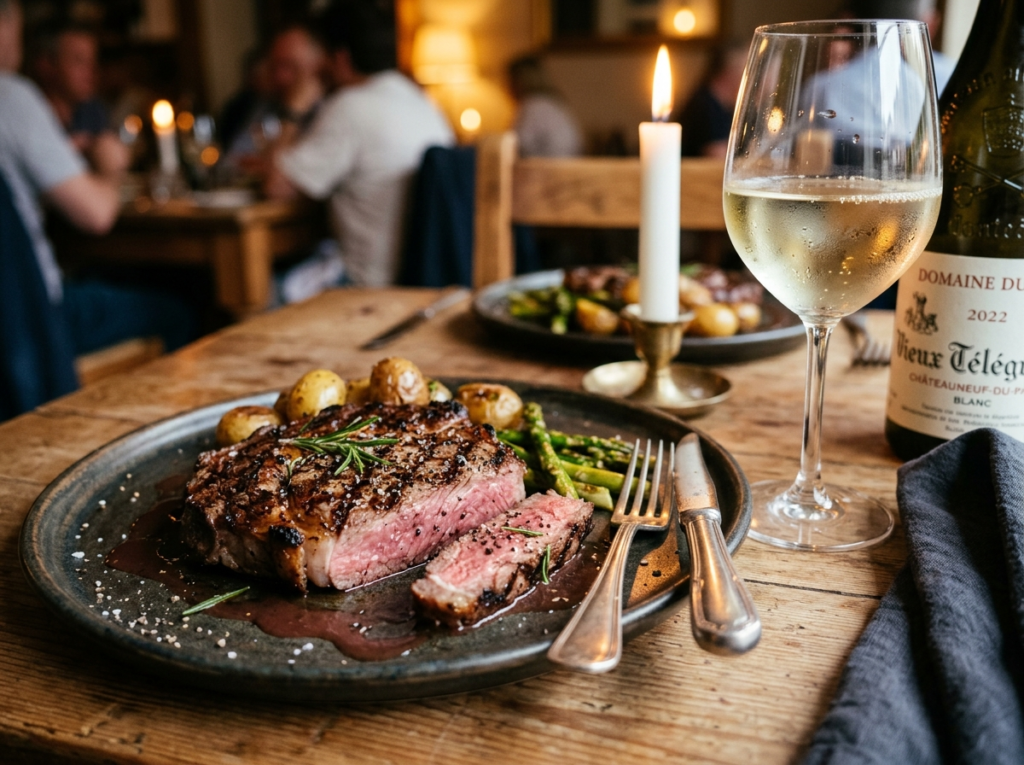
A sommelier once told me something that stuck: “The best wine pairing is the one you actually enjoy.” That single line quietly dismantled years of rigid thinking about what belongs in my glass next to a steak. And honestly? It’s about time more of us heard it.
For decades, the “rule” has been drilled into us — red wine with red meat, white wine with fish and chicken. It sounds clean and simple. But food and wine pairing isn’t math. It’s sensory. It’s personal. And that old formula? It’s way more flexible than most people realize.
If you’ve ever felt a pang of guilt for craving a glass of crisp Chardonnay alongside your grilled lamb chops, this one’s for you. White wine with red meat isn’t just “allowed” — there are solid reasons it can be a genuinely better pairing than red wine in certain situations. Let’s talk about why.
Where Did the “Red Wine with Red Meat” Rule Come From?
Before we get into the good stuff, it helps to understand why this rule became gospel in the first place.
The logic behind the traditional pairing is based on weight and tannins. Red meats — beef, lamb, venison — tend to have rich, bold flavors and significant fat content. Red wines, with their tannin structure and fuller body, complement that richness. The tannins bind with the proteins and fats in the meat, which creates a balanced, almost cleansing sensation on the palate.
That’s real science, and it’s valid. Nobody’s saying red wine and red meat is a bad pairing.
But here’s the thing — that rule was born in an era when wine culture was far more rigid. French fine dining in the mid-20th century popularized these pairing “laws,” and they spread across restaurants, wine courses, and magazine columns. They became shorthand. Easy advice for people who didn’t want to overthink their order.
The problem? Shorthand became dogma. And dogma stopped people from discovering pairings that are equally good — sometimes even better.
Why White Wine Actually Works with Red Meat
Let’s get specific. What makes white wine a genuinely good partner for certain red meat dishes?
It’s about acidity. Many white wines — Riesling, Grüner Veltliner, white Burgundy — carry bright, sharp acidity. That acidity cuts through the richness of fatty meats the same way a squeeze of lemon cuts through a heavy cream sauce. It refreshes your palate between bites and keeps the meal from feeling overwhelming.
Weight isn’t just a red wine thing. Not all white wines are light and delicate. A barrel-aged Chardonnay from Burgundy has body, texture, and complexity. A Viognier from the Rhône Valley carries richness and an almost oily mouthfeel. These fuller-bodied whites can stand up to a steak without being pushed aside by the meat’s intensity.
Preparation matters more than protein. This is the part most people miss. A pork loin roasted with rosemary and garlic has a completely different flavor profile than a pork shoulder braised in soy and ginger. The cooking method, the sauce, the seasonings — these drive the pairing decision just as much as the protein itself. A veal chop with a lemon-butter sauce? That’s practically begging for white wine.
Think of it this way: you wouldn’t pair a wine with the raw ingredient. You pair it with the finished dish. And finished dishes are complicated, layered things.
The Best White Wines to Pair with Red Meat
Not every white wine works here. A bone-dry Pinot Grigio might get completely lost next to a big ribeye. But several white varieties hold their own — and then some.
Chardonnay (especially oaked or Burgundy-style) is the most natural starting point. The richness from oak aging, the buttery texture, and the moderate acidity make it a strong match for grilled steaks, roast beef, and veal dishes. If you’re having a meat fest weekend and want something different, a well-made Burgundy Chardonnay can genuinely surprise you.
Riesling, particularly the off-dry styles from Alsace or Germany, pairs beautifully with spiced or slightly sweet preparations. Think lamb with Moroccan spices, or a pork roast with an apple glaze. The hint of sweetness in the wine complements the spice without competing.
Viognier from the northern Rhône (or good examples from California and Virginia) brings stone fruit aromas and a lush, rounded body. It works wonderfully with herb-crusted lamb or pork tenderloin with a peach chutney.
Grüner Veltliner, Austria’s flagship white, carries a peppery, herbal quality with firm acidity. It handles rich meats with surprising ease, especially when there’s a vegetable-forward side dish involved.
Chenin Blanc from the Loire Valley or South Africa offers versatility — it can be dry, off-dry, or sparkling, and the best versions carry enough acidity and complexity to stand alongside a hearty beef stew or a braised short rib.
White Rhône blends — Marsanne, Roussanne, and their combinations — tend to have weight and texture that echo the richness of red meat without needing tannins to balance it.
The key thread running through all these wines? Body, acidity, and flavor complexity. You need something in the wine that can engage with the weight of the meat, not just sit passively beside it.
Specific Pairings That Actually Sing
Let’s move beyond theory. Here are real-world pairings where white wine doesn’t just work — it shines.
Grilled ribeye with lemon-herb butter + oaked Chardonnay. The butter in the sauce echoes the buttery quality of the wine. The lemon bridges the wine’s acidity and the meat’s char. It’s a pairing that feels cohesive rather than forced.
Roast leg of lamb with garlic and rosemary + Viognier. The aromatic quality of Viognier — apricot, honeysuckle, a touch of spice — plays beautifully off the herbaceous crust on the lamb. If you’ve ever been lucky enough to taste this combination in southern France, you know it’s not some experiment. It’s tradition.
Braised pork shoulder with mustard sauce + Riesling. The acidity and subtle sweetness of a Spätlese Riesling tame the mustard’s bite and complement the tender, falling-apart pork. This pairing is genuinely better than most red wine options for this dish.
Veal Milanese + Pinot Grigio or Verdicchio. A breaded veal cutlet with a squeeze of lemon is one of the classic Italian white-wine-with-meat pairings. It’s been done for generations in Milan, and it works because the dish is lighter than a thick steak.
Grilled venison with berry reduction + off-dry Chenin Blanc. The berry sauce gives you a bridge between the wine’s fruit character and the gamey meat. The acidity cuts the richness of both sauce and protein.
Beef carpaccio + crisp Chablis. Raw beef served thinly sliced with olive oil, lemon, and Parmesan is a dish that needs a white wine. Red wine would bulldoze the delicate flavors. A mineral-driven Chablis lifts the whole plate.
You’ll notice a pattern: the sauce, the seasoning, the cooking technique — they all push the pairing toward white wine. That’s not accidental. These dishes were designed, often over centuries of regional cooking, to work with the local wines. And in many of those regions, the local wine is white.
Regional Traditions That Prove the Point
The “red with red” rule feels universal, but it’s actually a pretty narrow, mostly French-and-American convention. Look around the world, and you’ll find entire culinary traditions built on white wine with meat.
Alsace, France. This northeastern French region is famous for Riesling, Gewürztraminer, and Pinot Gris — all white. The local food? Choucroute garnie (sausages and pork with sauerkraut), baeckeoffe (a meat and potato casserole with beef, pork, and lamb), tarte flambée. These are hearty, meat-heavy dishes, and they’re always paired with white wines. Nobody in Strasbourg is reaching for a Cabernet.
Austria. Wiener Schnitzel, one of the country’s most iconic dishes, is breaded and fried veal. It’s served with a glass of Grüner Veltliner or a crisp Austrian Riesling. Suggesting a red wine here would actually get you a raised eyebrow.
The Basque Country. If you’ve ever had the chance to explore Basque culinary traditions, you know that Txakoli — a slightly sparkling, bone-dry white — gets served alongside grilled meats, pintxos, and chuleta (massive bone-in steaks). The locals don’t see any contradiction.
Northern Italy. In Friuli and Trentino-Alto Adige, white wines dominate the wine lists, and meats — from cured speck to roast pork to beef tagliatas — appear on every menu. These regions figured out long ago that their aromatic whites and structured Pinot Bianco hold up to meat just fine.
Sicily. Grilled lamb and sausages paired with a full-bodied Grillo or Carricante? Totally normal. Sicilian food traditions blend bold flavors with local wines, and the result feels effortlessly right.
These aren’t quirky outliers. They’re deeply rooted culinary traditions that have been refined over hundreds of years. If white wine with red meat didn’t work, these pairings wouldn’t have survived.
How to Choose the Right White Wine for Your Red Meat Dish
You don’t need a sommelier certification to make good choices here. A few simple principles will guide you well.
Match the weight of the wine to the weight of the dish. A heavy, braised short rib needs a full-bodied white like oaked Chardonnay or a white Rhône blend. A lighter preparation — beef tartare, thin-sliced pork loin — works with a lighter white like Vermentino or Albariño.
Look at the sauce, not just the meat. This is worth repeating because it changes everything. A filet mignon with béarnaise sauce? The sauce is rich, buttery, and tarragon-forward. A Chardonnay mirrors that beautifully. A filet with a red wine reduction? Now a red wine makes more sense because the sauce already set the tone.
Consider the seasoning profile. Citrus, herbs, and lighter spice profiles lean toward white wine. Heavy spice rubs, smoky flavors, and dark sauces lean toward red. Asian-inspired preparations — soy, ginger, lemongrass — often pair better with an aromatic white like Gewürztraminer or Riesling than with any red wine you could name.
Think about temperature and season. On a hot August evening, a chilled glass of white wine with your grilled lamb kebabs isn’t just acceptable — it’s smart. You match the wine to the moment, not just the plate. A cold Chablis on a summer night beside a perfectly charred steak? That’s living.
Trust your instincts. If something tastes good together, it is good together. Don’t let anyone — not a wine writer, not a sommelier, not a well-meaning uncle — tell you your palate is wrong.
What About Temperature and Serving?
One often-overlooked factor in wine pairing is serving temperature. Most white wines are served between 45–55°F (7–13°C), and that chill actually plays a role in how the pairing works.
Cold wine alongside hot, fatty meat creates a temperature contrast that heightens the experience. The chill tightens the wine’s acidity, making it more refreshing against the richness of the meat. It’s similar to why a cold beer tastes so right with barbecue — the contrast itself becomes part of the pleasure.
For fuller-bodied whites that you’re pairing with red meat, let the wine warm up just slightly from typical fridge temperature. Around 50–55°F is ideal. You want enough chill to keep the acidity crisp, but enough warmth to let the wine’s flavor complexity come through. Too cold, and you’ll lose all those gorgeous secondary aromas — the toast, the honey, the stone fruit — that make a wine like aged Burgundy Chardonnay so special.
And while we’re on the subject, choosing the right wineglass makes a real difference too. A slightly larger bowl lets those aromas develop, which matters when you’re pairing against a strong-flavored dish. Don’t serve a great Viognier in a narrow flute — give it room to breathe.
When Red Wine Is Still the Better Call
Let’s be honest and balanced about this. White wine with red meat works brilliantly in many situations, but there are times when red wine is genuinely the stronger choice.
If you’re having a dry-aged, heavily charred bone-in ribeye with nothing but salt and pepper? A big Cabernet Sauvignon or Malbec is hard to beat. The tannins grab onto those charred fats in a way that white wine simply can’t replicate. If you’re curious about what makes Malbec such a great option, it’s worth exploring — especially for Argentine-style grilled beef.
Rich stews and braises cooked in red wine — beef Bourguignon, osso buco with a Barolo reduction — are naturally going to pair best with the wine that went into the pot. The flavors are already integrated.
Heavily smoked meats — Texas-style brisket, smoked short ribs — carry deep, charred, almost bitter flavors that a white wine can struggle to meet. A Syrah or Zinfandel echoes those smoky notes and feels more at home on the plate.
The point isn’t that white wine is always better with red meat. It’s that the old rule suggesting it’s never appropriate is wrong. Sometimes white is the better choice. Sometimes red is. And sometimes, honestly, a really good beer is the right answer. The meal should drive the decision, not a rule from 1955.
A Pro Chef’s Perspective on the Pairing
Professional chefs have been quietly pairing white wine with red meat for years. In professional kitchens, the “red with red” rule barely gets a mention anymore. Chefs think about acidity, fat, texture, and flavor compounds — not color.
If you’ve ever watched a skilled chef organize a home kitchen, you’ll notice they think about food holistically. The same applies to pairing. It’s about the whole plate — what acid is present, how the fat is rendered, what sauce ties things together.
Understanding the fundamentals — like how acid and fat interact as the yin and yang of cooking — unlocks your ability to pair intuitively. If your dish is fat-heavy, you want acidity in your wine. Many white wines deliver that acidity more effectively than reds do. It’s not complicated once you see it through that lens.
A rich consommé or demi-glace based dish might have layers of concentrated beef flavor, but if the finishing touch is a splash of sherry vinegar and fresh herbs, a white wine can be the more harmonious companion.
FAQ
Can you drink white wine with steak?
Absolutely. A full-bodied white wine like oaked Chardonnay, Viognier, or a white Burgundy can pair beautifully with steak — especially if the steak is served with a butter- or cream-based sauce. The wine’s acidity cuts through the fat and keeps each bite feeling fresh. It’s not the traditional choice, but it’s a genuinely good one.
What white wine goes best with lamb?
Viognier and off-dry Riesling are excellent choices for lamb. Viognier’s aromatic, stone-fruit quality complements herb-crusted or roasted lamb, while Riesling’s acidity and slight sweetness work particularly well with spiced lamb dishes — think Moroccan-style or curry-rubbed preparations.
Is the rule “red wine with red meat” outdated?
The rule isn’t wrong — it’s just incomplete. Red wine with red meat is a solid pairing in many cases. But treating it as an absolute rule ignores the role of sauces, seasonings, and cooking methods. Many professional sommeliers and chefs now consider the full dish, not just the protein, when recommending wine. The “rule” is a decent starting point, not a finish line.
Why does white wine sometimes taste better with meat than red wine?
It often comes down to acidity and contrast. Rich, fatty meats benefit from a wine that refreshes the palate. White wines tend to have higher acidity than reds, which creates that cleansing effect. On warm days or with lighter preparations of red meat, the chill and brightness of a white wine can feel more satisfying than the heaviness of a tannic red.
What white wines are full-bodied enough for red meat?
Oaked Chardonnay (especially from Burgundy or California), Viognier, Marsanne-Roussanne blends, richer styles of Chenin Blanc, and some aged Rieslings all carry enough weight and complexity to stand alongside red meat without being overwhelmed.
Your Glass, Your Rules
The most freeing thing you can do at the dinner table is stop worrying about whether your wine choice is “correct.” Wine pairing guidelines exist to help, not to restrict. They’re a starting point — a loose map, not a set of traffic laws.
Next time you’re grilling a steak or pulling a slow-braised pork shoulder out of the oven, reach for a white wine. Try a chilled Chardonnay. Pour a glass of Riesling. Open that Viognier you’ve been saving. Pay attention to what you taste — how the wine interacts with the fat, the salt, the herbs, the char.
You might discover that the pairing you were told was wrong is actually your new favorite. And that’s exactly how it should work. Good food and good wine are about pleasure, curiosity, and sharing something memorable. The color of the wine matters far less than the smile on your face while you’re drinking it.