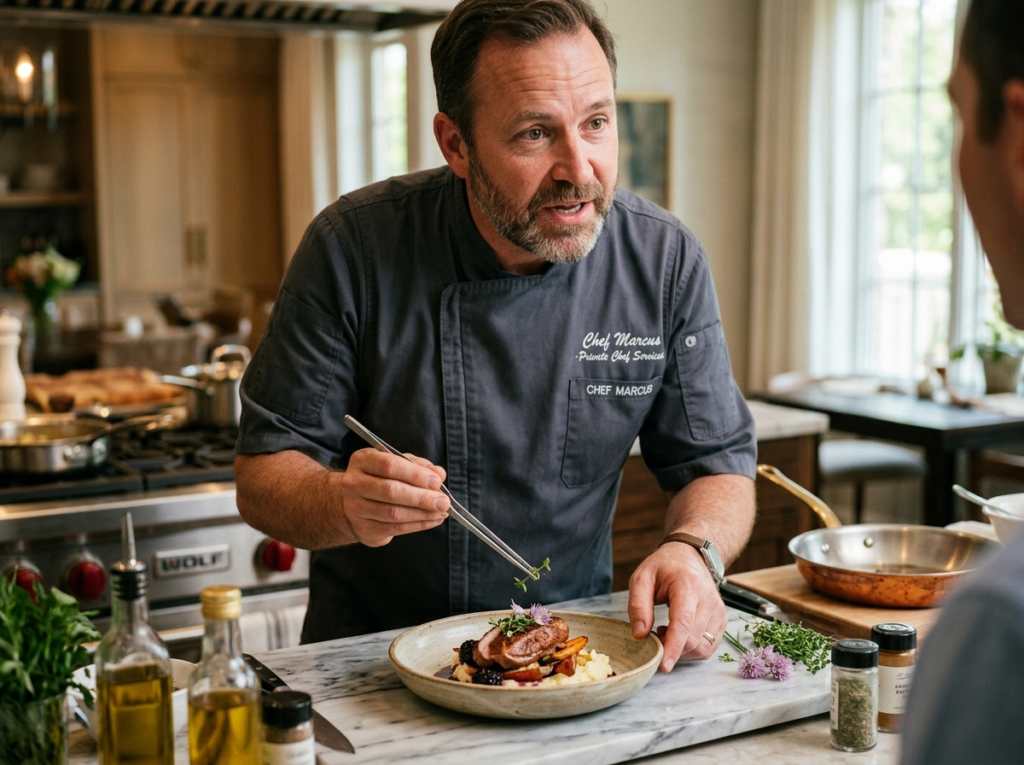
Most people picture a private chef working in a gleaming mansion kitchen, whipping up five-course meals with a team of helpers and unlimited budget. The reality? Private chefs often work alone, in unfamiliar kitchens, with whatever equipment the client happens to own — and they still make every plate look and taste extraordinary. That gap between expectation and reality is exactly where the best lessons hide.
The skills that make a private chef successful aren’t flashy knife tricks or molecular gastronomy gimmicks. They’re practical, repeatable habits that anyone can adopt at home. Things like how you plan a menu, how you prep your ingredients before the heat even comes on, how you balance flavors without a recipe telling you what to do. These are the pro tips that separate “I followed a recipe” from “I actually know how to cook.”
Whether you’re someone who cooks every night and wants to level up, or you’re tired of meals that taste fine but never feel special, this piece is for you. Let’s get into what private chefs actually do differently — and how you can do it too.
The Mise en Place Mindset Goes Way Beyond Chopping Vegetables
You’ve probably heard the phrase “mise en place” — it’s French for “everything in its place.” Most cooking tutorials teach it as a prep step: chop your onions, measure your spices, line up your bowls. That’s accurate but incomplete.
For a private chef, mise en place is a way of thinking. It’s not just about having your garlic minced before you heat the pan. It’s about walking into any kitchen — yours, a client’s, a rental property’s — and mentally organizing the entire cooking session before touching a single ingredient.
Here’s what that looks like in practice. Before you start cooking, ask yourself three questions: What needs the most time? What can I do while something else is cooking? And what absolutely cannot wait once I start?
A private chef cooking a dinner party for eight might be roasting a chicken, reducing a sauce, and prepping a salad all within the same hour. None of that works without a mental timeline. You don’t need to write it down every time (though it helps at first). You just need the habit of thinking through the sequence before you begin.
Pro Tip: Spend 5 minutes before you cook just standing in your kitchen and thinking. Not scrolling recipes. Not pulling out pans. Just thinking about what happens first, second, third. That alone will cut your stress in half and improve your results immediately.
This connects directly to how a pro chef organizes a small home kitchen — because physical organization and mental organization feed each other. If your tools are where you need them, your brain is free to focus on the food.
Seasoning Is a Skill, Not a Step
Here’s a truth that separates home cooks from professionals: most people under-season their food. Not because they’re afraid of salt, but because they season at the wrong time, in the wrong way, and they only do it once.
Private chefs season in layers. A pinch of salt goes into the onions as they start to sweat. A little more when the protein hits the pan. A bit of acid — lemon juice, vinegar, a splash of wine — right before plating. Each layer builds depth. Dumping all your salt in at the end is like trying to tune a guitar by only adjusting one string.
And it’s not just salt. Fat and acid are the other two pillars. A dish that tastes “flat” almost always needs acid. A squeeze of lime, a dash of sherry vinegar, even a spoonful of yogurt can wake everything up. The concept of acid and fat as the yin and yang of cooking isn’t abstract theory — it’s the single most useful framework you’ll ever learn in the kitchen.
Did you know? Professional chefs taste their food constantly while cooking — sometimes 15-20 times during a single dish. They’re not being indecisive. They’re tracking how the flavor is developing and adjusting in real time. You should be doing the same thing. Keep a small spoon nearby (or several), and taste at every stage. Your palate will sharpen fast.
One more thing about seasoning: the temperature of food changes how it tastes. Something that’s perfectly salted when it’s hot might taste bland at room temperature. If you’re making a dish that’ll be served cold or at room temp — a pasta salad, a gazpacho, a grain bowl — season it a touch more aggressively than your hot-food instincts suggest.
Menu Planning Is Where the Real Magic Happens
Ask any private chef what their most important skill is, and most won’t say “cooking.” They’ll say “planning.”
A private chef doesn’t just cook what sounds good. They think about the entire dining experience as a composition. Does the meal have contrast? Is there something rich balanced by something bright? Something soft balanced by something crunchy? If the main course is heavy — say, a braised short rib — the starter needs to be light. If the appetizer is acidic and herbaceous, the main can afford to be richer.
This isn’t about following rules. It’s about paying attention to how your mouth actually experiences a meal from start to finish. Think about the last time you ate three heavy courses in a row at a restaurant. By the end, nothing tasted special because everything blurred together. A private chef avoids that by designing contrast into every menu.
You can apply this at home even for a Tuesday dinner. If your main dish is a creamy pasta, pair it with a crisp, vinegar-dressed salad — not garlic bread. If you’re grilling burgers, skip the heavy potato salad and go for a bright slaw instead. Your mouth wants variety. Give it that.
Pro Tip: Plan your meals around one “star” component and build supporting players around it. If you buy beautiful wild salmon, don’t pair it with an equally assertive curry sauce and strong cheese on the side. Let the salmon shine. Keep everything else simple and supportive. Private chefs call this “knowing who the lead actor is.”
The no-plan meal plan approach works great for weeknights, but when you want to impress — or just eat really well — a little thoughtful planning goes a long way.
Your Knife Is Your Most Important Tool (So Learn to Use It)
There’s a reason private chefs obsess over their knives. A sharp, well-handled knife doesn’t just make prep faster — it makes your food cook more evenly, look better on the plate, and taste more consistent.
Think about it. If you’re cutting onions and some pieces are the size of a dime while others are the size of a quarter, they’re going to cook at different rates. You’ll end up with some burnt, some raw, and most somewhere in between. A private chef’s dice is uniform not because they’re showing off, but because uniform cuts mean uniform cooking. The flavor and texture of the finished dish depends on it.
You don’t need to be able to brunoise a shallot in 30 seconds. But you should be comfortable with a basic dice, a rough chop, and a chiffonade (that’s rolling leafy herbs or greens and slicing them into thin ribbons). These three cuts will handle 90% of your home cooking.
The other thing? Keep your knife sharp. A dull knife is more dangerous than a sharp one because it slips instead of cutting. You don’t need a professional sharpening service every week — a simple honing steel before each use and a proper sharpening every few months will keep you in great shape. If you’re curious about building this skill, knife skills classes are genuinely one of the best investments a home cook can make. It changes everything.
Warning: Don’t buy an expensive knife and then throw it in a drawer with all your other utensils. Blade-on-blade contact dulls edges fast. Use a magnetic strip, a knife block, or blade guards. Treat your knife like the precision instrument it is.
Heat Management: The Difference Between Cooking and Burning
Here’s something that takes most home cooks years to figure out: your stove has settings between “off” and “maximum.”
Private chefs understand heat like musicians understand tempo. Sometimes you need high heat — searing a steak, charring vegetables, getting a hard caramelization. But those moments are specific and intentional. The rest of the time, medium and medium-low heat do most of the work.
A common mistake is cranking the burner to high because you’re impatient. You want the onions to soften faster. You want the pan to get hot quicker. But high heat on onions doesn’t speed up softening — it burns the outside while the inside stays raw. You end up with bitter, scorched edges and a crunchy center. The patient cook who keeps the heat at medium and lets the onions sweat for 8-10 minutes gets sweet, translucent, flavorful onions every single time.
Quick fact: A properly preheated pan on medium-high heat will sear a piece of meat just as well as a screaming-hot pan — but with far more control. The key is preheating. Give your pan 2-3 minutes to come up to temperature before adding oil. Then wait for the oil to shimmer (not smoke) before adding your food.
There’s a related concept here that private chefs live by: don’t crowd the pan. When you pile too many pieces of chicken or too many mushrooms into a skillet, you drop the temperature drastically. Instead of searing, your food steams. It turns gray and rubbery instead of golden and crispy. Cook in batches if you need to. Yes, it takes longer. Yes, it’s worth it.
If you’ve ever wondered why restaurant food has that beautiful brown crust and yours doesn’t, the answer is almost always heat management and pan space. Not secret ingredients. Not special equipment.
The Power of Finishing: What Happens in the Last 60 Seconds
Private chefs pay more attention to the last minute of cooking than any other part of the process. That final 60 seconds is where a good dish becomes a great one.
What happens in that window? A few things. A knob of cold butter gets swirled into a sauce (this is called “mounting” and it adds richness and sheen). Fresh herbs get scattered — not stirred in, because heat destroys their brightness. A drizzle of really good olive oil goes over a finished dish. A squeeze of lemon juice lifts everything. A crack of flaky salt adds texture.
These aren’t fancy tricks. They’re finishing touches that take seconds but change the entire experience of eating the food. You’ve spent 30-45 minutes cooking — don’t skip the step that makes the biggest impression.
Pro Tip: Keep a small bowl of flaky finishing salt (like Maldon) near your stove, along with a lemon half and a bottle of your best olive oil. These three things are your finishing toolkit. Use them on almost everything, and you’ll notice an instant upgrade.
This principle extends to plating too. A private chef doesn’t just dump food on a plate. They think about how it looks, because we genuinely eat with our eyes first. You don’t need tweezers and edible flowers. Just take 10 extra seconds to place food intentionally instead of scooping it randomly. Wipe any drips off the rim of the plate. Add a small garnish that makes sense — a sprig of herbs, a few toasted seeds, a thin slice of radish. The simple plating tips for home cooks guide breaks this down beautifully if you want to go deeper.
Building a Flavor Pantry That Does the Heavy Lifting
Walk into a private chef’s travel kit and you’ll find a curated collection of ingredients that punch well above their weight. These aren’t rare or expensive items — they’re workhorses that add depth and complexity to almost anything.
Here’s what most private chefs keep within arm’s reach:
Good quality stock (homemade if possible, but a high-quality store-bought works). If you’ve ever made a proper consommé or even a solid demi-glace, you know what a difference real stock makes. It’s liquid gold — literally the foundation of sauces, braises, risottos, and soups.
Beyond stock, private chefs lean on ingredients that add umami — that deep, savory, almost meaty flavor that makes food taste more. Soy sauce (even in non-Asian dishes), anchovy paste, parmesan rinds, tomato paste, miso, fish sauce. A tiny amount of any of these can transform a bland vegetable soup or a flat vinaigrette into something you can’t stop eating.
Here’s a trick most people don’t know: tomato paste is one of the most underused ingredients in American home kitchens. Private chefs don’t just use it in tomato-based dishes. They stir a tablespoon into caramelized onions for French onion soup, add it to pan sauces for depth, and even use it in marinades. The key is cooking it — let it sizzle in a little oil for a minute or two until it turns a shade darker and smells almost sweet. That’s when the flavor really opens up.
Your spice shelf matters too, but probably not in the way you think. Having 40 spices doesn’t help if they’re all three years old. Most ground spices lose their potency within 6-12 months. A private chef would rather have six fresh, vibrant spices than a full rack of dusty old jars. Buy smaller quantities, replace them regularly, and store them away from heat and light.
Cleaning As You Go Isn’t Optional
This might be the least glamorous tip on this list, but it’s the one private chefs are most adamant about.
Cleaning as you go isn’t about being tidy for the sake of being tidy. It’s about staying efficient, staying safe, and keeping your head clear. A cluttered workspace leads to mistakes — burned food because you couldn’t find a spatula in time, cross-contamination because raw chicken juice spread across a board you needed for vegetables, or just the low-grade stress of working in chaos.
Private chefs wash their cutting board between tasks. They wipe down their station constantly. They keep a small bowl on the counter for scraps (chefs call this a “garbage bowl”) so they’re not walking back and forth to the trash can 30 times.
The easiest version of this for home cooks: every time you have a natural pause — while something simmers, while the oven preheats, while butter melts in a pan — wash one or two things. By the time you plate dinner, your kitchen will be mostly clean. You sit down to eat feeling calm instead of staring at a disaster zone. And if you want extra motivation, these easy tips for cleaning pots and pans make the whole process way less painful.
Reading the Room: Cooking for People, Not Just Recipes
Here’s where private chefs truly separate themselves from even talented home cooks. They don’t just cook food — they cook for specific people.
A private chef walks into a new client situation thinking about allergies, preferences, cultural backgrounds, the mood of the event, the time of year, and what the guests might have eaten earlier that day. A kids’ birthday party menu looks nothing like a couples’ anniversary dinner, which looks nothing like a corporate team lunch. The technical skills might be the same. The decisions are completely different.
You can apply this at home by simply asking: who am I feeding, and what do they actually want right now?
On a hot summer evening, don’t serve heavy stew because it’s what you planned three days ago. Pivot to something lighter. When your partner’s had a brutal day at work, maybe tonight isn’t the night to experiment with that complicated new recipe — make something comforting and familiar instead. When friends come over for a casual dinner, don’t stress yourself into a five-course production. Make one thing really well and put out some good bread from your favorite bakery, a nice cheese, and open a bottle of something you love.
Cooking is ultimately an act of generosity. Private chefs never forget that the person eating the food matters more than the food itself.
Mistakes Are Data, Not Disasters
Every private chef has a story about something going wrong. The sauce that broke 10 minutes before service. The fish that stuck to the pan and fell apart. The soufflé that didn’t rise. The difference between a pro and an amateur isn’t that the pro doesn’t make mistakes — it’s that the pro recovers faster and learns permanently from each one.
If your sauce breaks, stir in a splash of cold water or cream and whisk hard. If your fish falls apart, turn it into a composed salad or fold it into pasta. If something’s too salty, add acid and fat to balance it (not water — water just makes watery, salty food). Private chefs develop these saves through experience, but you can start building that instinct right now by paying attention every time something goes sideways.
Pro Tip: Keep a small notebook or note on your phone where you jot down what went wrong and what you did about it. After six months, you’ll have a personalized playbook that no cookbook can give you. These are what chefs sometimes call tricks of the trade — and they’re earned through real kitchen time, not reading alone.
FAQ
How much does it cost to hire a private chef?
Rates vary widely depending on location, experience, and the type of event. For a single dinner for 2-4 people, you might pay between $200 and $500, not including groceries. For a full week of meal prep or a multi-course dinner party, expect $500 to $2,000+. Many private chefs also offer cooking classes and private cooking events that can be surprisingly affordable when split among a group.
What’s the single most important skill a private chef uses that home cooks don’t?
Tasting constantly. Most home cooks taste at the end — if at all. Private chefs taste throughout the entire cooking process, adjusting seasoning, acid, and fat at every stage. This one habit will improve your cooking more than any gadget or technique ever could.
Can I apply private chef techniques if I only have a small kitchen?
Absolutely. Most private chef skills are about mindset and habits, not space or equipment. Mise en place, seasoning in layers, cleaning as you go, and proper heat management work in any kitchen, no matter the size. In fact, these habits become even more important in a small space because you can’t afford clutter or disorganization.
Do private chefs always cook without recipes?
Not always. Many private chefs use recipes as starting points, especially when trying a dish for the first time or cooking a cuisine outside their specialty. The difference is that they treat recipes as guides, not gospels. They know when to adjust, when to substitute, and when to trust their instincts over the printed instruction. That confidence comes from understanding why a recipe works, not just what it says to do.
Your Kitchen, Your Rules
The best private chefs aren’t the ones with the fanciest techniques or the rarest ingredients. They’re the ones who stay calm, think ahead, taste constantly, and never stop learning. Every single one of those qualities is available to you right now, tonight, in your own kitchen.
Start with one thing from this list. Maybe it’s seasoning in layers this week. Maybe it’s spending five quiet minutes planning before you cook. Maybe it’s finally sharpening that knife that’s been struggling through tomatoes for the past year. Pick one, practice it until it’s automatic, then add another.
Cooking well isn’t about talent. It’s about attention. And the fact that you read this far tells me you’ve already got plenty of that.