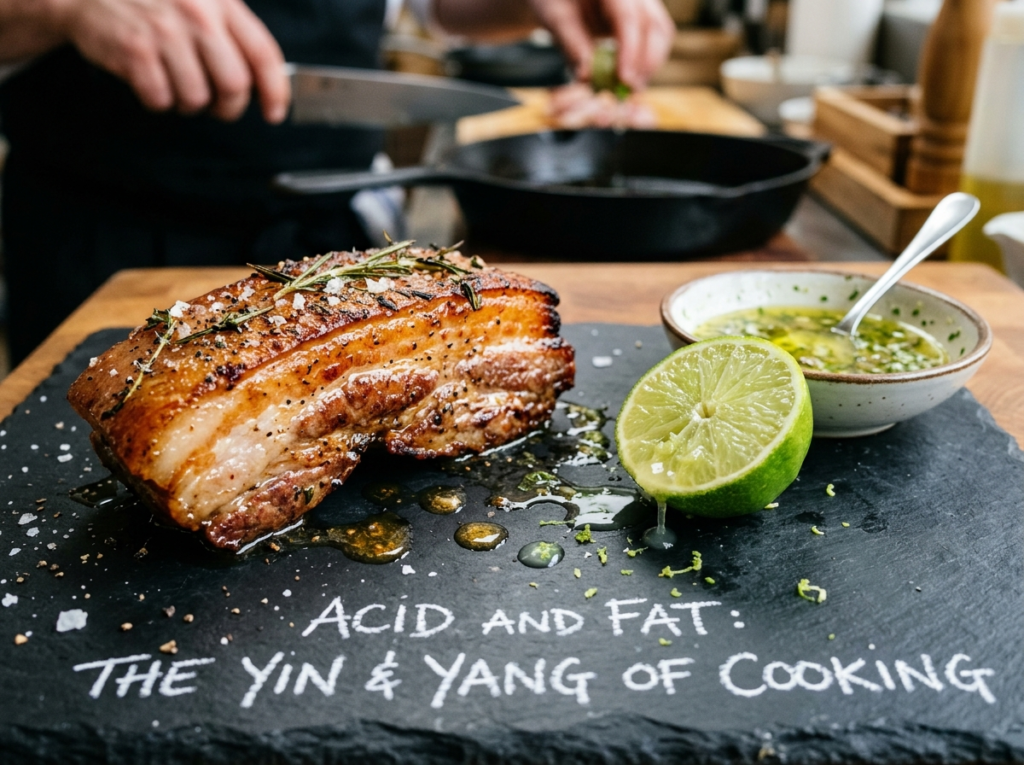
A squeeze of lemon over a rich, buttery piece of salmon. A drizzle of vinegar through a heavy, cheese-laden salad. A splash of lime across a fatty taco. You’ve done these things a hundred times, probably without thinking about why they work. But here’s what’s happening every single time: acid and fat are having a conversation on your palate, and that conversation is what makes food go from “fine” to “unforgettable.”
Most home cooks understand salt. They understand heat. But the relationship between acid and fat? That’s the quiet engine running underneath almost every dish you’ve ever loved. Once you understand how these two elements balance, support, and transform each other, your cooking changes. Not in a dramatic, flip-the-table way — but in that subtle, confident way where everything you make just starts tasting right.
Let’s talk about why.
What Acid and Fat Actually Do on Your Tongue
Before you can balance acid and fat, you need to understand what each one does when it hits your mouth. Not in a textbook way — just the basics that matter in a real kitchen.
Fat coats. That’s its primary job on your palate. When you eat something fatty — butter, olive oil, cream, a well-marbled steak — it creates a rich, smooth coating across your tongue. That coating is what gives food a sense of luxuriousness, body, and depth. Fat carries flavor compounds, too. Many of the aromatic molecules in spices, herbs, and aromatics are fat-soluble, meaning they literally dissolve into fat and spread across your palate more evenly.
But here’s the thing about fat: too much of it, and your mouth feels heavy. Sluggish. You get that cloying, one-note richness where every bite tastes the same as the last. Your palate gets fatigued. You stop tasting the nuances.
Acid cuts. It’s the opposite force. When you taste something acidic — lemon juice, vinegar, tomatoes, wine — your salivary glands kick into action. Acid literally makes your mouth water, which washes away that fatty coating and resets your palate. It brings brightness, sharpness, and a sense of freshness. Acid makes flavors feel clearer, more defined.
Too much acid, though, and food becomes harsh, sour, aggressive. It’s unpleasant on its own.
Here’s where the magic lives: when acid and fat exist together in the right proportion, they create balance. Fat gives richness and depth. Acid gives clarity and lift. Together, they make food that feels complete — satisfying without being heavy, bright without being sharp.
This isn’t some modern culinary theory, by the way. Samin Nosrat brought this idea into popular consciousness with her 2017 book and Netflix series Salt, Fat, Acid, Heat, but cooks have been working with this balance for centuries. French vinaigrette. Italian agrodolce. Mexican salsa verde over carnitas. Japanese ponzu with fatty fish. Every food culture figured this out independently, because the principle is universal.
Why Your Food Tastes “Flat” (And How Acid Fixes It)
You know that feeling when you cook something and it tastes… okay? Not bad, exactly, but not exciting either? You’ve salted it properly, the texture is good, the seasoning seems right — but it’s just flat?
Nine times out of ten, the missing piece is acid.
Here’s a scenario that plays out in home kitchens everywhere: you make a beautiful pot of soup. A rich, creamy butternut squash soup with good stock, well-caramelized onions, maybe a touch of cream at the end. You taste it. It’s… nice. Smooth. But it sits on your tongue like a blanket. Nothing pops.
Now squeeze half a lemon into that pot. Stir. Taste again.
Suddenly, the squash tastes more like squash. The sweetness from the caramelized onions stands out. The cream doesn’t weigh everything down anymore. Nothing about the soup changed except one thing: the acid cut through the fat and gave your tongue room to actually perceive all those flavors that were hiding under the richness.
This is probably the single most useful cooking lesson most people never learn. Professional chefs know it instinctively — you’ll see them reaching for a squeeze of citrus or a dash of vinegar right before plating, almost like a reflex. They’re not making the dish “sour.” They’re bringing it into balance.
The same principle applies to heavy braises, cream sauces, rich pasta dishes, fatty meats — basically anything where fat plays a starring role. If it tastes muted or one-dimensional, a small amount of acid will almost always sharpen the picture.
Quick test you can try tonight: Take a spoonful of whatever you’re cooking that has butter, oil, or cream in it. Taste it. Then add a tiny squeeze of lemon or a few drops of vinegar. Taste again. You’ll feel the difference immediately. The trick is to add just enough acid that you can’t taste the lemon or vinegar as a distinct flavor — you just notice that everything else tastes better.
The Science Behind the Balance
You don’t need a chemistry degree to cook well, but a tiny bit of understanding goes a long way here.
Fat molecules are nonpolar — they don’t mix with water. Acid, on the other hand, is water-based. Think of oil and vinegar in a jar before you shake it. They naturally want to separate. But when you emulsify them — through whisking, blending, or the help of an emulsifier like egg yolk or mustard — they combine into something entirely new. A vinaigrette. A mayonnaise. A béarnaise sauce.
That physical interaction mirrors what happens on your palate. Fat coats the hydrophobic surfaces of your tongue. Acid stimulates saliva production, which is water-based, and essentially breaks through that coating. Your taste receptors get exposed to the food again, fresh, and you perceive flavors more vividly.
There’s also a chemical interaction worth noting. Acid can change the structure of fats during cooking. When you braise pork shoulder with tomatoes, for example, the acid in the tomatoes helps break down connective tissues and renders the fat differently than dry heat alone would. The result is more tender meat with a sauce that feels lighter than you’d expect given its richness.
Did you know? Your perception of fat isn’t technically one of the “five basic tastes” (sweet, sour, salty, bitter, umami), but researchers at Purdue University have been studying a potential sixth taste — “oleogustus” — specifically for fat. Whether or not it becomes official, your tongue absolutely registers fat as a distinct sensation, which is why balancing it with acid feels so satisfying.
Classic Pairings That Prove the Point
You don’t have to look hard to find acid-fat balance in the world’s best food traditions. In fact, once you start noticing it, you can’t stop.
French cuisine might be the most obvious example. Think about a classic beurre blanc — a sauce made almost entirely of butter and white wine (or vinegar). That’s literally acid and fat, emulsified together. Hollandaise? Egg yolk fat plus lemon juice. A simple vinaigrette? Oil and vinegar. The French didn’t build their culinary reputation on butter alone — they built it on the balance between butter and acid. Even a classic consommé gets its clarity partly from the acid in egg whites used during clarification.
Italian cooking does this effortlessly. A rich ragù Bolognese simmers with tomatoes and a splash of wine — both acid sources — to keep the fatty pork and beef from becoming overwhelmingly heavy. Caprese salad puts creamy, fatty mozzarella next to acidic tomatoes with a drizzle of olive oil. Pasta with olive oil and a squeeze of lemon. The pattern is everywhere.
Mexican food is a masterclass in this balance. Fatty, slow-cooked carnitas get topped with raw onion, cilantro, and a squeeze of lime. Rich, lard-based tamales come with salsa. Guacamole — which is essentially pure avocado fat — always gets lime juice. If you’ve ever had breakfast in a place like Mexico City’s Roma Norte neighborhood, you’ve seen how naturally this balance shows up on every plate.
Basque cuisine takes it to another level. The Basque Country has a tradition of pairing rich, olive oil-heavy pintxos with acidic txakoli wine. The combination is so ingrained that visiting the region for a culinary immersion will change how you think about food pairing entirely.
Asian cuisines handle it differently but just as effectively. Japanese tempura — deep-fried, oily — gets served with a dipping sauce that contains rice vinegar or citrus. Korean barbecue, with its fatty grilled meats, comes with an array of pickled vegetables. Thai curries, rich with coconut cream, get hit with lime juice and tamarind.
The pattern repeats across cultures, centuries, and continents. It’s not a coincidence.
How to Use Acid and Fat Better in Your Own Cooking
Understanding the theory is great. Putting it to work in your kitchen is where it matters. Here are some practical ways to start working with acid-fat balance right away.
Start Finishing with Acid
The easiest habit to build is adding a small amount of acid right at the end of cooking. This is different from adding acid during cooking (which has its own uses — more on that in a moment). A finishing acid brightens the final dish without fundamentally changing its character.
Keep a lemon on your counter at all times. Not in the fridge — on the counter, where you’ll see it and reach for it. Before you serve any dish that feels rich or heavy, squeeze a little lemon over it. Creamy pasta? Lemon. Braised meat? Lemon. Sautéed vegetables in butter? Lemon.
If lemon doesn’t fit the flavor profile, try a light vinegar — sherry vinegar, rice vinegar, or white wine vinegar all work well as finishing acids because they’re relatively mild.
Pro Tip: Add acid a little at a time and taste as you go. You’re looking for the point where the dish tastes “brighter” but you can’t actually identify the acid. If someone eating your food says “Oh, there’s lemon in this” — you’ve added too much.
Use Acid During Cooking for Different Effects
Acid added early in the cooking process does something different than acid added at the end. Early acid breaks things down — it tenderizes proteins, helps dissolve connective tissue in braises, and can change the texture of vegetables.
When you make a tomato-based braise, the acid in the tomatoes works on the meat throughout the cooking process. A pot roast braised with wine and tomatoes will have a fundamentally different texture than one braised in pure stock.
Acid also prevents certain chemical reactions. Adding a squeeze of lemon to water when blanching green vegetables helps them keep their bright color. A touch of vinegar in poaching water helps egg whites set more quickly and neatly.
Build Acid into Your Sauces
If you’re making a pan sauce after searing a steak or a piece of chicken, deglazing with wine or vinegar is one of the most effective things you can do. You’ve got all that flavorful fond (the brown bits stuck to the pan) plus rendered fat. Adding an acidic liquid lifts the fond and creates a sauce where acid and fat are already in conversation.
A simple pattern: sear your protein in fat, remove it, pour off excess fat but leave a tablespoon or two, add shallots, deglaze with wine or vinegar, let it reduce by half, swirl in a knob of cold butter. That’s a restaurant-quality sauce, and its entire foundation is the balance between acid (wine/vinegar) and fat (butter plus pan drippings).
Think About Acid in Your Condiments and Sides
You don’t always have to build acid into the main dish. Sometimes the smartest move is to serve something acidic alongside something fatty. This is exactly what pickles, chutneys, relishes, and slaws are for — they’re acid delivery systems designed to balance a rich main.
Making barbecue? Serve it with a vinegar-based slaw or quick homemade pickles. Roasting fatty lamb? A mint sauce (which is basically mint in vinegar) is your best friend. Frying something? A dipping sauce with citrus or vinegar in it.
Even the classic burger with pickles and ketchup (which contains vinegar) follows this logic perfectly. The pickles and ketchup aren’t just condiments — they’re the acid counterbalance to the fatty beef patty and melted cheese.
Fat as the Fix for Too Much Acid
The balance works both ways. Just as acid rescues overly fatty dishes, fat rescues overly acidic ones.
Ever made a tomato sauce that tasted too sharp? Too bright, almost aggressive? The classic fix isn’t adding sugar (though a pinch can help). The classic fix is stirring in a glug of good olive oil or a knob of butter. The fat rounds out the acidity, smooths the sharp edges, and gives the sauce body.
This is why cream goes into tomato soup. Why butter gets stirred into lemon curd. Why rich coconut milk balances the sour tamarind and lime in Thai tom yum. The fat isn’t there for richness alone — it’s there to temper the acid.
If you’ve ever wondered why a cheese plate at a nice restaurant comes with fruit (which is naturally acidic), the logic runs the same way but in reverse. The acid in the fruit prevents the rich, fatty cheese from overwhelming your palate.
Warning: Don’t rely on sugar to fix acid-fat imbalance. Sugar masks acidity rather than balancing it, and you often end up with a dish that tastes oddly sweet and acidic at the same time. Fat is the proper counterweight to acid, just as acid is the proper counterweight to fat.
Choosing the Right Acid for the Right Fat
Not all acids taste the same, and not all fats behave the same way. Matching them well takes a little thought, but the basics are straightforward.
Delicate fats — like butter, light olive oil, or the fat in white fish — pair best with gentler acids. Lemon juice, white wine vinegar, champagne vinegar, yuzu, or verjuice. You don’t want a bold vinegar overpowering a subtle fat.
Bold, robust fats — like the marbling in a ribeye, duck fat, pork fat, or strong cheeses — can handle bigger acids. Red wine vinegar, balsamic vinegar, mustard (which contains acid), tomatoes, and tamarind all stand up well to aggressive fats.
Neutral fats — like vegetable oil in a deep fryer — are flexible. The acid often comes from the dipping sauce or condiment rather than the cooking process itself. That’s why fried foods around the world come with acidic accompaniments: tartar sauce (lemon + capers), malt vinegar on chips, ponzu with tempura.
Your wine choice follows this logic too. A fatty, rich dish often pairs well with a wine that has good acidity. That’s why a bright Malbec — with its natural acidity — works beautifully alongside a fatty grilled steak. And it’s why the old rule about “white wine with fish” exists — lighter wines with higher acidity complement lighter, more delicate fats.
The Role of Emulsification
When acid and fat combine physically — not just as contrasting elements on a plate, but actually blended together — you get emulsions. And emulsions are some of the most satisfying things you’ll ever eat.
A vinaigrette is the simplest emulsion: oil and vinegar, forced together with vigorous whisking (and sometimes a drop of mustard or honey to help stabilize). The result is neither oily nor acidic. It’s something new — creamy, coating, bright, and balanced all at once.
Mayonnaise takes it further. Egg yolk acts as the emulsifier, holding oil and lemon juice (or vinegar) in a stable suspension. The acid and fat become inseparable, creating that thick, tangy, creamy sauce that has about a thousand uses in the kitchen.
Classical French mother sauces rely heavily on emulsification. Hollandaise is clarified butter emulsified with egg yolks and lemon juice. Béarnaise adds tarragon vinegar. These sauces taste the way they do precisely because the acid and fat are in perfect, physical balance.
If your emulsions keep breaking — the oil separating from the acid — the usual fix is temperature control and patience. Add the fat slowly while whisking constantly. If it breaks, start over with a fresh egg yolk and slowly whisk the broken sauce into it. Emulsification is a mechanical skill, and like any skill, it gets easier with practice. Having a well-organized workspace helps too — keeping your home kitchen set up efficiently means your tools are ready when you need them.
Acid, Fat, and the Other Two Elements
Acid and fat don’t operate in isolation. They work alongside salt and heat — the other two pillars of flavor — and understanding how all four interact gives you real control over your cooking.
Salt amplifies both acid and fat. A pinch of salt makes acid taste less harsh and fat taste richer. That’s why salted butter with a squeeze of lemon on fish tastes better than unsalted butter and lemon separately. Salt bridges the gap between them.
Heat transforms both acid and fat. Cooking reduces acidic liquids, concentrating their sourness (think of a balsamic reduction). Heat renders fat, changing it from solid to liquid and altering its mouthfeel. When you sear a steak, you’re using heat to render surface fat while building fond — which you’ll later deglaze with an acid. All four elements are at play simultaneously.
The interplay between all four is what separates someone who follows recipes from someone who actually cooks. A recipe tells you what to add. Understanding acid, fat, salt, and heat tells you why — and more importantly, tells you what to adjust when something isn’t quite right.
That intuition — the ability to taste a dish and know whether it needs a pinch of salt, a squeeze of lemon, a knob of butter, or more time on the heat — is what people mean when they talk about someone being “a good cook.” It’s not talent. It’s understanding these four variables and how they push and pull against each other.
FAQ
How do I know if my dish needs more acid or more fat?
Taste it and pay attention to what you feel. If the dish tastes heavy, rich, and your palate feels coated or fatigued after a few bites, it needs acid. If it tastes sharp, thin, or aggressive — like it’s poking your tongue — it needs fat. The goal is a middle ground where neither sensation dominates.
Can I use citrus juice and vinegar interchangeably?
Broadly, yes — they’re both acids. But they taste different. Citrus juice (lemon, lime, orange) brings fruity, aromatic qualities along with its acidity. Vinegar is sharper and more purely sour. For finishing, citrus is usually more versatile. For cooking (deglazing, braising, pickling), vinegar often works better because it doesn’t lose its punch as quickly with heat.
What if I’ve added too much acid to a dish?
Fat is your rescue. Stir in some butter, cream, olive oil, or coconut milk. If that’s not appropriate for the dish, a small amount of sugar or honey can take the edge off — but use fat as your first option. You can also dilute by adding more of the base (more stock, more sauce) if you have it available.
Does the acid in tomatoes count?
Absolutely. Tomatoes are one of the most important acid sources in cooking, especially in Mediterranean, Mexican, and Indian cuisines. Fresh tomatoes, canned tomatoes, tomato paste — they all bring significant acidity. That’s why tomato-based sauces work so well with fatty meats and cheeses. If you’re already using tomatoes, you may not need additional acid in the dish.
Your Next Step
Here’s what I’d suggest: the next time you cook something — anything — taste it before you serve it and ask yourself one question. “Does this need a little brightness?” If the answer is yes, reach for a lemon or a bottle of vinegar and add just a tiny amount. Taste again.
That single habit will improve your cooking more than any new gadget, fancy ingredient, or complicated technique. Because once you feel the difference that acid makes in a rich dish — or the difference that fat makes in a sharp one — you’ll start sensing that balance intuitively. You won’t need to think about it anymore. You’ll just know.
And that’s what cooking really is. Not following instructions. Not measuring precisely. It’s understanding the handful of forces that make food taste good, and learning to adjust them on the fly. Acid and fat are the yin and yang of that equation — opposite forces that, together, create something whole.
Now go squeeze a lemon on something.