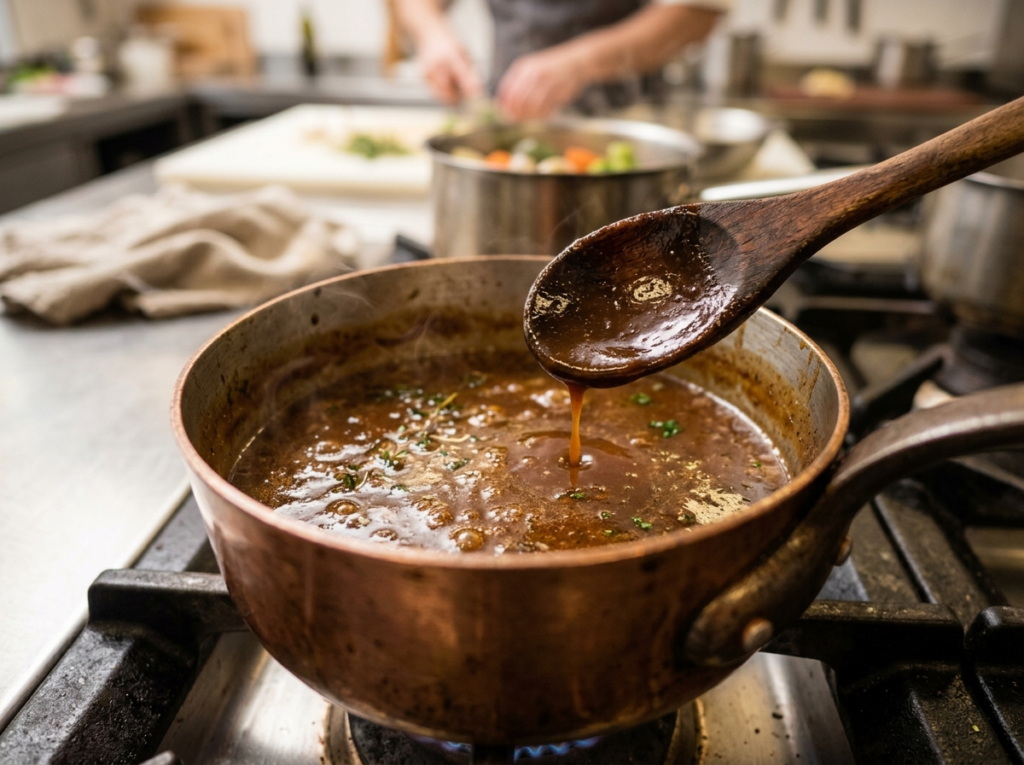
Most restaurant sauces that make you close your eyes and go “wow” have one thing in common — and it’s not butter. It’s demi-glace. That dark, glossy, deeply savory sauce sitting behind the line in almost every serious French kitchen? It’s been the backbone of professional cooking for well over a century. And yet, most home cooks have never attempted it.
That’s understandable. Demi-glace has a reputation. It sounds fancy, it takes time, and classic recipes read like they were written for a brigade of chefs with nothing else to do for two days. But here’s the thing — demi-glace isn’t actually difficult. It’s mostly about patience. If you can roast bones and simmer a pot, you can make a demi-glace that’ll put most restaurant sauces to shame.
Let’s break the whole process down, step by step, so you know exactly what you’re doing and why.
What Exactly Is Demi-Glace?
Demi-glace is a rich, concentrated brown sauce made by combining brown stock (usually veal, sometimes beef) with espagnole sauce (one of the five French mother sauces), then reducing that mixture by about half. The name literally translates from French as “half glaze,” which tells you everything about the technique — you’re cooking it down until it coats the back of a spoon with a silky, mirror-like sheen.
Auguste Escoffier, the legendary French chef who codified modern cuisine in the early 1900s, considered demi-glace one of the most essential preparations in any kitchen. In his Le Guide Culinaire (1903), it’s the foundation from which dozens of other classic sauces are built — bordelaise, chasseur, Robert, Madeira, and many more.
Quick Fact: A properly made demi-glace contains so much natural gelatin from the bones that it solidifies into a firm, jiggly block when refrigerated. That gelatin is what gives it the luxurious, mouth-coating texture no amount of flour or cornstarch can replicate.
Now, the traditional method is a two-day project involving making stock, then making espagnole, then combining and reducing. Many modern chefs — including professionals — use a simplified approach that skips the espagnole and produces a result that’s about 95% as good. We’ll cover both, so you can decide which path works for you.
Why Bother Making It at Home?
Fair question. You can buy demi-glace online or at specialty stores. Brands like More Than Gourmet sell decent versions. So why go through the trouble?
A few honest reasons.
Flavor depth you can’t buy in a jar. Commercial demi-glace is fine in a pinch, but homemade versions have a complexity and freshness that store-bought products simply don’t match. You control the roast on the bones, the aromatics, the reduction level. The result is something personal to your kitchen.
Cost. Good store-bought demi-glace isn’t cheap — sometimes $15–$20 for a small container. A batch of homemade demi-glace from a few pounds of bones (which your butcher might even give you for free or close to it) yields far more for far less.
Freezer gold. A single batch makes enough to last months. Pour it into ice cube trays, freeze, and pop out a cube whenever you need to elevate a pan sauce, stew, risotto, or braise. It’s like having a professional chef’s secret weapon sitting in your freezer at all times.
The satisfaction factor. There’s something deeply rewarding about pulling off a preparation that most home cooks never attempt. It connects you to centuries of culinary tradition — the same kind of cooking philosophy you’d find in the kitchens of France’s Basque Country or any old-school European restaurant that still does things the right way.
The Building Blocks: Brown Stock Comes First
You can’t make demi-glace without brown stock. This is the foundation, and it’s where most of the flavor development happens. If your stock is weak, your demi-glace will be weak. No amount of reducing will fix a stock that started without enough character.
Choosing Your Bones
Veal bones are the classic choice, and for good reason. They’re loaded with collagen that converts to gelatin during long simmering, giving the final sauce its signature body. Veal knuckles and joints are ideal because they’re packed with connective tissue.
Beef bones work too, though they produce a heavier, more assertive flavor. Many home cooks use a mix — say, 70% veal and 30% beef — to get good gelatin from the veal with a meatier punch from the beef.
Ask your butcher for marrow bones, knuckles, and neck bones. Most butchers are happy to set these aside if you ask a day in advance. You’ll want roughly 5–6 pounds of bones for a solid batch.
Pro Tip: Avoid bones that are mostly flat or have little connective tissue (like rib bones by themselves). They add some flavor but don’t contribute the gelatin you need.
Roasting the Bones
This step separates brown stock from white stock, and it’s non-negotiable. Spread your bones in a single layer on a sheet pan — don’t crowd them — and roast at 425°F (220°C) for about 40–50 minutes, turning once halfway through.
You want them deeply browned, almost to the edge of charring. That dark color comes from the Maillard reaction, the same chemistry that makes a good sear on steak so flavorful. The browner they get (without burning), the deeper and more complex your stock will taste.
About 20 minutes in, add roughly chopped onions, carrots, and celery (your classic mirepoix) to the roasting pan. Let those caramelize alongside the bones. Some cooks add a tablespoon of tomato paste smeared onto the bones during the last 10 minutes of roasting — it adds color, acidity, and umami.
Building the Stock
Transfer everything from the roasting pan into your largest stockpot. Before you add water, place that sheet pan across two burners on your stovetop. Add a cup or two of water or red wine and scrape up all those dark, stuck-on bits. That’s called deglazing, and those bits (called fond) are pure concentrated flavor. Pour it all into the pot.
Add cold water to cover the bones by about 2 inches. Then add your aromatics — a bouquet garni of thyme, bay leaves, parsley stems, and a few whole peppercorns. Some cooks add a couple of crushed garlic cloves, though Escoffier’s classic version doesn’t call for them.
Bring the pot to a gentle simmer. Not a boil — a simmer. You want lazy bubbles breaking the surface every few seconds. A rolling boil emulsifies the fat into the liquid and makes cloudy, greasy stock. Keep things calm.
Skim frequently during the first hour. A layer of gray-brown scum will rise to the surface. Remove it with a ladle or large spoon. After the initial skimming, you can mostly leave it alone.
Simmer for 8–12 hours. Yes, really. You’re slowly extracting gelatin, minerals, and flavor from those bones. Some cooks do this across two days — simmer for 6 hours, refrigerate overnight, then continue the next morning. That works perfectly fine.
When it’s done, strain through a fine-mesh sieve lined with cheesecloth. Don’t press on the solids — let gravity do the work. Pressing clouds the stock. You should end up with roughly 2–3 quarts of deeply flavored, dark brown liquid.
Chill the strained stock. The fat will solidify on top in a white layer. Remove and discard it (or save it for cooking — beef tallow is wonderful for roasting vegetables or frying). What’s underneath should be jiggly, like firm gelatin. That jiggle means you did it right.
The Classic Method: Stock Meets Espagnole
If you want to follow the traditional French approach that Escoffier laid out, your brown stock gets combined with espagnole sauce before the final reduction.
Making Espagnole
Espagnole is one of the five French mother sauces. It’s essentially a brown sauce made from brown stock, a dark roux, mirepoix, and tomato. Here’s the process:
Make a dark roux by melting about 4 tablespoons of butter in a heavy-bottomed saucepan over medium heat, then whisking in an equal amount of flour. Stir constantly. You’re cooking the roux until it turns a deep brown color — almost the shade of milk chocolate. This takes 15–20 minutes and requires your full attention. Walk away, and it burns.
Add finely diced onion, carrot, and celery. Cook until softened, about 5 minutes. Stir in a couple tablespoons of tomato paste and cook for another minute or two.
Gradually whisk in about 1 quart of your brown stock, a cup at a time, making sure each addition is smooth before adding the next. Add a bouquet garni, bring to a gentle simmer, and let it cook for about 45 minutes to an hour, skimming any skin that forms on the surface.
Strain the espagnole through a fine-mesh sieve. You’ll have a fairly thick, glossy brown sauce.
The Marriage: Combining and Reducing
Now combine equal parts brown stock and espagnole in a clean pot. Bring to a gentle simmer and reduce by roughly half. This takes anywhere from 45 minutes to an hour and a half, depending on volume and heat level.
Stir occasionally and keep the heat moderate. You’re looking for a sauce that coats the back of a spoon — run your finger through the coating, and the line should hold. That’s called nappé, and it’s the visual test every chef uses.
The finished demi-glace should be deeply dark, almost mahogany, with a sheen that looks like liquid velvet. Taste it. The flavor should be intensely savory — beefy, slightly sweet from the long-cooked vegetables, with a hint of wine if you used any.
The Modern Shortcut: Simplified Demi-Glace
Here’s the approach most working chefs actually use in 2025, and it’s what I’d recommend for most home cooks.
Skip the espagnole entirely. Instead, take your strained, defatted brown stock and simply reduce it. Pour the stock into a wide, heavy pot (wider surface area means faster evaporation) and simmer gently until it reduces to about one-quarter of its original volume.
That’s it. No roux, no separate sauce. Just concentration.
The gelatin-rich stock naturally thickens as the water evaporates. By the time you’ve reduced it enough, the sauce has a beautiful body and clings to food the way a classic demi-glace should. Some chefs add a splash of wine — Madeira, port, or dry red — during the final stages to add depth and acidity.
Is it technically a demi-glace? Purists would say no — they’d call it a glace de viande (meat glaze) or simply a reduced stock. But the practical difference in your home kitchen? Minimal. You get 90% of the same result with significantly less work.
The key is starting with a stock that has enough gelatin. If your stock doesn’t jiggle firmly when chilled, it won’t thicken properly when reduced. You might need to add a split pig’s foot or chicken feet to your next batch — they’re gelatin powerhouses.
How to Use Your Demi-Glace
This is where the fun starts. Once you’ve got demi-glace in your freezer, your cooking levels up immediately.
Pan Sauces in Minutes
Sear a steak, pork chop, or chicken breast. Remove the meat and rest it. Add a splash of wine to the hot pan, scrape up the fond, and then stir in a couple tablespoons of demi-glace. Swirl in a knob of cold butter at the end. You’ve got a restaurant-quality pan sauce in under three minutes.
This technique works for almost any protein. It’s one of those chef tricks that transforms home cooking with very little effort.
Enriching Stews and Braises
A cube of frozen demi-glace dropped into a beef bourguignon, a pot roast, or a lamb braise adds a layer of savory richness that hours of extra simmering can’t match. Think of it as a flavor accelerator.
Building Compound Sauces
All those classic French sauces branching off from demi-glace? They’re surprisingly simple once you have the base ready. Add red wine and shallots for bordelaise. Add mustard and cornichons for sauce Robert. Add mushrooms and white wine for chasseur. Each one takes about 15 minutes. You might find yourself working through a different sauce every week — the same way you might explore different cocktail creations once you stock a good home bar.
Gravy Upgrade
Thanksgiving, Christmas, Sunday roast — anytime you’re making gravy, stir in a tablespoon or two of demi-glace. It deepens the flavor and gives the gravy a professional body that drippings alone sometimes can’t achieve. Your holiday cooking will never be the same.
Risotto and Pasta
A spoonful of demi-glace stirred into a mushroom risotto or folded into a rich pasta sauce adds a meaty background note that makes people ask, “What’s in this?”
Storage: Making It Last
Demi-glace keeps beautifully, which is one of its greatest advantages.
Refrigerator: Up to a week in an airtight container.
Freezer: Up to six months, easily. The ice cube tray method is the most practical — freeze the demi-glace in trays, pop out the cubes once solid, and transfer them to a zip-lock bag. Each cube is roughly 1–2 tablespoons, which is perfect for a single pan sauce.
Pro Tip: Label your bags with the date. You’ll forget, and six months from now you’ll be staring at mystery cubes wondering if they’re demi-glace or frozen coffee. (It happens.)
Some chefs reduce their demi-glace even further — down to a tar-like paste — and store it in small jars. A tiny smear reconstituted with a little water or wine gives you sauce on demand. It’s the ultimate space saver if your freezer is already packed, a common problem in a small home kitchen.
Troubleshooting Common Problems
Even experienced cooks run into issues with demi-glace. Here are the ones I see most often and how to fix them.
It Won’t Thicken
Nine times out of ten, this means your stock didn’t have enough gelatin. You either didn’t use enough joints and connective tissue-rich bones, or you didn’t simmer long enough. The fix for next time: add a pig’s foot or several chicken feet. For this batch, you can reduce it further, but if the gelatin simply isn’t there, you’ll end up with concentrated flavor but thin body. A small amount of arrowroot slurry can help in a pinch, though it won’t have the same silky mouthfeel as natural gelatin.
It Tastes Bitter
You probably burned your roux, scorched the bones, or reduced at too high a heat. Bitterness is almost always a heat control issue. Keep things gentle. A dark roux should smell nutty and toasty, not acrid. Roasted bones should be brown, not black.
It’s Cloudy
You either boiled your stock too aggressively or pressed on the solids when straining. A cloudy demi-glace still tastes fine — it just won’t have that gorgeous clarity. For a clearer result, you can make a consommé-style clarification using egg whites, but that’s honestly more effort than most home cooks need to go through.
It’s Too Salty
If you salted your stock (many chefs recommend not seasoning stock at all), the reduction concentrates that salt dramatically. A stock that tasted perfectly seasoned can become inedibly salty once reduced by half or more. The rule: don’t salt your stock. Season only at the end, when you’re using the finished demi-glace in a specific dish.
A Note on Time, Effort, and Expectation
Let’s be real — demi-glace is a project. Between roasting bones, simmering stock, and reducing, you’re looking at a day or two of mostly hands-off but ongoing work. It ties up your biggest pot and heats up your kitchen. It’s not a Tuesday night activity.
But it’s also not as hard as its reputation suggests. Most of the time, you’re just waiting. Sipping coffee, reading a book, checking the pot every hour or so. The actual hands-on work — chopping mirepoix, roasting bones, skimming, straining — adds up to maybe 45 minutes total.
And the payoff? Months of instantly better sauces. A freezer full of liquid gold that turns an ordinary weeknight dinner into something genuinely special.
If you love cooking and you’ve never made demi-glace, put it on your list for the next rainy weekend. It’s one of those foundational skills — like learning to handle a knife properly or understanding how acid and fat balance each other — that quietly elevates everything you cook from that point forward.
FAQ
How is demi-glace different from beef broth or stock?
Broth and stock are the starting points — relatively thin liquids you’d sip from a mug or use as a soup base. Demi-glace is stock that’s been combined with espagnole sauce (or simply reduced significantly) to concentrate the flavor and body. Think of it as the difference between grape juice and a reduced balsamic glaze. Same origin, completely different intensity and purpose.
Can I make demi-glace with chicken bones?
You can make a reduced chicken stock with great body, and it’ll be useful in similar ways. But it won’t be demi-glace in the traditional sense — that term specifically refers to a preparation made with veal or beef brown stock. Chicken doesn’t deliver the same depth of flavor or color. That said, a rich reduced chicken stock is a fantastic thing to have on hand, especially for poultry dishes and lighter sauces.
Is there a vegetarian or vegan alternative to demi-glace?
Some cooks make a “mushroom demi-glace” using deeply roasted mushrooms, soy sauce, red wine, and reduced vegetable stock. It’s not the same thing, but a well-made mushroom version can deliver a surprising amount of umami and richness. The missing element is gelatin — you can add a small amount of agar-agar for body, but the mouthfeel won’t be identical.
How much demi-glace do I need per serving?
For a pan sauce serving two people, about 2–3 tablespoons of demi-glace is a good starting point. For enriching a stew or braise that serves six, a quarter cup works well. A little goes a long way — start small, taste, and add more if needed.
Can I use a pressure cooker or Instant Pot to speed up the stock?
Absolutely. A pressure cooker can produce a gelatin-rich brown stock in 2–3 hours instead of 8–12. The trade-off is slightly less clarity (pressure cooking tends to emulsify fats more), but the flavor and body are excellent. Many professional kitchens have adopted pressure cookers for stock production because the results are consistently good.
A small batch of demi-glace, tucked into your freezer in tidy little cubes, changes the way you cook. Not in a dramatic, throw-everything-out-and-start-over way. More like a quiet upgrade. The pan sauce you make on a Wednesday suddenly tastes like something you’d pay $40 for at a good bistro. The stew you throw together on a Sunday has a richness you can’t quite explain to your dinner guests.
That’s the beauty of going back to the basics — the old techniques earned their place for a reason. Give demi-glace a weekend, and it’ll give you months of better meals in return.