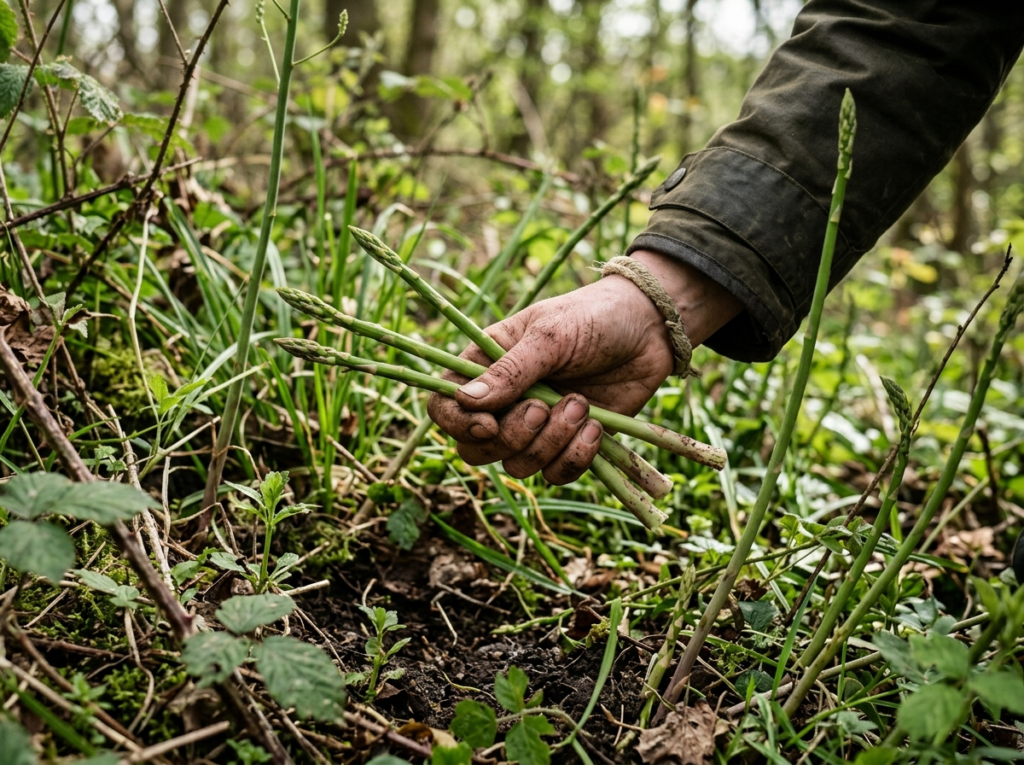
Most people only know asparagus as those neat green bundles wrapped in rubber bands at the grocery store. But here’s something that might surprise you — wild asparagus grows along roadsides, fence lines, and irrigation ditches across much of North America and Europe, and it’s been hiding in plain sight for thousands of years. The ancient Romans loved it so much they sent runners into the Alps to collect it. Greeks and Egyptians ate it centuries before that. And today, a growing community of foragers heads out every spring to hunt for this slender, flavorful plant that puts its cultivated cousin to shame.
If you’ve ever been curious about foraging but didn’t know where to start, wild asparagus is one of the most beginner-friendly plants you can hunt. It’s easy to identify once you know what to look for, it grows in abundance across temperate climates, and the taste? Intensely grassy, a little nutty, and far more concentrated than anything you’ll find on a supermarket shelf.
Let’s talk about how to actually find it, when to go looking, and what to do with it once you’ve got a handful.
What Exactly Is Wild Asparagus?
Wild asparagus (Asparagus officinalis) is the same species as the asparagus you buy at the store. The difference is environment and cultivation. Store-bought asparagus grows in carefully managed beds with controlled soil, irrigation, and nutrients. Wild asparagus grows wherever it pleases — along railroad tracks, at the edges of agricultural fields, beside country roads, and in open meadows.
Because it grows without human intervention, wild asparagus spears tend to be thinner and more fibrous than their farm-raised counterparts. They also pack a stronger flavor. Think of it like the difference between a hothouse tomato and one that grew in your grandmother’s backyard garden. Same species, wildly different eating experience.
There are also a few related species worth knowing about. Asparagus acutifolius, sometimes called “wild asparagus” in Mediterranean countries like Italy, Spain, and southern France, is a separate species with even thinner spears and a slightly bitter edge. If you’ve visited the Basque Country or traveled through Sicily, you may have seen these pencil-thin spears served simply with olive oil and coarse salt. It’s a different plant from what grows wild in the American Midwest, but the foraging approach is surprisingly similar.
When Is the Right Time to Hunt?
Timing is everything with wild asparagus. You’re working with a narrow window — typically mid-April through early June in most of the United States, depending on your climate zone. In warmer southern states, spears can pop up as early as late March. In northern regions like Minnesota, Wisconsin, or Michigan, you might be waiting until mid-May.
The trigger is soil temperature. When the ground warms to about 50°F (10°C) consistently, asparagus crowns underground start pushing spears toward the surface. A stretch of warm rain in spring is your best friend. Check the weather, and when you see a few consecutive days in the 60s following a rain, that’s your cue to get out there.
Pro Tip: The very best foragers scout their spots in autumn, not spring. Here’s why — wild asparagus develops tall, feathery fern-like fronds in summer that turn bright yellow and then brown in fall. These dried stalks are 4 to 6 feet tall and look like wispy, golden bushes along fence rows and ditches. They’re impossible to miss once you know what you’re looking at. Mark those locations on your phone’s GPS, and come spring, you’ll know exactly where to go.
This fall scouting trick is the single biggest advantage experienced foragers have over beginners. While newcomers are wandering around in April hoping to stumble onto something, seasoned hunters are walking directly to spots they flagged six months earlier.
Where to Look (The Habitats Wild Asparagus Loves)
Wild asparagus isn’t random. It gravitates toward specific environments, and once you understand its preferences, you’ll start seeing it everywhere.
The plant loves full sun and well-drained soil. It doesn’t do well in heavy shade or waterlogged ground. It tends to pop up in what you might call “edge” habitats — the borders between different environments. Think of the strip between a farm field and a gravel road. The transition zone between a mowed lawn and a wild meadow. The base of a fence line where soil gets disturbed but nobody cultivates.
Here are the spots that consistently produce finds:
Irrigation ditches and canal banks — Especially in western states like Colorado, Utah, and Idaho. The combination of moisture nearby and dry, sunny banks creates ideal conditions.
Railroad rights-of-way — Asparagus seeds spread easily via bird droppings, and birds love to perch on railroad infrastructure. You’ll often find asparagus growing in lines along tracks. Just be careful and stay aware of train schedules.
Old farmsteads and abandoned homesteads — Someone probably planted asparagus here decades ago. The crowns can survive for 20+ years underground, so even long-abandoned properties keep producing.
Highway medians and road shoulders — State highways through agricultural country can be surprisingly productive. The mowing crews keep competing vegetation down, giving asparagus an advantage.
Fence lines between pastures — Birds sit on fence posts, eat asparagus berries in summer, and deposit seeds below. This is classic habitat.
If you enjoy exploring how different regions shape their food culture, you’ll appreciate that wild asparagus patterns tell a story about local agriculture, bird migration, and land use history. Every patch has a backstory.
How to Identify Wild Asparagus (Without Mistakes)
Good news: wild asparagus is one of the safer plants for beginner foragers to identify. There aren’t many dangerous look-alikes, and the plant has distinctive features at every stage of growth.
In spring (the harvesting stage): You’re looking for spears emerging from the ground, often right next to the dried brown stalks from the previous year. The spears look exactly like miniature versions of what you see at the grocery store — tight, pointed tips with overlapping scale-like leaves pressed against the stem. They’re green to purple-green and typically thinner than a pencil, though occasionally you’ll find thicker ones. The tip should be tight and compact, not opened or flowering.
In summer: Unharvested spears grow into tall, bushy plants with fine, feathery foliage that looks almost like dill or fennel fronds. Small, white-green flowers appear, followed by red berries in late summer. Those berries are how the plant spreads — birds eat them and deposit seeds elsewhere.
In fall: The fern-like growth turns golden yellow, then brown. These dried stalks persist through winter and are your scouting markers for next spring.
⚠️ Warning: While there aren’t many truly dangerous asparagus look-alikes in North America, you should avoid confusing it with certain toxic plants in the lily family. If a plant has broad, flat leaves rather than the fine, needle-like foliage of asparagus, leave it alone. Death camas (Zigadenus) and lily of the valley can grow in similar habitats. The rule with foraging always applies: if you’re not 100% sure, don’t pick it. Bring a field guide or a plant identification app as backup.
One reliable trick — snap the spear near its base. Wild asparagus snaps cleanly where the tender growth meets the tougher base, just like store-bought asparagus does. If it doesn’t snap cleanly and feels rubbery or fibrous all the way through, it’s either too old or it’s something else.
The Etiquette and Ethics of Foraging
Before you grab a basket and head out, there are some ground rules that responsible foragers follow. These aren’t just nice-to-haves — they protect your legal standing, the plant populations, and your reputation in the foraging community.
Always get permission on private land. This sounds obvious, but it’s the rule people break most often. If you see asparagus growing along a farmer’s fence line, knock on the door and ask. Most farmers will say yes — many don’t even realize asparagus is growing there. But trespassing will get you in trouble and give foragers a bad name.
Know the rules on public land. Regulations vary widely. National parks generally prohibit foraging. National forests often allow it for personal use. State and county lands each have their own rules. Check with local land management offices before you harvest on public property.
Don’t take everything. A good forager leaves at least half the spears in any given patch. Those remaining spears grow into the fern-like plants that photosynthesize and feed the underground crown. If you harvest every single spear year after year, you’ll weaken and eventually kill the plant. Think of it like a savings account — you can take the interest, but don’t drain the principal.
Be mindful of herbicide. Roadsides and railroad corridors are sometimes sprayed with herbicides. Look for signs of chemical treatment — brown, dead vegetation in patterns that suggest spraying rather than natural die-off. If you suspect an area has been treated, skip it and move on. No asparagus is worth ingesting glyphosate.
What Makes Wild Asparagus Taste Different?
If you’ve only ever eaten grocery store asparagus, your first bite of wild asparagus will be an education. The flavor is more concentrated — more “asparagus-y,” if that makes sense. There’s a grassiness and a slight mineral quality that comes from the plant drawing nutrients from untended soil. Some people describe a faint bitterness that’s absent in cultivated varieties, especially in the Mediterranean A. acutifolius species.
The texture is different too. Thinner spears mean less watery crunch and more tender snap. You don’t get that thick, sometimes woody core that plagues fat grocery store asparagus. Wild spears are often tender enough to eat with minimal cooking — just a quick sauté in butter or olive oil, a squeeze of lemon, and a pinch of flaky salt.
If you’re someone who appreciates white asparagus season, you already know that growing conditions dramatically change how asparagus tastes. White asparagus is simply green asparagus deprived of sunlight. Wild asparagus is the opposite extreme — fully exposed, competing with other plants, toughened by weather and wildlife. That stress creates flavor, just like it does in wine grapes.
Did you know? Asparagus is one of the few vegetables that takes years to establish. A wild asparagus crown may be 10, 15, or even 20 years old. Each year, the root system grows larger and more productive. When you harvest wild asparagus, you’re picking from a plant that’s been building itself underground for potentially decades.
How to Cook Wild Asparagus
Because wild spears are thinner and more delicate than cultivated ones, they need less cooking time. Overcooking is the fastest way to ruin what you worked hard to find. You want to preserve that snappy texture and concentrated flavor.
Quick sauté: This is the purist’s method. Heat a tablespoon of good butter or olive oil in a skillet over medium-high heat. Add the spears in a single layer, season with salt, and cook for 2 to 3 minutes, tossing once or twice. Finish with a squeeze of lemon. That’s it. The asparagus should still have a bit of bite.
Grilled or charred: If you’ve got slightly thicker spears, toss them in olive oil, salt, and pepper, then grill over high heat for about 2 minutes per side. The slight char plays beautifully against the grassy flavor. This is how you’ll see it prepared across rural Italy and Spain during spring festivals.
In eggs: Wild asparagus and eggs are a classic pairing across virtually every culture that forages it. A simple frittata or scramble with thin asparagus slices, good cheese, and fresh herbs is one of the best ways to showcase what you’ve found. In the Basque Country, a tortilla de espárragos trigueros (wild asparagus omelet) is a springtime staple.
Raw in salads: The thinnest spears — really just a few millimeters thick — can be shaved with a vegetable peeler and added raw to salads. Pair them with shaved Parmigiano, lemon vinaigrette, and a handful of arugula. If you’re someone who likes learning the balance of acid and fat in cooking, this is a great dish to practice with.
In pasta: Sauté chopped wild asparagus with garlic and red pepper flakes, toss with short pasta like penne or orecchiette, and finish with pecorino and a glug of the pasta cooking water. Italians have been making this dish for centuries, and it remains one of the best ways to stretch a small harvest into a full meal. You might find more inspiration in exploring the history and techniques of great pasta.
Quick Fact: Wild asparagus doesn’t store as well as cultivated asparagus. Use it within a day or two of picking. If you need to hold it, stand the spears upright in a jar with an inch of water in the fridge, like a bouquet of flowers.
Essential Gear for Your First Hunt
You don’t need much, and that’s part of the appeal. Wild asparagus foraging is one of the lowest-barrier-to-entry outdoor activities you can take up. But a few items make the experience smoother.
A sharp knife or kitchen shears is essential. You want to cut spears cleanly at ground level rather than pulling or twisting them, which can damage the crown. A paring knife works fine. Some experienced foragers carry a dedicated asparagus knife — a long, narrow blade designed for the job — but it’s not necessary when you’re starting out.
A breathable bag or basket keeps your harvest fresh. Avoid plastic bags, which trap moisture and heat and will wilt your asparagus before you get home. A paper bag, a tote, or a traditional wicker basket all work well.
Good walking shoes matter more than you’d think. You’ll be covering ground on uneven terrain — ditch banks, field edges, rough paths. Ankle support and waterproof soles are your friends, especially during muddy spring conditions.
A plant identification app or field guide gives you confidence. Apps like iNaturalist, PictureThis, or Seek by iNaturalist can confirm your identification in the field. Combine digital tools with a printed guide like Samuel Thayer’s The Forager’s Harvest for the most reliable results.
And of course, your phone’s GPS or a mapping app to mark productive spots for future years. This is how you build your personal foraging map over time. Experienced foragers guard their spot lists like family recipes.
Common Beginner Mistakes to Avoid
After talking to dozens of foragers and making plenty of my own mistakes over the years, a few pitfalls come up again and again.
Looking too late in the season. By the time asparagus has opened into its ferny stage, you’ve missed the eating window. Those feathered-out plants are too tough to eat. You need to find spears while they’re still tight and compact, ideally 6 to 10 inches tall.
Searching in the wrong habitat. Walking through deep woods looking for wild asparagus is a waste of time. It needs sun. If you’re in shade, move to an edge habitat — a clearing, a road shoulder, a field border.
Over-harvesting a single patch. It’s tempting to take everything when you find a productive spot. Resist. Take half, leave half. You want this patch to be productive for years to come. Foraging is a long game.
Ignoring the dried stalks. So many beginners walk right past dead asparagus fronds in fall and winter because they don’t recognize what they’re seeing. Those brown, wispy stalks are your treasure map. Start paying attention to them in September and October, and your spring hunts will be dramatically more productive.
Not going out after rain. Asparagus can shoot up several inches overnight after a warm rain. If you checked a spot two days ago and it was bare, check again after a rainstorm. Spears that weren’t visible on Tuesday might be perfect harvesting height by Thursday. Having solid knife skills helps when you get home and need to prep your haul quickly while it’s still fresh.
The Bigger Picture: Why Foraging Matters
There’s something that happens to people when they start foraging that goes beyond just getting free food. It changes how you see the landscape around you. A highway ditch stops being just a highway ditch. A fence line becomes a potential pantry. You start paying attention to seasons, soil, weather patterns, and bird behavior in ways you never did before.
Wild asparagus foraging connects you to a food tradition that stretches back thousands of years. Long before humans cultivated asparagus in neat garden rows — which the Romans began doing around 200 BC — people gathered it wild from riverbanks and hillsides. When you snap a spear off at ground level on a spring morning, you’re doing essentially the same thing people did in ancient Egypt and Greece.
There’s also a practical argument. Store-bought asparagus travels an average of 1,500 miles to reach your plate. It’s often picked days before you buy it. Wild asparagus travels from the ground to your kitchen in hours. The freshness difference is real, and you don’t need a sophisticated palate to taste it.
And foraging builds a kind of self-reliance and environmental awareness that’s hard to get any other way. You learn to read landscapes, identify plants, understand ecological relationships, and move through wild spaces with purpose and respect. For people who care about where their food comes from — and if you’re reading a food-focused site, you probably do — foraging is one of the most direct ways to shorten the chain between soil and table.
If you’re also interested in cooking with seasonal and foraged greens, wild asparagus is a perfect gateway into a broader foraging practice.
FAQ
Is wild asparagus safe to eat?
Yes, wild asparagus (Asparagus officinalis) is the same species as cultivated asparagus and is completely safe to eat. The key is proper identification. Stick to plants you can identify with confidence, avoid areas that may have been sprayed with herbicides, and consult a field guide or identification app if you’re uncertain.
Where does wild asparagus grow in the United States?
Wild asparagus grows across much of the continental United States, particularly in temperate regions. It’s especially common in the Midwest, Great Plains, and western states like Colorado, Idaho, Utah, and Montana. Look for it along roadsides, fence lines, irrigation ditches, railroad corridors, and the edges of agricultural fields. It prefers full sun and well-drained soil.
What’s the best time of year to find wild asparagus?
Spring is the harvest season — typically mid-April through early June, depending on your region and local climate. Soil temperature is the trigger: when the ground consistently reaches about 50°F, asparagus crowns begin sending up spears. Warm rain accelerates growth. For scouting purposes, fall is ideal because the tall, dried asparagus fronds are easy to spot and mark for the following spring.
Can I grow wild asparagus in my garden?
Technically, yes. You can transplant wild asparagus crowns or collect seeds from the red berries that appear in late summer. Keep in mind that asparagus takes 2 to 3 years from seed to produce harvestable spears. Most gardeners find it easier to buy established crowns from a nursery. But if you transplant from the wild, take only small portions of a crown and never remove an entire plant from a productive patch.
Does wild asparagus taste different from store-bought?
Noticeably, yes. Wild asparagus tends to have a more concentrated, grassy, and slightly nutty flavor. The spears are usually thinner, which means less watery crunch and more tender snap. Many foragers and chefs consider wild asparagus superior in flavor to cultivated varieties, though it’s a matter of personal preference.
Your first wild asparagus hunt doesn’t need to be complicated. Start small — take a drive along some country roads in late April, look for dried asparagus fronds from last year, and mark any spots you find. Come back after a warm rain and look carefully at the ground near those markers. Bring a sharp knife, a paper bag, and a little patience.
The thing about foraging is that it rewards attention. The more you look, the more you see. And once you’ve tasted asparagus that was growing in the soil thirty minutes before it hit your skillet, store-bought will never feel quite the same again. That’s not snobbery — it’s just what freshness tastes like. So grab your walking shoes, pick a sunny morning, and go see what’s growing out there.